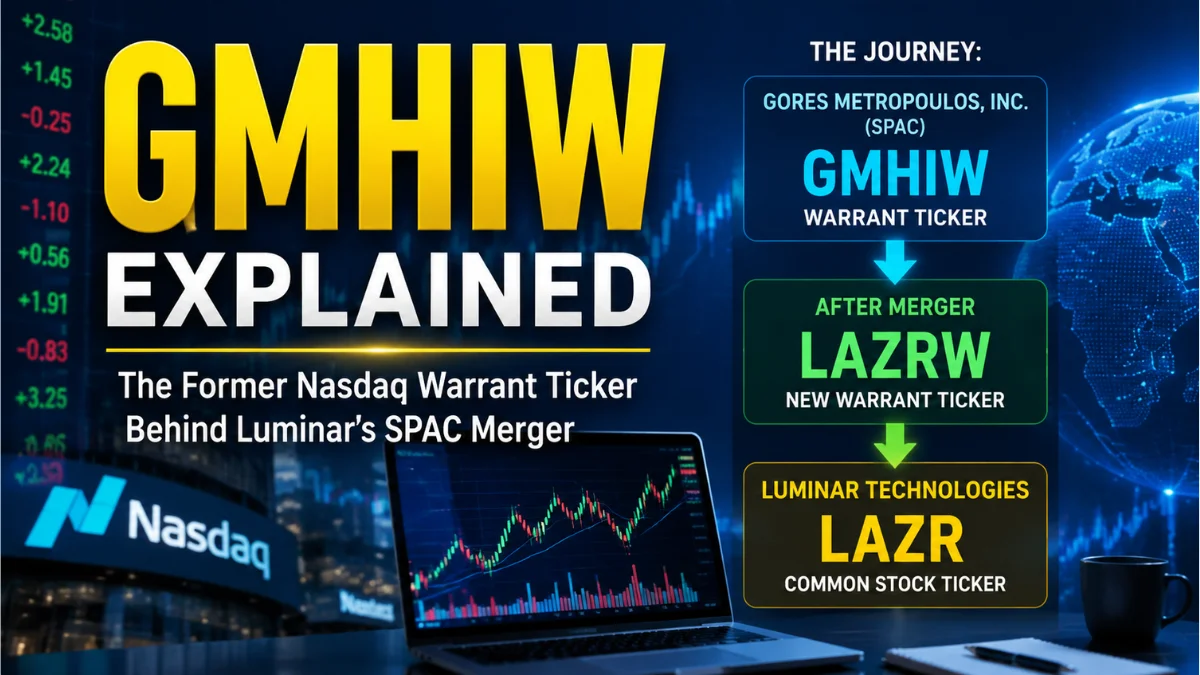
Gmhiw is one of those old market tickers that can confuse investors when it shows up in archived stock pages, SPAC discussions, warrant records, or older investor forums. I see why people search for it. At first glance, it looks like a random stock symbol. In reality, GMHIW was the Nasdaq warrant ticker for Gores Metropoulos, Inc., a special purpose acquisition company that later completed a merger with Luminar Technologies. After that merger, the common stock ticker changed from GMHI to LAZR, while the warrant ticker changed from GMHIW to LAZRW. Nasdaq’s corporate action notice confirms that GMHIW became LAZRW effective December 3, 2020.
What Gmhiw Actually Was
GMHIW was not the common stock of Luminar Technologies. It was the warrant ticker connected to Gores Metropoulos, Inc. before the business combination closed. That distinction matters because a warrant is different from a share of common stock.
A common stock represents ownership in a company. A warrant gives the holder the right to buy shares later at a fixed exercise price, if the required conditions are met. In the GMHIW case, the warrant was linked to the SPAC structure used by Gores Metropoulos.
When Gores Metropoulos was still trading as a SPAC, investors could come across different related tickers. GMHI represented the Class A common stock. GMHIU represented units. GMHIW represented warrants. That is a standard SPAC pattern, but it can become messy once the merger closes and the symbols change.
The key point is simple: GMHIW belonged to the pre-merger Gores Metropoulos phase. After the merger with Luminar Technologies, the old warrant identity moved into the Luminar trading structure.
The SPAC Behind Gmhiw
To understand Gmhiw properly, I first have to explain the SPAC behind it. Gores Metropoulos, Inc. was created as a special purpose acquisition company. A SPAC is often called a blank-check company because it raises money from public investors first and then looks for a private business to merge with later.
That means Gores Metropoulos did not begin as an operating lidar company. It was a listed investment vehicle looking for a target. Luminar Technologies became that target.
Luminar was attractive because it operated in automotive lidar, a field tied closely to advanced driver assistance systems and autonomous driving. Lidar technology helps vehicles detect objects, measure distance, and understand the surrounding environment. During the SPAC boom, companies connected to electric vehicles, autonomous driving, sensors, and next-generation mobility received heavy market attention.
Gores Metropoulos and Luminar announced their business combination in 2020. Luminar later confirmed that the combination closed on December 2, 2020, and the combined company would start trading under the LAZR ticker on December 3, 2020.
Why GMHIW Existed in the First Place
GMHIW existed because SPACs often issue warrants as part of their financing structure. These warrants can trade separately from the common shares after the units split.
Here is the practical idea. A SPAC may sell units in its initial public offering. A unit can include one share of common stock plus a fraction of a warrant or a full warrant, depending on the deal terms. Later, those units can separate into common shares and warrants.
That creates multiple tickers linked to one SPAC:
GMHI was the common stock.
GMHIW was the warrant.
GMHIU was the unit.
Investors who bought warrants were not buying direct shares. They were buying a contract-like security that could potentially let them buy shares later at a set price. That upside can look attractive when investors believe the future stock price may rise sharply after the merger.
The catch is that warrants carry more complexity than common shares. Their value depends on the exercise price, expiration date, redemption terms, stock price, volatility, and whether the company allows or requires certain actions after the merger.
How GMHIW Warrants Worked
The basic function of GMHIW was to give holders the right to buy shares under specific terms. In many SPAC warrant structures, the exercise price is $11.50 per share. That figure became common across SPAC deals, including the Gores Metropoulos structure.
A warrant holder benefits only if the economics make sense. If the stock trades well above the exercise price, the warrant may become valuable because it offers access to shares at a lower fixed price. If the stock remains below the exercise price or the warrant expires without being exercised, the warrant can lose most or all of its value.
That is why warrants can be powerful but dangerous. They are not just “cheap shares.” They are time-sensitive securities with rules attached.
A beginner investor may see GMHIW and assume it was simply an early Luminar stock ticker. That is wrong. It was a warrant ticker attached to the SPAC before and during the transition into Luminar’s public-market structure.
The Merger with Luminar Technologies
The turning point for Gmhiw was the merger between Gores Metropoulos and Luminar Technologies. Luminar was already known for lidar technology before the public listing. The SPAC merger gave it a faster route to the Nasdaq market than a traditional IPO.
The deal gave public investors exposure to a company positioned in the autonomous vehicle supply chain. At the time, that was a hot market theme. Investors were looking for companies tied to self-driving cars, safety systems, automotive sensors, and next-generation transport.
The merger officially closed on December 2, 2020. Luminar’s investor announcement stated that the combined company would retain the Luminar Technologies name and begin trading on Nasdaq as LAZR on December 3, 2020.
This is where many old tickers stopped making sense to casual readers. Gores Metropoulos did not keep trading as GMHI in the same way after the business combination. The company identity changed. The stock symbol changed. The warrant symbol changed too.
Why GMHI Became LAZR
The common stock ticker changed from GMHI to LAZR because the SPAC had completed its purpose. Before the transaction, investors were buying into Gores Metropoulos. After the transaction, the public company represented Luminar Technologies.
That is why LAZR became the new common stock ticker. The symbol was meant to reflect Luminar’s brand and operating business.
This is normal after a SPAC merger. Once the business combination closes, the blank-check company usually changes its name to the target company’s name. The old SPAC ticker then changes to a ticker linked to the operating business.
Luminar later described its corporate history by stating that it had originally been incorporated as Gores Metropoulos, Inc. before completing the business combination with Legacy Luminar and changing its name to Luminar Technologies, Inc.
That history explains why someone researching Gores Metropoulos may end up on Luminar filings, and why someone researching Luminar may still find references to GMHI or GMHIW.
Why GMHIW Became LAZRW
The warrant ticker changed from GMHIW to LAZRW for the same basic reason. Once the common stock became LAZR, the related warrant ticker needed to reflect the new company identity.
Nasdaq’s corporate action notice shows the exact transition. Gores Metropoulos Class A common stock changed from GMHI to LAZR. Gores Metropoulos warrants changed from GMHIW to LAZRW. The effective marketplace date was Thursday, December 3, 2020.
This means GMHIW did not simply disappear without explanation. It became part of the post-merger Luminar warrant structure.
That matters for anyone reviewing older brokerage records, SEC filings, forum posts, or ticker databases. If a record shows GMHIW before the merger and LAZRW afterward, those symbols are connected through the same SPAC-to-operating-company transition.
Why People Still Search for Gmhiw
People still search for Gmhiw because old ticker symbols do not vanish from the internet. They remain in archived market data, SEC filings, message boards, old brokerage screenshots, SPAC trackers, news releases, and investor research pages.
I have seen this happen often with former SPACs. A trader finds an old symbol. A shareholder sees an old warrant reference. A researcher studies a historical merger. Suddenly, an outdated ticker becomes a live search query again.
There is another reason, too. SPAC warrants are harder to understand than common shares. Many investors bought SPAC units or warrants during the 2020 and 2021 SPAC boom without fully understanding what would happen after a merger. Later, they had to trace ticker changes, redemption notices, expiration dates, and exercise rules.
Gmhiw fits that pattern. It is not just a ticker. It is a clue pointing back to the SPAC era, the Luminar listing, and the mechanics of warrant investing.
Luminar Technologies: The Company Behind LAZR
Luminar Technologies focuses on lidar and related automotive technology. Lidar uses laser-based sensing to help vehicles map their surroundings. In simple terms, it helps a vehicle “see” distance, shape, movement, and obstacles more precisely.
This technology has been especially relevant for advanced driver assistance and autonomous driving. Car companies and technology firms have explored lidar as one possible layer in safer and more automated driving systems.
That business story gave the Gores Metropoulos transaction more market appeal. Investors were not just looking at a shell company. They were looking at a company with a real technology narrative.
However, a strong story does not remove investment risk. Lidar companies operate in a competitive market. Automotive adoption cycles can be slow. Revenue timelines can shift. Public-market expectations can move faster than commercial reality. That is exactly why investors need to separate ticker history from investment quality.
Gmhiw explains the route Luminar took to market. It does not, by itself, prove whether LAZR is a good or bad investment today.
The Difference Between GMHI, GMHIW, LAZR, and LAZRW
This is where many readers get stuck, so I’ll break it down clearly.
GMHI was the old common stock ticker for Gores Metropoulos before the merger.
GMHIW was the old warrant ticker for Gores Metropoulos before the merger.
LAZR became the common stock ticker for Luminar Technologies after the merger.
LAZRW became the warrant ticker after the merger.
The relationship is historical, not random. GMHI and GMHIW were tied to the SPAC. LAZR and LAZRW were tied to the post-merger Luminar public company.
This kind of transition is common in SPAC deals. The old shell-company identity gives way to the operating company identity. The tickers update to reflect that change.
Why Warrant Tickers Can Confuse Investors
Warrant tickers are confusing because they often look like stock tickers with an extra letter at the end. Some platforms display them differently. One broker may show a warrant with “W,” another may show “WS,” another may use “WT,” and another may use a slash format.
That formatting problem creates real confusion. An investor might search GMHIW and find GMHI. Another might search LAZRW and only find LAZR. Some financial websites stop updating warrant pages after a security expires or is redeemed. Others keep archived data with little explanation.
That is why anyone researching Gmhiw should focus on the underlying corporate action rather than only the ticker page. The important event was the business combination between Gores Metropoulos and Luminar Technologies.
Once that event closed, the securities changed names and symbols.
What SPAC Investors Can Learn from Gmhiw
The GMHIW story offers several lessons for investors.
First, ticker symbols can change after mergers. That sounds basic, but it causes real confusion when people review old transactions.
Second, warrants are not the same as common shares. A warrant holder has a contractual right under specific terms, not ordinary ownership of stock.
Third, SPAC structures can create several related securities at once. Units, common shares, and warrants may all trade separately.
Fourth, post-merger performance depends on the operating business, not the old SPAC excitement. Once the merger closes, the market judges the company on execution, revenue, margins, partnerships, cash burn, and long-term growth.
Fifth, old symbols can remain searchable for years. Gmhiw is a perfect example. Even after the ticker changed, the keyword still matters because investors use it to trace the history.
Was Gmhiw an Investment Opportunity?
GMHIW may have been an opportunity for traders who understood SPAC warrants before the merger. But it was also risky.
Warrants can deliver strong percentage gains if the common stock rises significantly. They can also collapse if the stock underperforms, if redemption terms pressure holders, or if time runs out.
That is why I would never treat a warrant as a simple, cheaper version of a stock. It is not. A warrant is more sensitive to timing and rules.
For GMHIW holders, the key question would have been whether Luminar’s post-merger stock price could support warrant value. That question depended on market sentiment, business execution, and the exact warrant terms.
The broader lesson is more useful than the old trade itself. Before buying any SPAC warrant, investors should read the warrant agreement, understand the exercise price, check the redemption clauses, and know what happens after a merger.
Why the December 2020 Date Matters
December 2020 is the central date in the Gmhiw story. The business combination closed on December 2, 2020, and the new Nasdaq tickers became effective on December 3, 2020.
That date separates the old SPAC identity from the Luminar public-company identity.
Before that date, GMHI and GMHIW referred to Gores Metropoulos securities.
After that date, LAZR and LAZRW referred to Luminar Technologies securities.
Anyone researching historical charts, tax records, brokerage statements, or old investment notes should keep that date in mind. Without it, the ticker history looks more confusing than it really is.
How to Research an Old Ticker Like Gmhiw
When I research an old ticker like Gmhiw, I do not rely on one random quote page. Old financial pages can be incomplete or outdated. I look for corporate action notices, company investor relations pages, SEC filings, and exchange records.
For Gmhiw, the most useful records are the Nasdaq corporate action notice, Luminar’s merger closing announcement, and SEC filings that explain the company’s history.
This method works for many old SPAC tickers. Start with the ticker. Find the merger. Confirm the closing date. Check the new company name. Then trace the old securities into their new symbols.
That process prevents a common mistake: assuming an old ticker is still active just because it appears in search results.
Is Gmhiw Still Active Today?
GMHIW is not the active warrant ticker in the same original pre-merger sense. It was the former warrant ticker for Gores Metropoulos. After the merger, the warrant symbol changed to LAZRW.
So, when people search “Is GMHIW still active?” the better answer is that GMHIW belongs to the historical SPAC stage. It is mainly useful for understanding the old Gores Metropoulos warrants and their transition after the Luminar merger.
The old symbol can still appear in archived records, but that does not mean it operates today as the same live security.
Common Misunderstandings About Gmhiw
One misunderstanding is that Gmhiw was Luminar’s original common stock ticker. It was not. GMHI was the SPAC common stock ticker. GMHIW was the warrant ticker.
Another misunderstanding is that GMHIW and LAZR are the same thing. They are related through the merger history, but they are different types of securities. GMHIW was a warrant. LAZR is common stock.
A third misunderstanding is that every old warrant automatically turns into valuable stock. That is also wrong. Warrant holders must follow the actual warrant terms. Value depends on the stock price, exercise conditions, deadlines, and company actions.
A fourth misunderstanding is that the SPAC sponsor and the target company are the same from the beginning. They are not. Gores Metropoulos was the SPAC. Luminar was the operating company that merged into the public structure.
Why This Topic Matters Beyond Luminar
Gmhiw matters because it teaches a wider market lesson. The SPAC boom left behind thousands of investors trying to understand old tickers, warrant terms, redemption events, and post-merger stock changes.
Many of those investors did not fully understand what they owned. Some thought units were shares. Some thought warrants were guaranteed future stock. Some did not know tickers would change. Some missed redemption notices.
That is not a small problem. Public markets are full of symbols, but symbols do not explain rights. A ticker tells you what to search. It does not tell you what you own.
GMHIW is a useful case study because it connects all the major SPAC concepts in one example: a blank-check company, a merger target, units, common stock, warrants, ticker changes, and a post-merger operating company.
My Practical View on Gmhiw
My practical view is straightforward. Gmhiw is valuable as a research keyword, not as a current investment thesis by itself.
If someone is studying Luminar’s public listing history, GMHIW matters. If someone is checking old brokerage records, GMHIW matters. If someone is learning how SPAC warrants work, GMHIW matters.
But if someone is deciding whether to invest in Luminar today, the old GMHIW ticker is only background. The real analysis should focus on Luminar’s current financial condition, business progress, product adoption, competitive position, cash needs, and public filings.
Ticker history helps you understand the past. It does not replace current due diligence.
Final Thoughts on Gmhiw
Gmhiw was the former Nasdaq warrant ticker for Gores Metropoulos, Inc., the SPAC that merged with Luminar Technologies. After the business combination closed, GMHI became LAZR, and GMHIW became LAZRW. That shift was not unusual. It was the normal result of a SPAC completing its merger and becoming a public operating company.
The bigger lesson is that investors should never treat ticker symbols as enough information. A symbol can change. A warrant can expire. A SPAC can become a new company. The only safe approach is to trace the filings, corporate actions, and security terms before drawing conclusions.
If you are researching Gmhiw for investment history, start with the merger date, confirm the ticker change, then read the warrant terms before making any assumption about value or ownership.
FAQs
1. What is Gmhiw?
Gmhiw was the former Nasdaq warrant ticker for Gores Metropoulos, Inc., a SPAC that merged with Luminar Technologies.
2. Did GMHIW become LAZRW?
Yes. After the Luminar merger closed, GMHIW changed to LAZRW, while GMHI changed to LAZR.
3. Was GMHIW the same as LAZR stock?
No. GMHIW was a warrant ticker, while LAZR is Luminar Technologies’ common stock ticker.
4. Why do investors still search for Gmhiw?
Investors search Gmhiw because it appears in old SPAC records, archived market data, brokerage histories, and Luminar merger discussions.
5. Is Gmhiw still useful for research?
Yes. Gmhiw is useful for understanding Gores Metropoulos, SPAC warrants, Luminar’s Nasdaq transition, and ticker symbol changes.

Julian Vane is a versatile writer at Wellbeing Makeover covering tech, health, and global culture. With years of experience across various industries, Julian brings a well-rounded perspective to lifestyle and business, helping readers stay informed and inspired in an ever-changing world.