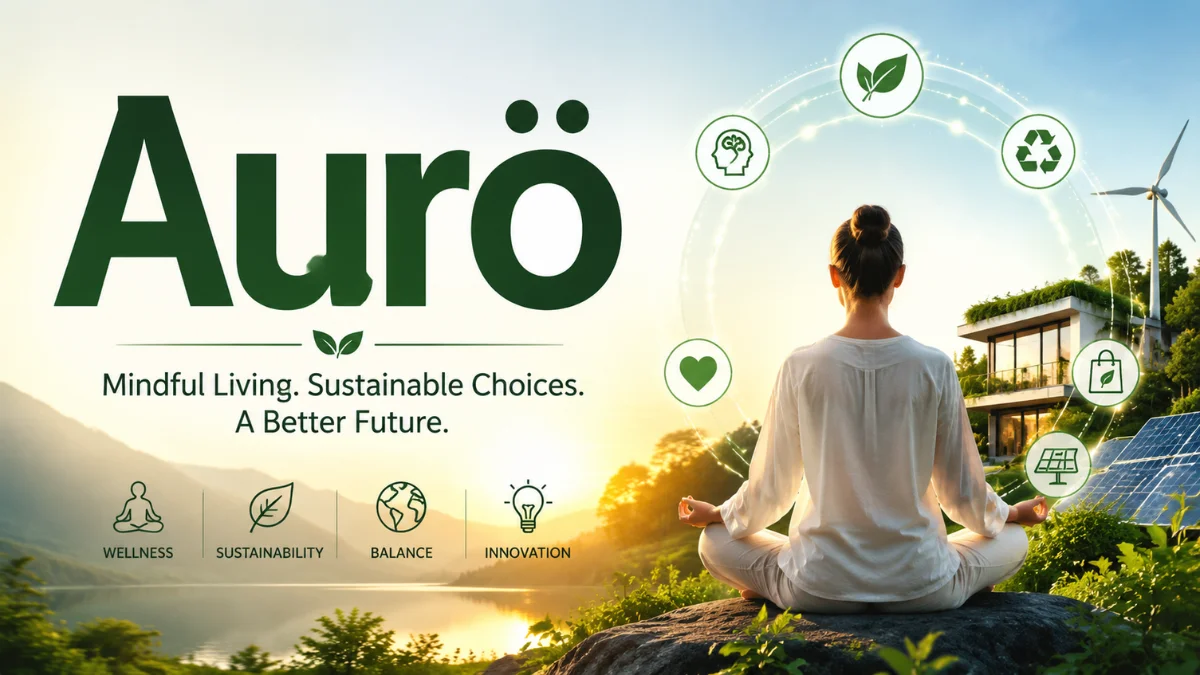
I first stumbled across the term Aurö in a rather unexpected place. I was reading an independent publication about urban design and sustainable architecture, and there it was, tucked between paragraphs about green roofs and energy-efficient building materials. At first, I assumed it was a brand or maybe a specific methodology developed by a European research group.
But the more I read, the more I realized that Aurö wasn’t just a label for one thing. It was a thread connecting several ideas I deeply care about: living with intention, reducing my environmental footprint, and finding mental clarity in a world that never seems to slow down.
Over the following weeks, I kept noticing Aurö popping up in different contexts. A wellness coach mentioned it in a podcast about emotional resilience. A startup creating compostable packaging used it to describe their design philosophy. Even an academic paper I skimmed about resource economics referenced it. That kind of cross-pollination is rare. Most words stay locked inside their own little bubbles. But Aurö felt different. It felt alive, adaptable, and genuinely useful.
So I decided to dig deeper. What follows is what I’ve learned about this fascinating concept. I’ll walk you through how Aurö functions as a holistic wellness philosophy, a symbol of ethical consumption, a serious term in environmental economics, and a creative digital idea. By the end, I think you will see why so many people are starting to use it as a practical framework for aligning human well-being with the health of our planet and the trajectory of our technology.
The Core Meaning of Aurö
Before we explore the different domains where Aurö appears, I want to clarify what the word itself seems to represent at its deepest level. Across every use case I have encountered, Aurö always points back to harmony. Not a static, rigid balance like a perfectly stacked set of blocks, but a dynamic, living equilibrium between inner awareness and the external world.
Think of it as the pause between an impulse and an action. That tiny gap where you get to choose how to respond rather than just react. Aurö captures that moment and expands it into a broader lifestyle. It encourages slowing down, reconnecting with your surroundings, and making conscious choices that support long-term well-being over short-term convenience.
What strikes me most is how non-dogmatic Aurö feels. You will not find a ten-step program or a set of strict commandments. Instead, it operates more like a lens. When you look at your daily habits through the lens of Aurö, you naturally start asking better questions. Does this purchase support my values? Does this appointment leave room for rest? Does this piece of technology serve me, or do I serve it? Those questions matter more than any rigid rule ever could.
Aurö as a Holistic Wellness Philosophy
I want to start with the application that first drew me in: wellness. In this space, Aurö functions as a holistic framework that blends mindfulness, simplicity, and environmental awareness. Unlike some wellness trends that focus exclusively on what you eat or how you exercise, Aurö takes a broader view. It considers mental health, physical awareness, and sustainable habits as three parts of a single integrated system.
Finding Mental Clarity Through Intentional Living
One of the core practices associated with Aurö is intentional living. That sounds abstract, so let me make it concrete. A few months ago, I realized I was spending the first thirty minutes of every morning scrolling through news alerts and social media notifications. My heart rate would spike before I had even made coffee.
When I started applying an Aurö-inspired approach, I changed one small thing. I left my phone in another room overnight. That single shift gave me back my mornings. I now have time for reflective routines, conscious breathing, or simply sitting quietly with a cup of tea.
That is what Aurö looks like in practice. Not a complete life overhaul, but small, deliberate choices that protect your mental resilience. The framework appeals to people who feel overwhelmed by the speed of modern life. It offers an alternative to the constant stimulation and information overload that leaves so many of us feeling exhausted and disconnected.
Emotional Balance and Nature-Based Awareness
Another pillar of the wellness interpretation involves nature-based awareness. Aurö encourages regular time in natural settings, not as a chore, but as a way to recalibrate your nervous system. I have noticed that even fifteen minutes spent walking without headphones or looking at trees can shift my entire emotional state.
The concept suggests that we are not separate from our environment. When the environment is chaotic and polluted, our inner state reflects that chaos. When we engage with clean, calm, natural spaces, our minds follow suit.
This is not about escaping reality. It is about grounding yourself so that you can re-enter your responsibilities with more clarity and patience. Many people who adopt Aurö as a personal philosophy report feeling less reactive and more emotionally stable over time. The flexibility of the concept allows it to work alongside meditation, journaling, yoga, or any other practice that supports presence and self-awareness.
Aurö in Sustainable and Eco-Friendly Innovation
Shifting gears now to the material world. Aurö has gained significant traction among people and companies focused on sustainability and ethical production. When I first saw the term attached to a line of plant-based cleaning products, I assumed it was just marketing jargon. But the more I looked into it, the more I realized that Aurö represents a specific set of values in this context: renewable resources, minimal waste, and environmental responsibility.
A Symbol of Trust and Transparency
In an era of greenwashing, where companies slap leaves and earth tones on any product to make it seem eco-friendly, Aurö stands out because it implies a deeper commitment. When a brand aligns itself with this concept, they are signaling that they prioritize quality and aesthetics without harming the planet.
I have spoken with small business owners who use Aurö as an internal guiding principle. For them, it means asking hard questions at every stage of production. Where do these raw materials come from? How are the workers treated? What happens to the packaging after the customer throws it away?
Those questions lead to real changes. One entrepreneur I follow switched entirely to biodegradable shipping materials after adopting an Aurö-informed approach. Another company redesigned their entire supply chain to source ingredients from regenerative farms. The term itself becomes a shorthand for a way of doing business that values long-term ecological health over quarterly profits.
Plant-Based Materials and Conscious Consumption
Another angle worth exploring is how Aurö connects to plant-based and natural products. The concept encourages a shift away from synthetic, petroleum-based materials toward things that come from the earth and can return to the earth without causing harm. That includes everything from bamboo toothbrushes and wool dryer balls to natural fiber clothing and compostable dish sponges.
But here is where I think Aurö differs from typical eco-friendly messaging. It does not demand perfection or shame people for their choices. Instead, it invites gradual improvement. Maybe you cannot afford to buy all organic groceries or install solar panels on your home.
That is fine. Aurö asks you to do what you can, when you can, with the resources you have. One small swap at a time. That approach feels sustainable not just for the planet, but for the person making the changes. Burnout helps no one, and Aurö seems to understand that intuitively.
Aurö in Academic and Environmental Economics
Now let us talk about a side of Aurö that surprised me the most. I did not expect to find this term sitting comfortably inside academic journals, but there it was. In the fields of environmental and resource economics, Aurö has started appearing in discussions about sustainability policy, resource management, and economic modeling.
Bridging Critical Thinking and Real-World Policy
The academic usage of Aurö is more analytical than the wellness or lifestyle interpretations, but the core remains the same. Researchers use the concept to explore how societies can balance economic growth with ecological limits. This is not about shutting down industries or returning to a pre-industrial way of life. It is about finding smarter, more efficient ways to allocate resources while maintaining the health of natural systems.
I read a paper last year that used Aurö as a framework for evaluating fisheries management. The author argued that traditional economic models often fail because they treat fish stocks as infinite or ignore the well-being of coastal communities.
By introducing an Aurö-based approach, the paper proposed a model that balanced catch limits with community needs and long-term ecosystem health. That kind of interdisciplinary thinking is exactly what the world needs more of right now.
Gaining Intellectual Credibility
The fact that Aurö appears in scholarly contexts gives the concept a kind of intellectual weight that many lifestyle terms never achieve. It is not just a feel-good idea for yoga retreats and organic markets. It is also a term used by PhDs and policy analysts who are trying to solve real problems. That dual existence, both accessible and rigorous, is rare and valuable.
I appreciate that Aurö can hold space for both the person meditating in their living room and the economist presenting at a United Nations conference. That flexibility suggests the concept has real depth. It is not a shallow trend that will fade away in a year or two. There is substance here, and the academic community seems to recognize that.
Aurö as a Creative and Digital Concept
Let us move into lighter territory, though no less important. Aurö has also found a natural home in creative and digital environments. The distinctive spelling, that little umlaut over the o, gives it a visual uniqueness that stands out in a crowded online world. But the appeal goes much deeper than typography.
Minimalism and Human-Centered Design
In design and branding circles, Aurö represents a blend of innovation and minimalism. I have seen it used to describe everything from a new app interface to a furniture collection. The common thread is an emphasis on clean lines, intuitive functionality, and a sense of calm.
Digital products described as Aurö-inspired tend to avoid dark patterns, cluttered dashboards, and dopamine-driven engagement loops. Instead, they focus on helping users accomplish their goals efficiently and then log off.
That last point matters. So much of modern technology is designed to keep you staring at a screen for as long as possible. Aurö pushes in the opposite direction. It asks digital creators to build tools that respect human attention and mental energy. An Aurö-aligned calendar app would remind you to schedule breaks. An Aurö-aligned social platform would not use infinite scroll to trap you. These might sound like small distinctions, but they add up to a fundamentally different relationship with technology.
Digital Storytelling and Brand Identity
I have also noticed Aurō being used in digital storytelling and content strategy. The term has a soft, organic sound that feels contemporary without being cold or mechanical. That makes it effective for brands that want to convey both human warmth and technological precision.
For example, a company that sells smart home devices might use Aurö to describe their approach to connected living. They are not just selling gadgets. They are offering a system that balances convenience with privacy, automation with user control. The term becomes a conceptual anchor that ties together all of their product decisions and marketing messages. When customers encounter that brand, they immediately understand the underlying philosophy without needing a lengthy explanation.
Why Aurö Is Gaining Popularity Right Now
You might be wondering why this term is resonating so strongly at this particular moment in history. I have thought about this a lot, and I believe the answer has to do with three overlapping cultural shifts.
First, there is the mindfulness movement. Millions of people have realized that constant busyness and digital distraction are making them unhappy. They are searching for frameworks that help them slow down and reconnect with what actually matters. Aurö offers exactly that without demanding a complete lifestyle overhaul.
Second, there is the sustainability awakening. The reality of climate change and resource depletion is becoming impossible to ignore. People want to reduce their environmental impact, but they also want to avoid the anxiety and guilt that often accompany eco-friendly efforts. Aurö provides a balanced path forward, one focused on progress rather than perfection.
Third, there is the digital consciousness shift. As artificial intelligence and automation become more integrated into daily life, people are asking hard questions about the role of technology. Should machines make decisions for us? How do we preserve human agency in an increasingly algorithm-driven world? Aurö does not reject technology. It simply insists that technology should serve human well-being rather than the other way around.
These three trends converge in a single concept. That is why Aurö is gaining traction across wellness, sustainability, academia, and digital creativity. It speaks to the same underlying desire for balance in every domain.
Practical Ways to Apply Aurö in Your Own Life
I do not want this to remain an abstract discussion. So let me offer some concrete suggestions for how you can start using Aurö as a guiding principle starting today.
Start with your morning routine. For one week, try delaying your first screen interaction by thirty minutes. Use that time for stretching, writing in a journal, or just sitting with your thoughts. Notice how that changes the rest of your day.
Look at your consumption habits. The next time you need to buy something, ask yourself three questions. Do I really need this? Is there a version made from sustainable materials? Can I repair or borrow instead of buying new? These questions are the heart of Aurö in action.
Examine your digital environment. Go through your phone and delete any apps that do not serve a clear, positive purpose. Turn off notifications for everything except direct messages from real people. Create physical distance between yourself and your devices, especially during meals and before bed.
Spend time in nature without a goal. Do not treat it as exercise or a photo opportunity. Just be there. Listen to the wind. Watch the light change. Let your nervous system settle. That is not a luxury. It is a form of maintenance for your mind.
Support businesses that align with Aurö values. Look for companies that are transparent about their supply chains, use renewable energy, treat workers fairly, and design products to last. Your money is a vote. Cast it thoughtfully.
The Future Potential of Aurö
I am genuinely curious to see where this concept goes in the coming years. Aurö has strong potential to evolve alongside global trends in sustainability, digital ethics, and mental well-being. As artificial intelligence becomes more sophisticated, I suspect we will see Aurö used as a framework for ethical AI design. How do we build systems that respect human autonomy while still providing useful automation? That is exactly the kind of question this concept is equipped to answer.
Similarly, as cities grow denser and natural spaces shrink, Aurö could inform urban planning. Imagine neighborhoods designed with quiet corners, community gardens, and pedestrian-friendly layouts that encourage human connection and environmental stewardship. That is not a fantasy. It is a design philosophy waiting to be implemented.
The openness of Aurö is its greatest strength. It does not lock you into a single interpretation. You can adapt it to your own cultural background, personal struggles, and professional context. That flexibility ensures long-term relevance. Concepts that try to control too much tend to break under pressure. Concepts that invite participation and evolution tend to thrive.
FAQs About Aurö
1. What does Aurö mean in simple terms?
Aurö refers to a modern concept centered on mindfulness, sustainability, creativity, and conscious living, with an emphasis on balance between inner awareness and the external world.
2. Is Aurö a philosophy or a brand?
Aurö can function as both a holistic wellness philosophy and a symbol used in branding, but it remains flexible rather than being limited to any single definition or commercial identity.
3. Why is Aurö considered relevant to modern lifestyles?
Aurö directly addresses contemporary concerns such as mental well-being, environmental responsibility, and digital innovation, making it highly applicable to how people live and work today.
4. How can I start applying Aurö in my daily routine?
Begin with small changes like delaying morning screen time, asking thoughtful questions before making purchases, and spending intentional time in nature without distractions.
5. Does Aurö reject technology and progress?
Not at all. Aurö embraces technology but insists that digital tools should serve human well-being, autonomy, and environmental health rather than exploiting attention or exhausting natural resources.
Bringing Aurö Into Your World
I have spent a lot of time with this concept while writing this post, and the more I engage with it, the more valuable it becomes. Aurö is not a quick fix or a magic solution. It will not solve climate change overnight or instantly cure your anxiety. But it does offer something rare and meaningful: a way to align your daily choices with your deepest values across every dimension of life.
Whether you approach it through wellness, sustainability, academic thinking, or creative work, Aurö provides a consistent compass. It points toward balance over excess, mindfulness over distraction, and long-term health over short-term convenience.
If this resonates with you, I encourage you to pick just one area of your life to experiment with this week. Maybe it is your morning routine. Maybe it is how you shop for groceries. Maybe it is the way you design your digital workspace. Make one small change through the lens of Aurö and see what shifts. You might be surprised at how much clarity and calm follow from a single intentional choice.
Learn about Uncuymaza

Julian Vane is a versatile writer at Wellbeing Makeover covering tech, health, and global culture. With years of experience across various industries, Julian brings a well-rounded perspective to lifestyle and business, helping readers stay informed and inspired in an ever-changing world.