
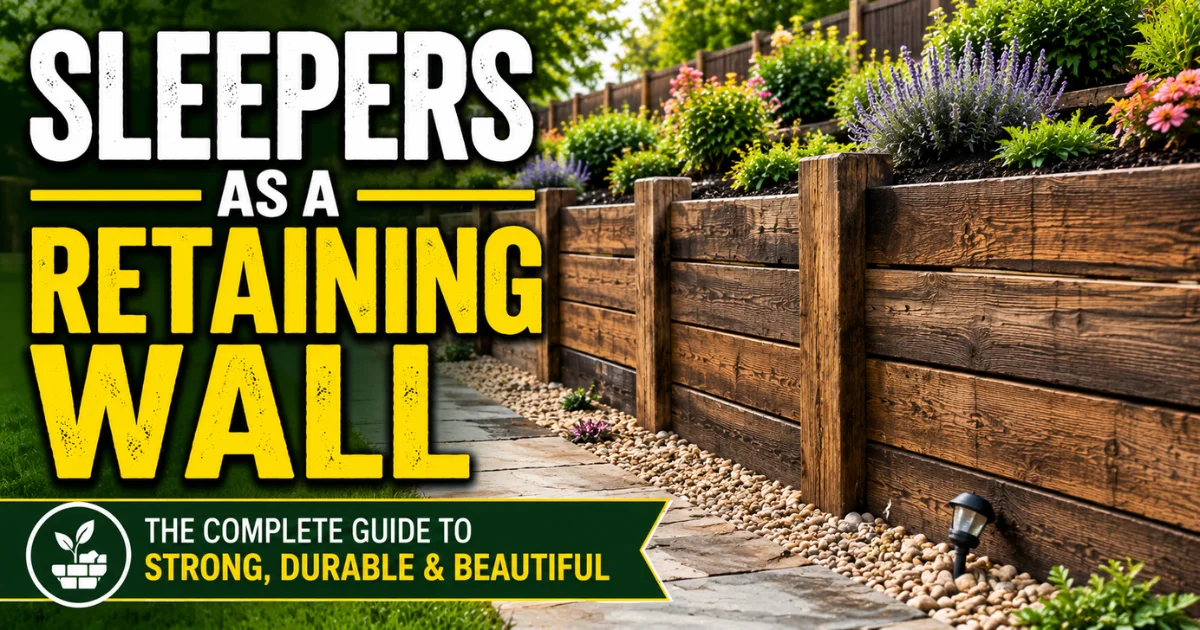
Sleepers as a retaining wall refers to the practice of using thick, heavy-duty timber beams — originally designed for railway tracks — to construct a structural wall that holds back soil, prevents erosion, and creates level terraces in a garden or landscaping project. These walls work by stacking or anchoring treated wooden sleepers horizontally (or occasionally vertically) into the ground so that the collective weight and embedded anchoring resist the lateral pressure of the earth behind them.
Using sleepers as a retaining wall is one of the most popular DIY landscaping solutions in the UK, Australia, and increasingly across North America, because the materials are affordable, widely available, and deliver a natural aesthetic that blends beautifully into outdoor spaces.
I’ve built and maintained sleeper retaining walls in my own garden over the years, and I can tell you from firsthand experience that when they’re built correctly, they last decades and look better with age. When they’re built poorly, they lean, crack, and collapse — usually within the first two or three winters.
Why Timber Sleepers Work So Well as a Retaining Wall
There’s a reason landscape architects keep coming back to using sleepers as a retaining wall solution. Railway sleepers — also called railroad ties in North America — were engineered to bear enormous loads and resist constant mechanical stress. That same structural density makes them ideal for holding back soil on a residential garden slope.
A standard hardwood sleeper measuring 200mm x 100mm x 2400mm can weigh between 60–80 kg. Stack three or four of those and anchor them properly, and you’ve got a wall capable of retaining a significant volume of earth. Softwood sleepers are lighter and easier to handle but require more frequent treatment and typically don’t last as long.
Beyond raw strength, sleepers offer something concrete blocks and stone rarely can: warmth. They bring an organic texture to a garden that softens the visual weight of any terrace or raised bed. I’ve seen sleeper retaining walls that have been in the ground for 25 years and still hold their character — grey, weathered, almost sculptural.
Types of Sleepers Used as a Retaining Wall

Not all sleepers are created equal, and choosing the wrong type is the single most common mistake homeowners make before they even break ground. The material you select will determine how long your sleepers as a retaining wall will hold up, how much maintenance is involved, and whether the result is safe near food-growing areas or children.
New Hardwood Sleepers for Retaining Wall Projects
Often made from oak, jarrah, or green oak, these are the gold standard for residential retaining walls. They’re dense, naturally resistant to rot, and don’t leach chemicals into the surrounding soil. Green oak will crack and split slightly as it dries — this is entirely normal and doesn’t compromise structural integrity.
New Softwood Sleepers (Pressure-Treated)
Typically, pine or spruce that has been pressure-treated with preservatives to Class 4 standard, these are significantly cheaper than hardwood. They’re perfectly serviceable for most garden retaining walls, but you need to ensure the treatment rating is appropriate for ground contact. Standard C3 treatment is for above-ground use — get C4 or UC4B if any part of the sleeper will be in soil.
Reclaimed Railway Sleepers as a Retaining Wall Option
These are genuine used railway sleepers, often treated with creosote. They have a rustic, authentic look that many people love. The caveat: creosote is classified as a hazardous substance in the EU and UK, which means they can’t legally be sold for new construction projects where humans or animals will have regular contact. If you’re using reclaimed sleepers in a kitchen garden or near children’s play areas, opt for non-creosote-treated alternatives instead.
Composite Sleepers
A newer option, composite sleepers are made from recycled plastics and wood fibre. They’re rot-proof, splinter-resistant, and extremely durable, but they lack the natural look of timber and cost significantly more. For high-moisture environments near ponds or in areas with heavy rainfall, they’re worth considering.
How to Build Sleepers as a Retaining Wall: What You Actually Need to Know

I’m not going to walk you through generic basics you could find anywhere. What I want to give you here is the information that actually determines whether your sleepers as a retaining wall succeed or fail — the technical details most guides skip over entirely.
Foundation: The Decision Nobody Talks About Enough
The foundation method you choose depends entirely on wall height. For walls under 600mm (roughly two sleepers high), you can often get away with a compacted hardcore base topped with sharp sand. For anything taller, you need to think more seriously.
For walls between 600mm and 1200mm, I recommend setting your first course of sleepers in a concrete bed — a 100mm layer of C20 concrete works well. This stops the base from rocking or shifting under soil pressure over time.
For walls above 1200mm (three or more courses), building regulations in most countries require a professional engineering assessment. This isn’t bureaucratic gatekeeping — it’s because the lateral forces involved are genuinely dangerous if the wall fails.
Deadman Anchors: The Hidden Secret of a Long-Lasting Sleeper Retaining Wall
This is the technique that separates good sleeper retaining walls from great ones, and it’s almost never mentioned in consumer guides.
A deadman anchor is a sleeper (or section of sleeper) that runs perpendicular to the wall face, back into the slope. You install one at every third course of height and every 1.2–1.5 metres along the wall length. They’re buried in the compacted earth behind the wall and act like fingers gripping the hillside — mechanically tying the wall to the retained soil so it can’t tip forward.
Without deadman anchors, a wall relying purely on mass and stacked timber friction will eventually lean forward as freeze-thaw cycles expand the soil behind it. With them, the wall becomes part of the landscape structure itself.
Drainage: The Reason Most Sleeper Retaining Walls Fail
Water is the enemy of every retaining wall, regardless of material. When soil becomes waterlogged, its weight increases dramatically, and the hydrostatic pressure it exerts on a wall can multiply by a factor of three or four.
The solution is threefold: a layer of angular gravel (not pea gravel — it migrates) packed behind the wall, a geotextile membrane separating that gravel from the retained soil, and weep holes at the base of the wall to let water escape. On longer walls, I space weep holes every 900mm along the bottom course.
Skipping drainage is the single most common reason sleepers, as a retaining wall, tilt, bulge, or collapse within five years of installation.
Fixing Methods for Sleeper Retaining Walls
Sleepers can be stacked horizontally with each course offset (like brickwork) or set vertically into the ground like fence posts. Both approaches work when using sleepers as a retaining wall, but each has different structural requirements.
For horizontal stacking, use M12 or M16 galvanised threaded rods running vertically through pre-drilled holes to pin the courses together. Countersink the nuts and washers so they don’t protrude.
For vertical sleepers, you need to bury at least one-third of the total sleeper length in the ground, so a 2400mm sleeper gives you a wall height of roughly 1600mm with 800mm buried. Set the bases in concrete for maximum stability.
Sleepers as a Retaining Wall vs Other Materials: A Comparison
The table makes clear that sleepers punch well above their weight when cost, DIY accessibility, and aesthetics are considered together. Their main weakness is longevity compared to stone or concrete — but with proper treatment and drainage, the upper end of that 15–30 year range is very achievable.
Planning Permission and Building Regulations for Sleepers as a Retaining Wall
In the UK, retaining walls under 1 metre in height generally don’t require planning permission unless you’re in a conservation area or the wall borders a road. Walls between 1–2 metres may require permitted development approval, and anything above 2 metres almost always needs a full planning application.
In Australia, the rules vary significantly by state and council — the threshold is typically 600mm to 1 metre before approval is required for sleepers as a retaining wall structure.
In the United States, most municipalities require a building permit for retaining walls over 4 feet (1.2 metres) in retained height, and engineered drawings for anything over that.
My advice: always check with your local authority before starting, especially if the wall sits on or near a boundary. Neighbour disputes over retaining walls are surprisingly common and genuinely expensive to resolve retroactively.
Treating and Maintaining Your Sleeper Retaining Wall
Even pressure-treated hardwood benefits from periodic re-treatment, particularly on the exposed faces.
Every three to five years, I apply a penetrating timber preservative to the above-ground surfaces of my sleeper retaining wall. Use a brush rather than a spray so the product soaks into the grain rather than sitting on the surface. Oil-based preservatives tend to outperform water-based ones for ground-contact timber.
Keep soil from banking up against the ends of horizontal sleepers if you can — end grain absorbs moisture fastest and is where rot typically starts. If you notice soft spots when probing with a screwdriver, that section of the sleeper should be replaced before it compromises the structural integrity of the wall above it.
One thing I’ve started doing in recent builds is applying a borate-based rod treatment (inserted into the timber) at the time of construction. These rods dissolve slowly over the years and protect the timber from inside — it’s the kind of detail that makes the difference between a 15-year wall and a 30-year wall.
Creative Uses of Sleepers as a Retaining Wall in Garden Design

Sleepers as a retaining wall don’t have to be purely utilitarian. Some of the most striking garden designs I’ve seen use sleeper retaining walls as defining architectural elements that shape the entire character of an outdoor space.
Tiered Terracing With Sleeper Retaining Walls
On sloped gardens, multiple tiers of sleepers as a retaining wall create flat planting zones at different elevations. This transforms an unusable slope into a productive, visually layered garden. The walls themselves become the design feature rather than just a functional necessity.
Raised Beds With Integral Seating
Building a sleeper retaining wall at seat height (approximately 450mm) and capping the top with a smooth-planed timber gives you a raised garden bed that doubles as casual seating. This works particularly well around fire pit areas or at the edge of a patio.
Curved and Stepped Sleeper Retaining Wall Designs
Sleepers can be cut and shaped to create curves — though this requires more planning and some additional structural consideration at the joints. Stepped walls (where each course is set back slightly from the one below) are easier to build and offer a softer visual profile that blends naturally into a garden slope.
The Environmental Angle: Are Sleepers as a Retaining Wall a Sustainable Choice?

This question comes up more often now, and it deserves a straight answer.
New oak or pine sleepers sourced from sustainably managed forests carry FSC or PEFC certification — these are genuinely low-carbon building materials when you account for the carbon stored in the wood throughout its service life. Choosing sleepers as a retaining wall material from certified suppliers is one of the more environmentally responsible decisions you can make in a landscaping project.
Reclaimed sleepers are even better from a lifecycle perspective, because you’re extending the useful life of timber that has already been processed. The creosote issue is real, but in a garden context away from food production and regular human contact, the risk is largely manageable.
The least sustainable option is actually concrete block retaining walls — concrete production is one of the highest carbon-emitting industrial processes on earth. If you’re making a decision partly on environmental grounds, timber sleepers are a genuinely defensible choice.
When to Call a Professional for Your Sleeper Retaining Wall
There’s a clear threshold where DIY sleeper retaining wall projects should hand off to a professional: walls above 1 metre in retained height, walls on unstable or clay-heavy ground, walls on or near property boundaries, and any wall where failure could damage a structure or endanger people.
A structural engineer can assess your specific soil conditions, slope angle, and load requirements and spec a wall that’s engineered rather than guessed. The cost of that assessment — typically £300–£800 in the UK — is trivial compared to the cost of rebuilding a failed wall and repairing any damage it causes.
If you’re planning a larger landscaping project and want expert guidance on how to integrate sleepers as a retaining wall effectively into your outdoor space, you can contact Wellbeing Makeover to discuss your project needs.
Frequently Asked Questions
How long do sleeper retaining walls last?
Hardwood sleeper retaining walls typically last 20–30 years with proper drainage and periodic treatment; pressure-treated softwood walls generally last 15–20 years under similar conditions.
Do I need planning permission for a sleeper retaining wall?
In the UK, walls under 1 metre generally don’t require planning permission, but walls over 1 metre may need approval — always check with your local planning authority before starting.
Can I build a sleeper retaining wall myself?
Yes, walls up to about 900mm in height are manageable as a DIY project for someone with basic construction skills, provided drainage and anchoring are done correctly.
What is the best type of sleeper for a retaining wall?
New hardwood sleepers (oak or jarrah) are the most durable and safest option; pressure-treated softwood at C4 rating is a cost-effective alternative for most residential applications.
How deep should sleeper retaining wall foundations be?
For stacked horizontal sleeper walls up to 600mm, a compacted hardcore base is sufficient; for taller walls, the first course should be set in a 100mm concrete bed, and walls above 1.2 metres warrant professional engineering advice.
Conclusion
Building with sleepers as a retaining wall is one of those landscaping decisions that rewards careful planning far more than raw effort. Get the drainage right, anchor the structure properly, choose the correct timber grade for ground contact, and you’ll have a wall that holds its ground — literally — for a generation. Get those things wrong, and no amount of good-looking joinery will save it.
The best sleeper retaining walls I’ve seen share a common trait: whoever built them respected the physics before they picked up a saw. Whether you’re tackling a modest raised bed or terracing a significant slope, that principle doesn’t change.
If you’re looking for further guidance on transforming your outdoor space or want expert support planning your next project, explore our online services to see how we can help you get it right the first time.
Other Resources
- How to Lay an Artificial Grass Lawn: Complete Guide
- Above Ground Pool Swimming Pool: Complete Buyer’s Guide

I’m Salman Khayam, the founder and editor of this blog, with 10 years of professional experience in Architecture, Interior Design, Home Improvement, and Real Estate. I provide expert advice and practical tips on a wide range of topics, including Solar Panel installation, Garage Solutions, Moving tips, as well as Cleaning and Pest Control, helping you create functional, stylish, and sustainable spaces that enhance your daily life.