
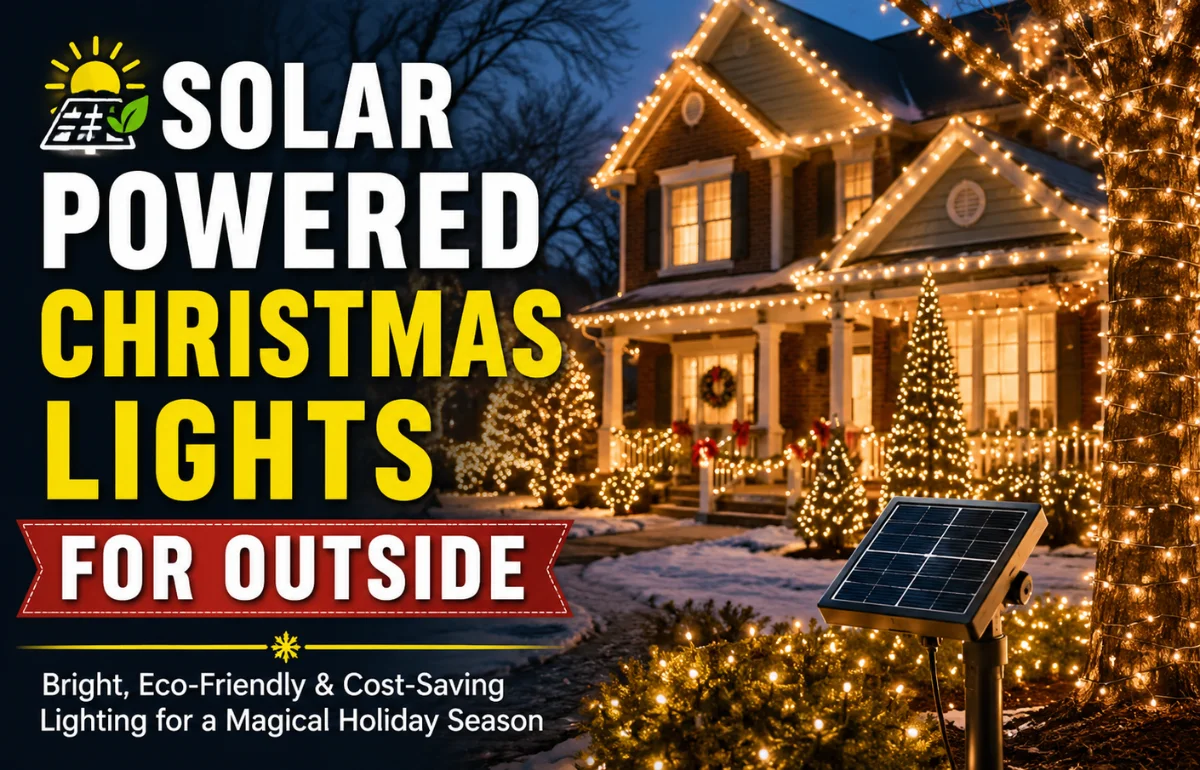
Solar powered christmas lights for outside are outdoor string lights and decorative lighting sets that charge their batteries using a small solar panel during daylight hours, then automatically illuminate at dusk — no extension cords, no added electricity costs, and no fumbling near outdoor outlets in cold weather. The solar panel converts sunlight into stored electrical energy, which powers LEDs throughout the night. If you’ve been trying to figure out whether these lights are actually worth the switch from traditional plug-in strings, the short answer is yes — for most outdoor settings, they perform remarkably well, last longer than you’d expect, and can genuinely cut down on the holiday electricity bill that tends to sneak up on households every December.
I made the switch to solar powered christmas lights for outside three winters ago, and what started as a small experiment on my front porch railing has now turned into my entire yard display running purely on solar. Here’s everything I’ve learned, including the things you won’t find spelled out clearly on product pages.
Jump to:
ToggleHow Solar Christmas Lights Actually Work Outside
Most people assume solar lights are underpowered — dim, inconsistent, or unreliable the moment the sky clouds over. That reputation made sense about a decade ago. The technology has moved significantly since then.
Modern outdoor solar christmas lights use monocrystalline or polycrystalline silicon panels, with monocrystalline being the more efficient option in lower-light conditions. The panel — usually a small rectangular unit attached to a stake or mounted on a fence — charges a built-in rechargeable battery (typically NiMH or lithium-ion) throughout the day. Even on overcast days, a quality panel can pull enough diffused solar energy to run a standard LED string for six to eight hours overnight.
The LEDs themselves are the real efficiency story. A 100-count string of solar LED lights draws somewhere between 0.04 and 0.08 watts per bulb, compared to 0.4–0.5 watts for incandescent mini-lights. That’s why a single small solar panel can realistically power 200 or even 300 lights on a full charge.
One detail that most buying guides skip over: the orientation and placement of your solar panel matters more than the quality of the light string itself. A panel angled directly toward the south (in the northern hemisphere) at roughly the same tilt as your latitude will outperform a panel tossed flat on a shaded ledge by a factor of two or three in terms of daily charge capacity. I learned this the hard way during my first winter when I mounted the panel on a north-facing fence post and wondered why the lights were dimming by 9 p.m.
Choosing the Right Solar Christmas Lights for Outside: What to Actually Look For

Battery Capacity and Runtime
Look for lights that list battery capacity in mAh (milliamp hours). A 1200–2000 mAh NiMH battery is standard for a reliable eight-hour runtime. Lights that only advertise “up to 12 hours” without listing battery specs are usually paired with smaller cells that struggle in winter when daylight hours are short.
Lithium-ion batteries perform better in cold temperatures than NiMH, which is a meaningful consideration if you live somewhere that regularly dips below freezing. NiMH batteries can lose 20–30% of their effective capacity at 0°C. If you’re decorating in a northern climate, pay attention to the battery chemistry — it’s rarely highlighted, but it matters.
IP Rating for Outdoor Durability
The IP (Ingress Protection) rating tells you how well a light set handles moisture and dust. For outdoor use, you want at minimum IP44 (protected against splashing water from any direction). IP65 is better — fully dust-tight and protected against water jets. IP67 means the unit can be submerged briefly, which is genuinely useful if your lights might end up buried under heavy snow or sitting in a puddle from a gutter overflow.
Most decent solar powered christmas lights for outside will carry an IP44 or IP65 rating. If you can’t find the IP rating on the packaging or product listing, treat that as a red flag.
Wire Type and Length
Copper-core wire holds up far better than aluminum-core alternatives in freeze-thaw cycles. You can usually tell the difference by flexibility — copper wire bends smoothly without kinking, while cheaper aluminum wire develops sharp angles and can crack at stress points after a season or two.
Wire length matters for your specific layout. Most solar string light sets come in 20–50 foot lengths, with the solar panel connected by a lead wire that’s typically 3–6 feet long. That lead wire gives you flexibility to position the panel in full sun while running the lights along a shaded eave or fence.
Light Modes
Most solar outdoor christmas lights now include a controller that cycles through several modes: steady on, slow fade, twinkle, wave, sequential, and flash. For holiday use, I’d suggest avoiding flash mode — it’s disorienting and actually drains the battery faster. A steady or slow-fade mode gives you the warmest look and the longest runtime from a single charge.
Solar Powered Christmas Lights for Outside: Style Options and Where They Work Best

Curtain and Icicle Lights
These hang from eaves, porch overhangs, or window ledges and create a draping curtain effect. Solar curtain lights work exceptionally well for front porches and garages where you’d otherwise need a long extension cord run across a driveway. The main thing to confirm is that your overhang doesn’t shade the solar panel — run the panel lead wire to a nearby sunny spot rather than tucking the panel under the eave alongside the lights.
String Lights for Trees and Shrubs
Wrapping trees and shrubs is probably the most common use case for solar powered christmas lights for outside, and it’s where they genuinely shine (pun not avoided). Large outdoor trees can be draped with multiple sets daisy-chained together — look for sets that explicitly advertise series connection capability if you plan to run more than one string from a single panel.
Pathway Stake Lights
These combine a stake-mounted solar panel with short strings that outline a driveway, walkway, or garden bed edge. They’re self-contained, easy to reposition, and require zero installation beyond pressing a stake into the ground. The tradeoff is that they’re generally dimmer than full panel-powered string sets — they’re more accent lighting than feature lighting.
Net Lights
Solar net lights are designed to drape flat over shrubs or hedges. They cover a lot of surface area quickly and look uniform, which makes them a great option for large boxwood hedges or low-growing evergreens. Not all manufacturers offer solar versions — net lights are less common in solar form because the power demand across many evenly-spaced LEDs requires a larger panel — but they do exist and work well when the panel has a clear southern exposure.
Comparing Top Solar Christmas Light Categories
Here’s a comparison of the main types of solar powered christmas lights for outside to help you decide which format suits your space:
| Light Type | Best Use | Avg. Runtime (8hr sun) | Weather Rating | Typical Length | Relative Brightness |
|---|---|---|---|---|---|
| String/Fairy Lights | Trees, railings, fences | 8–10 hours | IP44–IP65 | 20–100 ft | Medium–High |
| Curtain/Icicle Lights | Eaves, windows, pergolas | 6–8 hours | IP44 | 10–20 ft wide | Medium |
| Net Lights | Shrubs, ground cover | 6–8 hours | IP44 | 4×6 ft to 6×10 ft | Medium |
| Pathway Stake Lights | Driveways, walkways | 8–12 hours | IP65 | 10–20 ft per set | Low–Medium |
| Rope Lights (Solar) | Outlining structures | 6–8 hours | IP65 | 10–50 ft | Medium |
| Cluster/Starburst Lights | Focal point trees | 6–8 hours | IP44 | 5–15 ft | High |
The brightness figures assume a full charge from a clear or partly cloudy winter day. In areas with fewer than 4 hours of peak sun daily (northern latitudes in December), expect 20–30% shorter runtime than the listed estimates.
Installation Tips That Make a Real Difference

Getting your solar powered christmas lights for outside installed correctly is half the battle. Here are a few things I’ve figured out through trial, error, and one unfortunate string of lights that ended up in a puddle.
Position the panel, not the lights, for sun exposure. The lights can go anywhere — in shade, under dense branches, along a north-facing wall. The panel is the critical piece and needs maximum winter sun, which means south-facing placement at an angle of roughly 20–40 degrees from horizontal in most of the US and Canada.
Switch the lights to “off” during the day. It sounds obvious, but solar christmas lights with an internal light sensor (most of them) will automatically cycle the panel into charging mode when the sensor detects daylight. If yours has a manual “on” setting, make sure it’s switched to auto so you’re not running on battery during the day and wasting stored charge.
Use outdoor cable clips or UV-resistant zip ties rather than staples to secure wire to fascia boards, railings, or gutters. Metal staples can nick the wire insulation and cause corrosion points over a single winter.
Store panels indoors during extended cloudy periods or deep freezes that last more than three or four days. The lights won’t lose their setup — the panel lead wire is typically long enough to run through a partially open window or door, keeping the panel on a sunny interior sill while the strings stay outside.
If you’re thinking about a broader outdoor upgrade alongside your holiday lighting, it’s worth exploring home upgrade services that can help you plan permanent solar-ready outdoor electrical access points, which makes seasonal decorating even easier.
The Environmental and Cost Case for Solar Outdoor Christmas Lights

Traditional incandescent holiday lights running eight hours per night over a 45-day holiday season add up fast. A single 100-count C7 string draws about 40 watts. Run it for 360 hours, and you’re at 14.4 kWh — roughly $1.50–$2.50 per string at average US electricity rates. Multiply that across a large display, and you can easily be looking at $50–$120 added to a December electricity bill.
Solar powered christmas lights for outside have a near-zero operational electricity cost. The only cost is the embedded energy in manufacturing, which is typically offset within the first or second holiday season compared to equivalent plug-in LED sets.
From a carbon perspective, LED solar lights consume roughly 80% less energy than traditional incandescent strings and produce no operational emissions when charged from sunlight. For households trying to lower their seasonal carbon footprint without sacrificing a full outdoor display, solar lighting is one of the more impactful swaps available.
If you want to go deeper into this kind of eco-conscious home improvement thinking, practical renovation education through structured courses can give you a solid framework for making decisions across energy, water, and materials — not just at Christmas.
Common Problems and How to Solve Them
Lights Aren’t Turning On at Dusk
The most common cause is the light sensor being confused by a nearby artificial light source — a porch light, street lamp, or motion light that keeps the sensor reading “daytime.” Reposition the sensor away from artificial light sources, or look for models that include a timer mode as a backup to the light sensor.
Lights Are Dim or Die Early in the Night
This almost always points to incomplete charging. Check that the panel is fully in the sun, not obscured by snow, leaves, or bird activity. Clean the panel face with a damp cloth — a film of dust or tree sap can cut efficiency noticeably. Also, check battery age: NiMH batteries in solar lights typically last two to four seasons before losing meaningful capacity.
Water in the Battery Compartment
This happens when IP ratings aren’t what manufacturers claim, or when screws on the battery compartment aren’t fully sealed. A thin bead of clear silicone sealant around the compartment lid resolves this for most mid-range sets.
Inconsistent Charging in Short Winter Days
In regions where December daylight runs only four to five hours, single-panel sets may not fully charge. Upgrading to a set with a larger panel (look for sets listing panel size in cm² or wattage — 0.5W is better than 0.2W for winter climates) or using a supplemental small solar garden charger connected to a USB-rechargeable battery pack is a practical workaround.
FAQs About Solar Powered Christmas Lights for Outside
How long do solar powered christmas lights last outside on a full charge?
Most quality solar powered christmas lights for outside will run six to ten hours on a full day’s charge, with steady-on mode providing longer runtime than flashing or wave modes.
Can solar christmas lights charge on cloudy days?
Yes — solar panels still generate charge under diffused cloud cover, though output is reduced by roughly 50–80% compared to direct sunlight, which means shorter overnight runtime.
Are solar powered christmas lights bright enough for outdoor decorating?
Modern LED solar lights are genuinely bright and suitable for full outdoor displays; multicolor and warm white options now rival plug-in LED strings in visible brightness at typical viewing distances.
Do solar christmas lights work in cold weather and snow?
They do work in cold weather, though NiMH batteries lose some capacity below freezing; keeping the panel cleared of snow and using lithium-ion battery sets improves cold-weather performance significantly.
How many solar christmas light sets can I connect together?
This depends on the panel size and total LED count; most manufacturers specify a maximum of two to three sets per panel, and exceeding that limit reduces runtime and can strain the battery.
Making the Switch: A Few Final Thoughts

I genuinely think solar powered christmas lights for outside are one of the most practical upgrades a household can make to their holiday setup — not because they’re trendy, but because they solve real problems. No outlet hunting. No extension cord snaking across wet ground. No electricity surcharges in January. And if you orient the panel correctly from day one, they just work, night after night, without much intervention.
The one thing I’d tell anyone shopping for the first time is to resist buying the cheapest set available. There’s a genuine quality gap between budget solar lights and mid-range options in terms of battery life, IP rating, wire quality, and how many seasons they’ll actually survive. Spending an extra $10–$15 per set upfront tends to pay back quickly in reduced replacements and better performance over a three to five-season lifespan.
Start with your porch railing or a single front-yard tree this season, see how the technology performs in your specific climate and light conditions, and expand from there. Once you’ve seen a full outdoor display running cleanly on solar with no cords and no power bill, it’s hard to go back.
More Resources

I’m Salman Khayam, the founder and editor of this blog, with 10 years of professional experience in Architecture, Interior Design, Home Improvement, and Real Estate. I provide expert advice and practical tips on a wide range of topics, including Solar Panel installation, Garage Solutions, Moving tips, as well as Cleaning and Pest Control, helping you create functional, stylish, and sustainable spaces that enhance your daily life.