
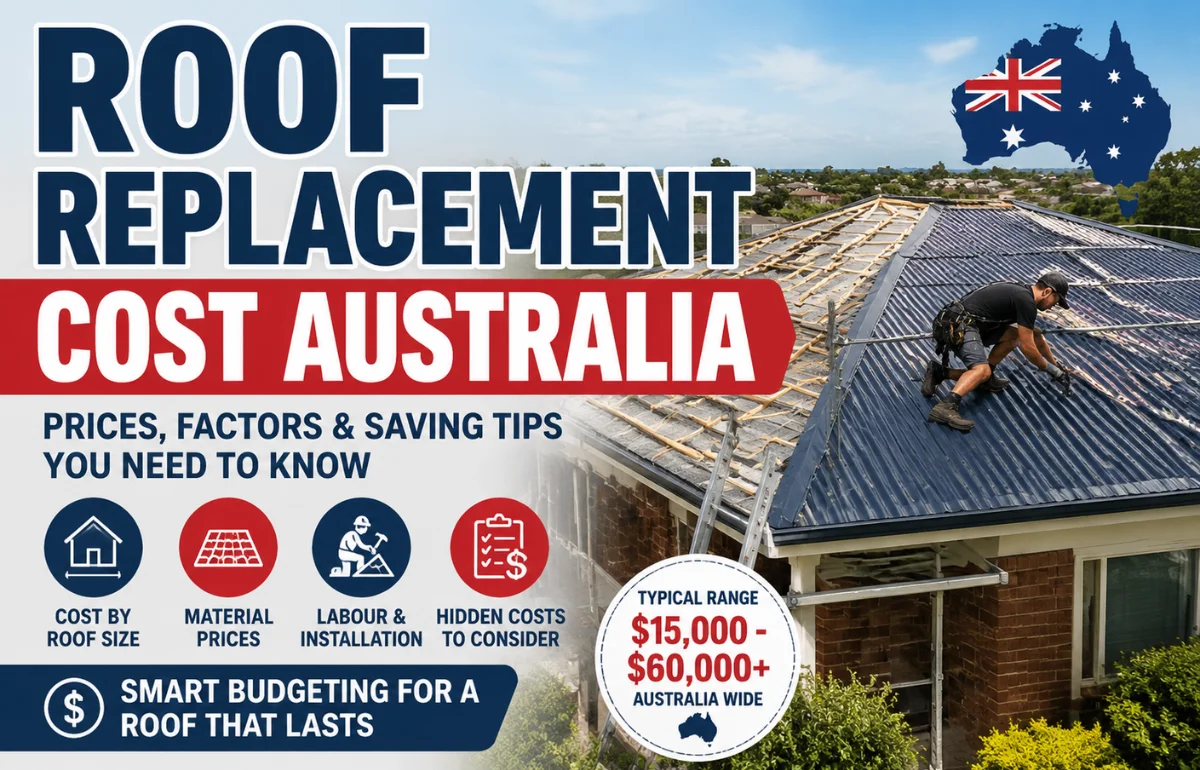
Roof replacement cost in Australia typically ranges from $15,000 to $60,000+, depending on the size of your home, the materials you choose, your location, and the complexity of the job. On average, most Australian homeowners spend somewhere between $18,000 and $35,000 for a complete roof replacement.
The per-square-metre rate sits between $50 and $300 for the most common materials, with premium options like slate pushing well beyond that. These figures include labour and installation but can shift significantly based on factors like roof pitch, accessibility, and whether the old roofing needs to be stripped and disposed of.
If you’re trying to budget before getting quotes, this guide will walk you through everything that shapes the final number — clearly and honestly.
Why Roof Replacement Cost in Australia Is So Easy to Underestimate
I’ve seen too many homeowners get caught off guard by roofing bills — not because they were ripped off, but because they genuinely didn’t know what questions to ask. A neighbour of mine budgeted $20,000 for a Colorbond re-roof, and by the time the job was done — with old tile removal, sarking, gutter replacement, and a few rotten fascia boards thrown in — the invoice landed closer to $31,000. Not unusual at all, but a shock when you weren’t prepared for it.
Roof replacement cost in Australia is one of those home improvement expenses that almost everyone underestimates the first time around. This article is here to change that.
Key Factors That Affect Roof Replacement Cost in Australia
There’s no single answer to “how much does a roof replacement cost?” because there are genuinely a lot of moving parts. Here’s how they break down.
Roof Size and How It Shapes the Total Cost
This one is the most obvious cost driver. The larger the roof, the more material and labour hours are required. Australian homes typically range from around 100 to 300+ square metres of roof area. To estimate your roof area, multiply your home’s floor plan footprint by a pitch multiplier — usually 1.15 for a low-pitched roof or up to 1.3–1.5 for steeper designs. Add 15% for eave overhang.
A 150m² Colorbond roof replacement will cost considerably less than a 280m² one in the same suburb, even with identical materials and a single contractor.
Roofing Material: The Biggest Cost Variable
Material choice has the single biggest effect on cost per square metre. More on specific material pricing in the next section.
Roof Pitch and Complexity: How Design Adds to the Bill
Steeper roofs require additional safety scaffolding, slower installation work, and more specialised labour. A flat or near-flat membrane roof presents different logistical challenges. Multiple gable ends, dormer windows, valleys, chimneys, and skylights all add complexity — and cost.
As a rough guide, a roof with a pitch over 30 degrees can add $5–$15 per square metre in additional labour compared to a standard pitch.
Old Roof Removal and Disposal Costs
Stripping the existing roof adds $30–$50 per square metre to the total. If asbestos is involved — still common in homes built before 1990 — licensed asbestos removal is mandatory and typically costs $50–$100+ per square metre, depending on extent and your state’s regulations.
Location: Why Roof Replacement Costs Vary Across Australia
Labour costs vary across Australia. Tradespeople in Sydney and Melbourne generally charge more than those in regional Queensland or South Australia. Demand spikes after major storm events in storm-prone regions like Southeast Queensland can also push prices up temporarily.
Structural Repairs: The Hidden Cost in Many Roof Replacements
This is the one that catches people most off guard. Once tiles or sheeting come off, roofers sometimes find rotted rafters, damaged battens, or corroded flashings that need replacing. These aren’t always foreseeable costs, but they need to be addressed before the new roof goes on. Budget a contingency of 10–15% above your quote for this reason alone.
Permits, Council Requirements, and What They Add to Your Cost
Most straightforward like-for-like roof replacements don’t require a building permit in Australia. However, if you’re changing the roofline, switching from a lightweight to a heavy material (or vice versa), or your home is heritage-listed, local council approval may be required. Permit fees vary by state and council but typically range from $200 to $1,500.
Roofing Material Costs: What Each Option Will Set You Back
Here’s where the rubber meets the road. The table below gives you a clear, side-by-side comparison of the most common roofing materials in Australia, including per-square-metre cost, lifespan, and key considerations.
Roof Replacement Cost Comparison Table (Australia, 2025)
| Roofing Material | Cost per m² (incl. installation) | Estimated Lifespan | Best For |
|---|---|---|---|
| Colorbond Steel | $90–$150 | 50–70 years | Most Australian climates; lightweight homes |
| Long-Run Metal / Corrugated Iron | $56–$120 | 40–60 years | Rural, coastal, and contemporary homes |
| Metal Roof Tiles | $50–$70 | 50+ years | Budget-conscious tile look |
| Concrete Roof Tiles | $52–$130 | 50 years | Suburban homes; wide style range |
| Terracotta / Clay Tiles | $104–$200 | 60–100 years | Period homes; Mediterranean styles |
| Asphalt Shingles | $90–$200 | 15–30 years | Style variety; gaining popularity in Australia |
| Slate (Quarried) | $280–$600 | 100+ years | Premium/heritage homes |
| Copper Roofing | $180–$350 | 150–200 years | Architectural feature roofing; coastal |
| Membrane (Flat Roofs) | $100–$200 | 20–30 years | Flat or near-flat roof designs |
| Cedar / Timber Shingles | $160–$280 | 30–40 years | Bushland and character homes |
Note: Prices are indicative and include standard installation. Costs can vary by state, roof complexity, and contractor.
Colorbond Steel
Colorbond remains the most popular re-roofing choice in Australia, and for good reason. It’s lightweight, thermally efficient, low-maintenance, and suited to nearly every Australian climate — from tropical Queensland to coastal NSW and dry inland regions. The Thermatech technology in Colorbond reflects more of the sun’s heat, which translates to real energy savings in summer.
At $90–$150 per square metre installed, it’s one of the more cost-effective options for a full replacement, especially when you factor in its 50–70 year lifespan.
Concrete and Terracotta Tiles
Tiles remain Australia’s second most common roofing choice. Concrete tiles are the budget-friendly version at $52–$130 per m², while terracotta commands a premium at $104–$200 per m² — justified by its colour stability (terracotta doesn’t need painting or recoating), longer lifespan, and genuine thermal mass that helps regulate indoor temperatures.
One thing worth noting that most cost guides skip: tiles are heavy. Before switching from a metal roof to tiles, you need a structural engineer to confirm your framing can handle the additional load. This assessment typically costs $500–$1,500, and structural upgrades, if needed, can add thousands to the project.
Slate
Quarried slate is genuinely the gold standard for longevity. A properly installed natural slate roof can outlast the building it sits on. At $280–$600 per square metre, it’s not for every budget — but the 100+ year lifespan changes the maths on lifecycle cost considerably. If you own a period home or a property you’re investing in for generations, the calculus makes sense.
Colorbond vs Tiles: Which Is Cheaper Over Time?
This is one of the questions I get asked most often. Upfront, tiles (concrete) are comparable or slightly cheaper than Colorbond. But over a 50-year period, Colorbond typically wins on total cost of ownership — it doesn’t need repointing, re-bedding, or recoating, and individual tiles don’t crack and need replacing. Tiles require more periodic maintenance, which adds up.
Labour Costs for Roof Replacement in Australia
Labour typically accounts for 40–50% of your total roof replacement bill. In 2025, you can expect to pay licensed roofers between $60 and $120 per hour across most Australian capital cities.
How Labour Rates Vary
- Material complexity: Slate and terracotta tiles require more skilled, slower installation than Colorbond or corrugated iron.
- Roof pitch: Anything over 25–30 degrees requires full scaffolding, which adds $2,000–$5,000 to the project on its own.
- Accessibility: Multi-storey homes or properties with limited access around the perimeter will cost more due to equipment and safety requirements.
- Seasonal timing: Scheduling outside of peak storm-repair season (late summer and autumn in Queensland, late autumn in Victoria and NSW) can sometimes yield more competitive quotes.
One thing the industry doesn’t advertise openly: roofing contractors often run tighter margins in their off-peak winter months. If your roof isn’t urgently leaking, waiting until late June or July to schedule work in southern states can sometimes save you 10–15% on labour.
Hidden Roof Replacement Costs That Blow Out Budgets
Based on real-world projects, here are the costs that regularly catch homeowners out:
Sarking and underlayment — required under metal roofing in bushfire zones and recommended in most climates for thermal and moisture control. Adds approximately $20–$40 per square metre.
Gutter and downpipe replacement — if you’re replacing a 30-year-old roof, your gutters may be at end-of-life too. Budget $50–$120 per linear metre for new gutters and fascia.
Fascia board replacement — rotted or damaged fascia is extremely common and adds $40–$100 per linear metre.
Flashing replacement — around chimneys, skylights, and roof penetrations, old flashing often needs to go. Typically $200–$800 per location, depending on complexity.
Gutter guard installation — not essential but often recommended when new gutters go in. Adds $10–$35 per linear metre.
How to Get the Most Accurate Roof Replacement Quote
Getting three separate quotes from licensed roofing contractors is the non-negotiable first step. But what most homeowners don’t do — and should — is ask each contractor to itemise the quote by material, labour, removal/disposal, and any additional work. This makes comparisons meaningful, rather than comparing a low number that excludes removal and sarking against a full-scope, higher number.
When reviewing quotes, confirm:
- Is removal of the old roof included?
- Does the price include disposal fees?
- Is new sarking/underlayment included?
- What’s the warranty on both materials and workmanship?
- Is scaffolding factored in, or is it an additional cost?
- Does the contractor hold a valid QBCC licence (Queensland), contractor licence (NSW/VIC/SA/WA), or relevant state licence?
A legitimate roofing contractor will answer all of these without hesitation. If someone is reluctant to itemise, that’s worth noting.
Realistic Roof Replacement Cost Ranges for Australian Homes
To put this into practical terms, here are three scenarios based on common Australian home sizes.
- Small home (100–120m² roof area, Colorbond, standard pitch): Material + labour + removal: $12,000–$18,000. With gutters and minor repairs: $16,000–$22,000
- Medium home (160–200m² roof area, concrete tiles, moderate pitch): Material + labour + removal: $22,000–$35,000. With sarking, gutters, and fascia work: $28,000–$42,000
- Larger home (250–300m² roof area, terracotta tiles or slate, complex roof): Material + labour + removal + structural contingency: $45,000–$80,000+
These aren’t exact quotes — they’re realistic planning ranges. Always get formal quotes before committing to any budget.
Repair or Full Roof Replacement? How to Weigh the Cost
This is the question most homeowners sit with for too long, sometimes while a slow leak is quietly doing damage to ceiling timbers and insulation.
A repair makes sense when the roof is structurally sound, less than 15–20 years old (for metal or tile), and damage is localised to a specific section. Repairs generally run $200–$2,000 depending on scope. Replacing a handful of cracked tiles, resealing flashings, or treating a localised rust spot on a metal roof are all reasonable repair scenarios when the surrounding material is still in good condition.
A full replacement is worth considering when:
- The roof is over 25 years old and showing widespread deterioration
- You’re dealing with recurring leaks in multiple locations
- Rusting or cracked tiles are widespread across the surface
- You’re changing the roofline or adding a significant extension
- You’ve had the roof patched repeatedly and the patches keep failing
There’s a financial tipping point here that’s worth thinking about explicitly. If you’re spending $800–$1,500 per year on ongoing repairs and the roof is still leaking, you’re potentially throwing $8,000–$15,000 at a 10-year-old problem that a $25,000 replacement would have solved permanently. Run the numbers over a realistic timeframe, not just what feels more manageable this month.
One thing worth doing before you commit either way: get a professional roof inspection. These typically cost $200–$400 and give you an honest condition report — separate from a roofing contractor who has an obvious interest in recommending replacement. Some inspectors will photograph exactly what they find, which gives you leverage if quotes start to include repairs you didn’t know you needed.
If you want to sharpen your eye for what to look for before calling a tradesperson, it’s worth taking the time to learn home improvement skills that help you assess your own property — you’ll ask better questions and spot warning signs earlier.
How Roof Replacement Costs Differ State by State in Australia
Roof replacement cost in Australia also varies by state in ways that go beyond just labour rates. Building codes, climate requirements, and licensing rules all have a genuine bearing on what your project will cost.
- Queensland: Storm damage is common, and demand for roofers spikes sharply after significant hail or cyclone events — particularly across Southeast Queensland and the Sunshine Coast. In northern Queensland, cyclone-rated fixing requirements under the Queensland Development Code mandate specific fixing patterns and hardware, which add to both material and labour costs. Always verify your contractor holds a current QBCC (Queensland Building and Construction Commission) licence before signing anything.
- New South Wales: Bushfire Attack Level (BAL) ratings affect roofing material requirements in fire-prone areas. Homes rated BAL-29 or above may require ember-resistant sarking, non-combustible roofing materials, and specific flashing configurations. These requirements can add $2,000–$8,000 to a project, depending on the BAL rating and roof size. Check your property’s BAL rating with your local council before committing to materials.
- Victoria: Victoria has a high proportion of homes built before 1990, meaning asbestos roofing materials — particularly fibrous cement tiles — are more commonly encountered during replacements than in newer states. Strict WorkSafe Victoria guidelines govern how asbestos is identified, removed, and disposed of. Licensed asbestos removalists must be engaged for any removal over 10m², and disposal must go to approved facilities. Budget for this specifically if your home was built before 1987.
- South Australia and Western Australia: Both states have significant coastal and semi-arid climate zones that demand corrosion-resistant materials. Salt-spray environments require roofing products with higher levels of zinc-aluminium coating or marine-grade finishes. Standard Colorbond is suitable for most coastal SA and WA applications, but verify the product’s listed corrosion rating with your supplier or contractor before proceeding in high-exposure locations.
Getting Help from Professionals
Trying to navigate a major roof replacement project alone — understanding material specs, vetting contractors, managing timelines, and handling unexpected structural finds — is genuinely overwhelming. If you’ve been researching this for a while and want structured support, exploring our home improvement services can help you approach the project with more confidence and less guesswork.
FAQs
How much does a full roof replacement cost in Australia?
Most Australian homeowners pay between $18,000 and $40,000 for a complete roof replacement, with the final figure depending on home size, material choice, roof complexity, and location.
Is Colorbond cheaper than tiles for a roof replacement?
Upfront costs are comparable, but Colorbond typically offers a lower lifetime cost due to minimal maintenance requirements compared to concrete or terracotta tiles, which need periodic repointing and recoating.
How long does a roof replacement take in Australia?
A standard residential roof replacement takes 2–5 days for a straightforward job; complex roofs with multiple levels, slate, or significant structural repairs can take 1–2 weeks.
Do I need a permit to replace my roof in Australia?
A like-for-like replacement generally doesn’t require a permit, but changing materials, altering the roofline, or working on a heritage-listed property may trigger council approval requirements — always check with your local council first.
What is the cheapest roofing material in Australia?
Corrugated metal and concrete tiles are among the most affordable options, starting from around $50–$90 per square metre installed, though total project cost depends heavily on roof size and condition.
Wrapping Up
Roof replacement cost in Australia sits anywhere from under $15,000 for a small, simple job to well over $60,000 for a large or complex roof with premium materials. The honest advice is this: don’t let price be the only factor. A cheap quote that excludes removal, sarking, and gutters will rarely stay cheap. A quality roof installed by a licensed contractor on your specific home’s requirements is the investment that actually protects everything underneath it.
Get three itemised quotes, check licences, ask about warranties, and build in a contingency buffer. The homeowners who come out ahead are the ones who go in informed — not the ones who went with whoever answered the phone first.
Other Cost Resources
- Landscaping Cost Australia: Complete 2026 Pricing Guide
- Retaining Wall Cost Australia: Complete 2026 Pricing Guide
- Fence Cost Australia: Complete Pricing Guide 2026

I’m Salman Khayam, the founder and editor of this blog, with 10 years of professional experience in Architecture, Interior Design, Home Improvement, and Real Estate. I provide expert advice and practical tips on a wide range of topics, including Solar Panel installation, Garage Solutions, Moving tips, as well as Cleaning and Pest Control, helping you create functional, stylish, and sustainable spaces that enhance your daily life.