
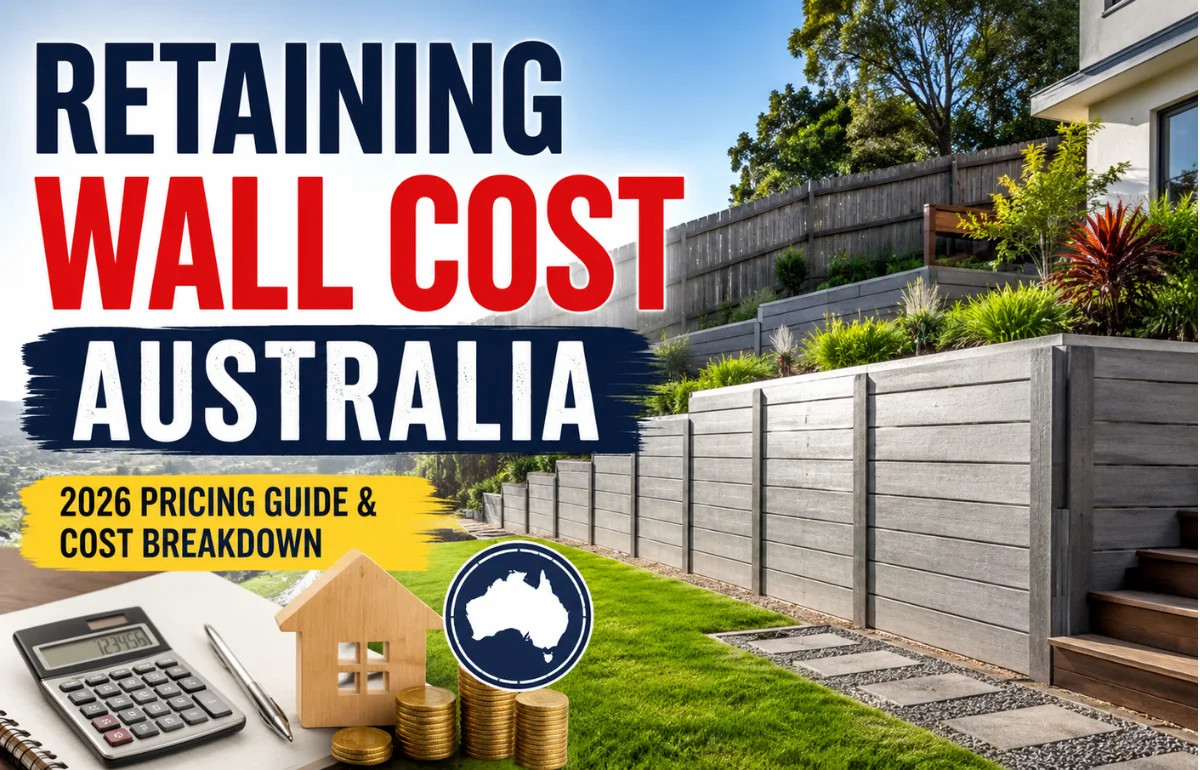
Retaining wall cost in Australia typically ranges from $1,000 for a small garden edging wall to over $20,000 for a large structural boundary wall, with most homeowners paying somewhere between $250 and $700 per square metre depending on the material, height, and site conditions.
A retaining wall is a structure built to hold back soil on a sloped block, stop erosion, or create usable flat space in a yard. The final price comes down to three things: what it’s made from, how big it is, and how complicated your site is to work with.
I’ve spent a fair bit of time around renovation projects and talking to builders about exactly this question, and the honest answer is that nobody can give you a single number without knowing your block.
Why Retaining Wall Pricing Is So Hard to Pin Down
I remember the first time a friend asked me to help her get quotes for a retaining wall along her back fence in outer Melbourne. We had three contractors come through, and the quotes ranged from $4,200 to $11,800 for what looked, on paper, like the same job. That gap isn’t unusual, and it’s exactly why so many people get frustrated trying to find a straight answer online.
The reason for the spread is that a retaining wall quote isn’t really pricing a “wall” — it’s pricing a whole list of variables that interact with each other. Height changes whether you need engineering. Soil type changes how much excavation and drainage work is needed. Access changes whether machinery can get in or whether everything has to be done by hand. Even the direction the slope faces can matter, because water runoff behaves differently depending on the terrain.
So when you’re researching retaining wall cost Australia-wide, treat any number you find as a starting point for a conversation with a builder, not a final figure.
Average Retaining Wall Cost in Australia by Material
Material is usually the biggest single factor in your final price, so it’s worth understanding the trade-offs before you fall in love with a particular look.
Timber Sleeper Retaining Walls
Timber is still the most common choice for smaller, budget-conscious projects, and I get why — it looks warm, it’s relatively quick to install, and it’s the cheapest option upfront. Treated pine sleepers generally cost between $250 and $400 per square metre installed, while hardwood sleepers sit a bit higher, often $300 to $450 per square metre, because the timber itself costs more and is heavier to handle.
The catch with timber is longevity. Even treated pine (look for H4-rated timber if you go this route) tends to last somewhere between 15 and 25 years before rot or termite damage starts to show, especially in wetter climates like parts of Queensland or coastal New South Wales. I’ve seen timber walls in Perth’s drier climate hold up noticeably longer than similar walls in Brisbane, simply because there’s less moisture working against the wood year-round.
Concrete Sleeper Retaining Walls
Concrete sleepers have become the go-to choice for a lot of Australian homeowners over the last decade, and after watching a few of these go up, I understand the appeal. They’re priced higher than timber, generally $400 to $700 per square metre, but they come with a lifespan that can stretch past 50 years when installed properly with galvanised steel posts.
For anyone weighing this up, the maths usually favours concrete if you’re planning to stay in the home long-term, since you’re not facing a rebuild in 15 to 20 years like you might with timber.
Besser Block (Concrete Block) Retaining Walls
Besser blocks sit in the middle of the pricing spectrum, usually landing between $300 and $550 per square metre. They’re popular for DIY-friendly jobs because the blocks are modular and relatively easy to stack, though a structural wall using Besser blocks still needs proper reinforcement, footings, and core-filling to perform well over time.
Stone and Brick Retaining Walls
Natural stone, whether it’s sandstone, granite, or a stacked boulder wall, tends to be the most expensive option, often ranging from $400 right up to $900 or more per square metre. Brick retaining walls land in a similar bracket, particularly if you want a finish that matches existing brickwork on the house. These materials are usually chosen for visual impact rather than budget, especially on front-of-house or feature walls where the retaining structure is meant to be seen, not just functional.
Gabion Wall Retaining Walls
Gabion walls (wire cages filled with rock) have grown in popularity, particularly for rural properties or anyone wanting a more industrial, textured look. Pricing usually sits between $250 and $450 per square metre, and one underrated advantage is drainage — because the structure is essentially a pile of loose rock in a cage, water moves through it far more freely than through a solid wall, which can reduce the risk of hydrostatic pressure building up behind it.
Comparison Table: Retaining Wall Material Costs in Australia
These figures are a general guide pulled together from typical market rates across Australian states, and your actual quote can sit outside these ranges depending on your specific site.
What Actually Drives Retaining Wall Cost in Australia
Height of the Wall
This is the single biggest cost lever, and it’s not a straight line — costs accelerate as height increases rather than rising evenly. A wall under 600mm is usually classed as low-risk and might not need any engineering input at all. Once you cross the 1-metre mark, most Australian councils require an engineer to certify the design, and that’s where costs jump noticeably, both from the engineering fee itself and from the extra materials and footing depth needed to handle the additional soil pressure.
A wall that’s 1.5 metres tall isn’t just 50% more expensive than a 1-metre wall — in my experience, helping friends price these out, it often ends up 80% to 100% more, because the engineering requirements, post depth, and concrete volumes all scale up together.
Length of the Wall
Length scales more predictably than height. A 10-metre wall will roughly double the materials cost of a 5-metre wall of the same height and material, though labour efficiencies sometimes bring the per-metre rate down slightly on longer runs, since the contractor isn’t repeating setup and pack-down costs as many times relative to the total job size.
Site Access and Terrain
This is the variable that surprises most homeowners. If a contractor can get a small excavator into your backyard, costs stay reasonable. If they have to hand-dig because the only access is through a narrow side gate, or because there’s no vehicle access at all, labour costs can climb by 30% to 60% on the same wall. I’ve seen this play out firsthand — a colleague’s renovation in a tightly packed inner-Sydney suburb ended up costing nearly double the original estimate purely because the excavator couldn’t fit through to the rear yard, and everything had to be barrowed in by hand.
Soil Type and Drainage Requirements
Clay-heavy soils, which are common across much of Melbourne and parts of Adelaide, hold water and expand and contract with moisture changes, which means retaining walls in these areas need more robust drainage systems behind them — usually a combination of agricultural pipe, gravel backfill, and geotextile fabric. Sandy soils drain more easily on their own but can be less stable for footings, sometimes requiring deeper or wider foundations to compensate.
Skipping proper drainage is one of the most common (and costly) mistakes I’ve seen on retaining wall jobs. Water that builds up behind a wall adds enormous pressure, and a wall that looked solid on installation day can start leaning or even collapsing within a few years if drainage wasn’t done properly. Budgeting for drainage isn’t optional if you want the wall to last — it’s part of what you’re paying for, even if it’s invisible once the job is finished.
Removal of an Existing Wall
If you’re replacing an old retaining wall rather than building on a clear site, expect to pay extra for demolition and disposal. Depending on the material and size of the existing structure, removal alone can add anywhere from $1,500 to $4,000 to your overall project, particularly if the old wall has timber posts set in concrete that need to be dug out.
Council Permits and Engineering Fees
In most states, walls over 1 metre, or walls near a property boundary where there’s a risk of affecting your neighbour’s land, will need council approval and a structural engineer’s certification. Engineering fees typically range from $300 for a straightforward small wall up to $1,000 or more for a larger or more complex one, and permit fees vary by council but often sit somewhere between $200 and $600.
It’s worth checking with your local council before you get quotes, because some areas have stricter rules than others, and a wall that doesn’t need approval in one council area might need it in the next suburb over.
Retaining Wall Cost Australia: Real Examples Based on Common Scenarios
To make this more concrete, here’s how the numbers tend to play out across a few common project sizes I’ve seen quoted or helped friends through.
A small garden retaining wall, around 6 metres long and 500mm high, using treated pine sleepers, typically lands somewhere between $1,200 and $2,200 fully installed, including basic drainage. This is the kind of project a confident DIYer could potentially handle themselves for materials cost alone, which would usually fall in the $400 to $700 range, but I’d still recommend getting professional input on drainage, even on small jobs.
A mid-sized structural wall, say 15 metres long and 1 metre high, using concrete sleepers with steel posts, generally runs between $9,000 and $14,000, factoring in the engineering certificate, proper footings, and full drainage behind the wall. This is the bracket where I’d strongly suggest not cutting corners on engineering, because a 1-metre wall holding back a sloped yard is carrying a real structural load.
A larger boundary retaining wall, around 30 to 40 metres long and varying between 1 and 1.8 metres in height, can range anywhere from $25,000 to $60,000 depending on material choice, access, and how much excavation is involved. These bigger jobs are also where you’re most likely to need to coordinate with neighbours, particularly if the wall sits on or near a shared boundary, since most states require formal notice to adjoining property owners before construction on a boundary wall begins.
DIY vs Hiring a Professional: What You’re Actually Saving
I’ll be upfront here — I think DIY retaining walls have their place, but only within a fairly narrow set of conditions. If your wall is under 600mm and isn’t holding back a slope that could affect a structure, fence, or neighbouring property, doing it yourself can genuinely save you 50% to 60% of the total cost, since labour is usually the bigger portion of any retaining wall quote.
Once you go beyond that, the maths flips. A failed DIY retaining wall doesn’t just cost you the materials you’ve wasted — it can cause soil movement, damage to fencing, drainage problems, and in some cases damage to a neighbour’s property, which then becomes a legal and financial headache on top of the rebuild cost. I’ve seen a case where a homeowner’s DIY timber wall failed within two years because there was no drainage behind it at all, and the eventual fix, including removing the collapsed wall and rebuilding properly with engineering, cost more than double what a professional installation would have cost from the start.
If you’re weighing up whether to tackle a renovation project like this yourself, it’s worth getting a feel for the scope of work involved before committing. Some platforms offer practical renovation education that walks through exactly this kind of decision-making, which can be a useful way to figure out whether a project is genuinely DIY-friendly or better left to a professional, before you’ve already bought materials and started digging.
How to Get an Accurate Retaining Wall Quote
Based on what I’ve seen go right and wrong with quoting, a few things consistently lead to more accurate, comparable quotes from different builders.
Always get at least three quotes, and make sure each contractor is pricing the same scope of work. It’s surprisingly common for one quote to include drainage and removal of an existing wall while another doesn’t, which makes the cheaper quote look better on paper without actually being a fair comparison.
Ask specifically whether the quote includes council permit costs, engineering fees, drainage materials, and disposal of excavated soil. These are the line items most likely to be missing from a low-ball quote, only to show up later as “extras.”
Get a clear answer on warranty terms, particularly for the steel posts or reinforcement if you’re going with concrete sleepers, since galvanised steel can still corrode over time in coastal areas with high salt exposure.
Find out who’s responsible if underground services are hit during excavation. A proper builder should be organising a Before You Dig Australia search before any digging starts, and you want that confirmed upfront rather than discovered as an issue mid-project.
Retaining Wall Costs by Australian City
Labour rates and material availability shift the price noticeably depending on where you are in the country. Sydney and Melbourne tend to sit at the higher end due to labour costs and council compliance requirements, while regional areas and cities like Perth and Adelaide often come in somewhat lower, partly because of lower labour rates and partly because some councils have simpler approval processes for smaller walls.
As a rough guide, Melbourne and Sydney jobs often run 15% to 25% higher than equivalent projects in Adelaide or regional Victoria, while Brisbane and Perth tend to sit somewhere in between. Local supply of materials matters too — concrete sleepers are widely manufactured in Victoria, for instance, which can make them comparatively cheaper there than in states where they need to be freighted further.
Maintenance Costs You Should Factor In
A retaining wall isn’t a one-off cost, even though most people budget for it that way. Drainage pipes can clog with sediment over time and may need clearing every five to ten years, particularly in clay-heavy soils. Timber walls need periodic checks for rot, especially near ground level, where moisture sits longest. Concrete sleeper walls hold up well structurally, but the steel posts are worth a visual inspection every few years, particularly in coastal regions where salt air accelerates corrosion.
Budgeting an extra few hundred dollars every five years or so for inspection and minor maintenance is a sensible approach, and it’s far cheaper than discovering a drainage failure after it’s already caused damage to the wall or the soil behind it.
Retaining Wall Cost Australia: Key Takeaways for Your Project
If there’s one thing I’d want every Australian homeowner to take away from researching retaining wall cost, it’s that the cheapest quote isn’t always the best value, and the most expensive material isn’t always the right choice for your situation. A timber wall that lasts 20 years might genuinely suit a rental property or a section of garden you’re not precious about, while a concrete sleeper wall makes more financial sense for a forever home or a structural wall holding back a significant slope.
Get the height and engineering requirements sorted first, because that determines almost everything else about your budget. Then choose a material that matches both your aesthetic preference and how long you actually need the wall to last. And don’t skip drainage, no matter which material you go with, because it’s the single factor most likely to determine whether your wall is still standing properly in fifteen years or needs an expensive rebuild.
If you’re in the middle of planning a broader backyard or landscaping project and want guidance that goes beyond just the retaining wall itself, our home makeover services are set up to help homeowners think through these kinds of decisions as part of a complete renovation plan, rather than tackling each element in isolation. Getting the full picture early on tends to save both money and headaches down the track.
FAQs About Retaining Wall Cost Australia
How much does a retaining wall cost per metre in Australia?
Most retaining walls cost between $250 and $700 per square metre installed, depending on the material chosen and the height of the wall.
Do I need council approval for a retaining wall in Australia?
Generally, yes, if the wall is 1 metre or taller, or sits near a property boundary where it could affect a neighbour’s land, though exact rules vary by council.
What is the cheapest material for a retaining wall?
Treated pine timber sleepers are usually the cheapest option, typically costing $250 to $400 per square metre installed.
How long do retaining walls last in Australia?
Lifespan depends on material: timber walls last roughly 15 to 25 years, while concrete sleeper or stone walls can last 40 to 60 years or more with proper drainage.
Can I build a retaining wall myself to save money?
Small walls under 600mm with no structural load can often be DIY-built safely, but taller or boundary-adjacent walls should be left to a professional due to engineering and legal requirements.
Other Retaining Resources

I’m Salman Khayam, the founder and editor of this blog, with 10 years of professional experience in Architecture, Interior Design, Home Improvement, and Real Estate. I provide expert advice and practical tips on a wide range of topics, including Solar Panel installation, Garage Solutions, Moving tips, as well as Cleaning and Pest Control, helping you create functional, stylish, and sustainable spaces that enhance your daily life.