
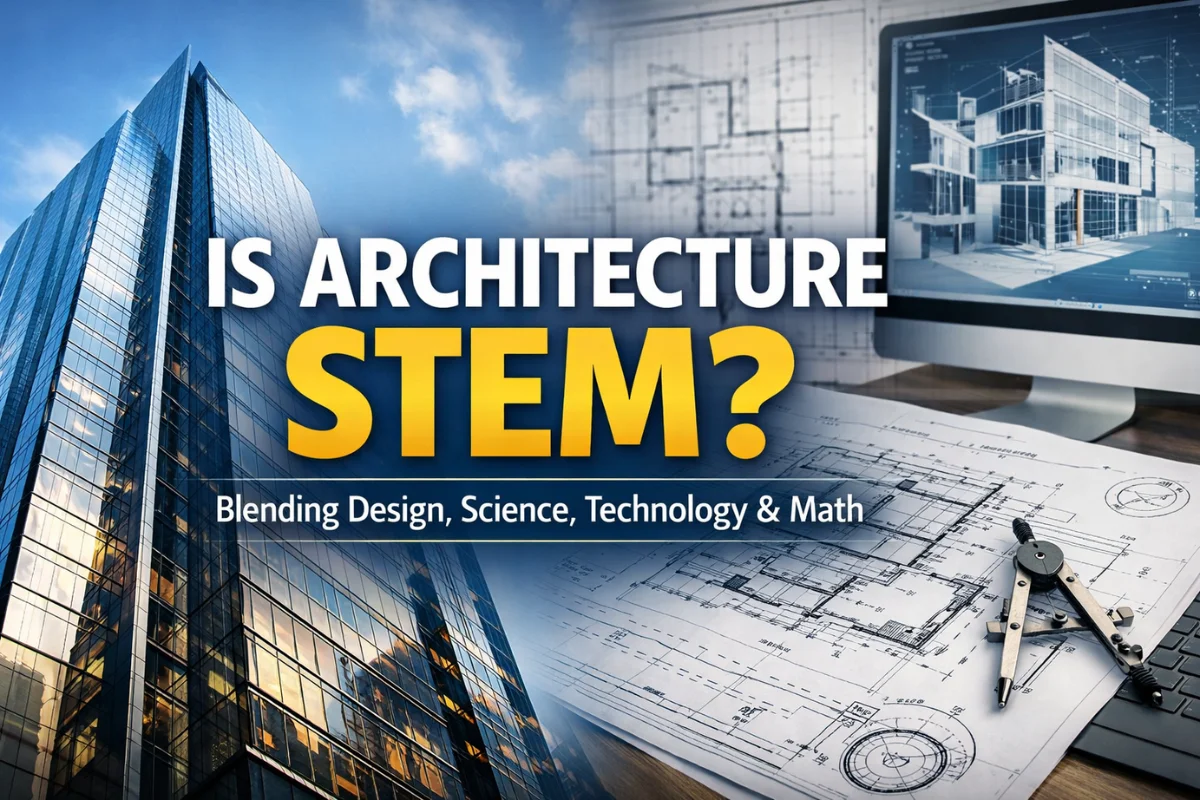
If you’ve ever stood at the base of a towering skyscraper and felt something — awe, curiosity, maybe a little discomfort — you’ve experienced architecture doing exactly what it’s supposed to do. But here’s a question that doesn’t get nearly enough attention outside of academic circles: Is architecture STEM? The answer matters more than you might think, and not just philosophically. It shapes how architecture is funded, taught, and valued as a profession. My take? Architecture is undeniably a STEM discipline — and it always has been, long before anyone made it official.
Is Architecture STEM or Art? The Old Debate Explained
Architecture has been caught between two worlds for centuries. On one side, you have the romantic vision of the architect as a creative genius — sketching bold forms, playing with light, shaping how people feel in a space. On the other hand, you have the cold, precise reality: load calculations, thermal performance, drainage systems, and building codes that run hundreds of pages long.
Neither side wins this debate, because both are right. Architecture is simultaneously a fine art and an applied science, and pretending otherwise does a disservice to both the profession and the people who train for it. The real question isn’t whether architecture is creative or technical — it’s whether the technical rigor it demands qualifies it as a STEM field. And that answer, increasingly, is a firm yes.
When Was Architecture Officially Recognized as a STEM Field?
The formal recognition came in 2018, when the U.S. Congress officially designated architecture as a STEM subject. This wasn’t a ceremonial gesture — it was a policy shift with direct consequences for how architecture education is funded, how students access scholarships, and how the profession is perceived in broader workforce conversations.
The designation acknowledged what practitioners had known for decades: that designing a building requires the same rigorous analytical thinking as engineering, environmental science, and applied mathematics. It also opened doors for architecture students to access STEM-specific grants and financial aid programs, which is no small thing given the cost and duration of architecture education — typically a five-year professional degree at minimum, often followed by years of licensure preparation.
The American Institute of Architects (AIA) and the National Architectural Accrediting Board (NAAB) had long advocated for this recognition, arguing that architecture programs already taught physics, structural systems, environmental science, and digital modeling at a level comparable to any STEM-designated discipline.
How Architecture Qualifies as a STEM Discipline: The Four Pillars
So what actually makes architecture STEM? Let me break it down across each pillar.
Science: Why Architecture Is a STEM Field at Its Core
Architects work with the physical world in ways that demand genuine scientific understanding. Material science is central — you need to know how concrete behaves under compression, how steel expands with heat, how timber responds to moisture over decades. Environmental science shapes decisions around daylighting, passive cooling, stormwater management, and indoor air quality. Understanding thermodynamics isn’t optional when you’re designing a building envelope that needs to stay comfortable across seasonal extremes.
Physics underpins it all. Every structural decision — the span of a beam, the depth of a foundation, the thickness of a shear wall — involves applied physics, even when the architect delegates the final calculations to a structural engineer.
Technology: The Digital Tools That Make Architecture STEM
Modern architectural practice is deeply technology-driven. Computer-aided design (CAD) software replaced drafting boards decades ago, and today, building information modeling (BIM) platforms like Revit allow architects to create fully coordinated digital models that integrate structural, mechanical, electrical, and plumbing systems before a single shovel breaks ground.
Beyond BIM, parametric design tools like Grasshopper enable architects to generate and test complex geometries based on mathematical rules. Energy modeling software simulates how a building will perform thermally and energetically. Computational fluid dynamics tools analyze airflow. Virtual reality is increasingly used both in design review and in client presentations. The technology stack in a contemporary architecture firm rivals that of many engineering companies.
Engineering: The Technical Backbone of Architectural Practice
Architects don’t typically stamp structural or mechanical drawings — that’s what licensed engineers do. But architects need to understand engineering well enough to make informed design decisions, coordinate across disciplines, and avoid producing designs that are structurally or mechanically impossible. Sizing a structural bay, understanding the implications of a transfer beam, knowing when a building will need a mechanical penthouse versus distributed rooftop units — these are architectural judgments that require engineering literacy.
The coordination role of the architect is, in many ways, the most technically demanding part of the job. On a complex project, the architect is the integrating intelligence that holds together the work of structural, civil, mechanical, electrical, plumbing, fire protection, and façade engineers, among others.
Mathematics: The Hidden Language of Architecture as a STEM Subject
Geometry is the most obvious application — architecture is spatial design, and spatial design is fundamentally mathematical. But the math goes further: calculating material quantities, verifying structural proportions, modeling acoustic performance, ensuring accessibility compliance through precise dimensional coordination. Trigonometry appears in roof framing; algebra underlies energy calculations; calculus-based reasoning shows up in advanced structural analysis.
Mathematical proportioning systems have also been a deliberate design tool throughout architectural history, from the golden ratio in classical Greek temples to Le Corbusier’s Modulor system in the twentieth century.
Is Architecture a STEM Field? Comparing It to Other Disciplines
To understand where architecture sits within the STEM ecosystem, it helps to compare it directly with adjacent disciplines.
| Discipline | Core Focus | Creative Component | Technical Rigor | STEM Designation |
|---|---|---|---|---|
| Architecture | Built environment design | High | High | Yes (2018) |
| Civil Engineering | Infrastructure systems | Low–Medium | Very High | Yes |
| Interior Design | Interior space planning | High | Medium–High | Partial |
| Urban Planning | Land use and policy | Medium | Medium–High | Varies by program |
| Mechanical Engineering | Mechanical systems | Low | Very High | Yes |
| Landscape Architecture | Outdoor environments | High | High | Partial |
What this table makes clear is that architecture occupies a unique position: it matches or exceeds other STEM fields in creative demand while maintaining comparable technical depth. That combination — rather than being a weakness in its STEM case — is actually what makes architecture distinctive.
Real-World STEM Skills Architecture Requires Every Day
It’s worth getting specific about what STEM skills actually look like in daily architectural practice, because the abstract case is less convincing than the concrete one.
Structural Coordination: Where Architecture Meets Engineering STEM
Before a structural engineer finalizes sizing, the architect is already making structural decisions through the design. Choosing a column grid, planning a long-span roof, and integrating exposed concrete — all of these require an intuitive grasp of structural behavior. I’ve seen projects where early structural naivety in the design phase cost weeks of redesign down the line. Structural literacy saves time, money, and credibility.
Energy Modeling and Sustainability in STEM-Based Architecture
Net-zero buildings don’t happen by accident. They require energy modeling, envelope optimization, solar analysis, and careful coordination between passive and active systems. Architects are increasingly expected to lead sustainability strategy, which demands command of environmental science concepts and the software tools used to simulate building performance.
Digital Fabrication
Computational design has moved from academic novelty to professional standard. Parametric modeling, CNC fabrication, and algorithmic design tools are now taught in most accredited architecture programs. The math underlying these tools — linear algebra, calculus, computational geometry — is graduate-level STEM content by any measure.
Site and Civil Coordination
Reading topographic surveys, understanding grading and drainage, coordinating with civil engineers on utility connections — this is routine work in architectural practice that draws on applied earth science and civil engineering principles.
Architecture STEM Career Paths That Blend Technical and Creative Skills

One of the strongest arguments for architecture’s STEM status is the sheer range of technically demanding specializations within the field.
Residential Architecture
Designing homes is technically demanding in ways that aren’t always visible. Residential architects work with structural engineers on wood framing, seismic bracing, and foundation systems. They coordinate mechanical systems in tight spaces. They navigate energy codes that are becoming more stringent every cycle. And they do all of this while designing spaces where families will actually live — which means the human, experiential side of the work never disappears.
Hospitality Architecture
Hotels, resorts, and restaurants bring unique technical challenges alongside the experiential design demands. Wayfinding, acoustic separation between rooms, fire egress in complex multi-story layouts, back-of-house operational efficiency — hospitality architecture requires both a sophisticated understanding of building systems and an acute sensitivity to how guests move through and experience space.
Interior Architecture
The best interior designers understand what’s behind the walls — structural columns, mechanical chases, electrical panels — because working around these systems intelligently is what separates good space planning from great space planning. Interior architecture increasingly incorporates lighting science, acoustics, and material performance data alongside the aesthetic sensibility most people associate with the field.
Landscape Architecture
Landscape architects are applied scientists as much as they are designers. Hydrology, soil science, ecology, and urban heat island mitigation are all in scope. Designing a park in a dense urban environment means managing stormwater, supporting biodiversity, and creating thermal comfort — problems that require scientific rigor as much as design vision.
Why the Architecture STEM Designation Matters for Education and Careers

The implications of architecture’s formal STEM recognition extend well beyond semantics.
- For students, STEM classification means access to a broader pool of scholarships, grants, and visa pathways (including OPT extensions for international students in the U.S.), which makes a long and expensive education slightly more accessible.
- For educators, STEM recognition supports curriculum investment in computational design, environmental systems, and research — areas that have historically been underfunded in architecture schools compared to studio coursework.
- For the profession, alignment with STEM disciplines positions architects to engage more credibly in policy conversations about infrastructure, climate resilience, housing, and urban development — areas where technical expertise is increasingly expected at the table.
- For public perception, the STEM designation helps address a persistent undervaluation of the technical complexity of architectural work. Architecture is often seen as a luxury profession — something you hire when you want things to look nice. The reality is that architects are managing complex technical systems, legal liability, and public safety every time they put their stamp on a set of drawings.
FAQt Architecture as a STEM Field
1. Is architecture considered a STEM major?
Yes. Since 2018, architecture has been officially recognized as a STEM field by the U.S. Congress, making architecture students eligible for STEM-specific financial aid and visa benefits.
2. Do architects need to be good at math?
Absolutely. Geometry, algebra, trigonometry, and increasingly computational math are all part of architectural practice — from space planning and structural coordination to digital fabrication and energy modeling.
3. Is architecture more creative or technical?
It’s genuinely both, and the balance shifts depending on the project phase and specialization. Early design phases are more creatively driven; construction documentation and technical coordination are heavily analytical.
4. Can architecture students apply for STEM scholarships?
Yes. The 2018 STEM designation means architecture students can apply for scholarships, grants, and fellowships that are open to STEM fields — check with your institution and national organizations like the AIA and NCARB for specific opportunities.
5. What technology do architects use that qualifies as STEM?
Architects routinely use BIM software (like Revit), parametric design tools (like Grasshopper), energy modeling platforms, structural analysis software, and increasingly, AI-assisted design tools — all of which require technical proficiency comparable to engineering and computer science disciplines.
Final Thoughts: Is Architecture STEM? Here’s the Answer
The question “Is architecture STEM?” has a clear answer: yes, and the recognition is overdue. Architecture has always required the kind of rigorous, science-based thinking that defines STEM disciplines — it just also requires the creative vision that most STEM fields don’t. That’s not a contradiction. It’s what makes architecture one of the most demanding and rewarding professions in existence.
If you’re considering architecture as a career path, don’t let anyone tell you it’s “just design.” You’ll be doing physics, material science, environmental modeling, and digital fabrication alongside your design work. And if you’re already in the field, the STEM designation is an invitation to stake a stronger claim in conversations about research funding, public policy, and the future of the built environment.
The blueprint for how we live, work, and gather is drawn by people who think in both dimensions — and that’s exactly where architecture belongs.

I’m Salman Khayam, the founder and editor of this blog, with 10 years of professional experience in Architecture, Interior Design, Home Improvement, and Real Estate. I provide expert advice and practical tips on a wide range of topics, including Solar Panel installation, Garage Solutions, Moving tips, as well as Cleaning and Pest Control, helping you create functional, stylish, and sustainable spaces that enhance your daily life.