I first stumbled across the word Piçada while reading a Portuguese novel set in the rural countryside. The character was describing an old path used by cattle, worn into the earth over decades. The translator had rendered the word as “footprints,” but something about the original term kept tugging at me. When I finally looked it up, I realized why. Piçada is one of those rare words that refuse to be confined to a simple dictionary definition.
At first glance, Piçada translates to footstep or footprint. That much is straightforward. But the more I dug into how native speakers use it, the clearer it became that this word carries layers of meaning that English can only approximate with multiple terms. Movement, presence, memory, and even the slow creation of a path over time—all of that lives inside Piçada.
Over the next few minutes, I want to walk you through everything I have learned about this fascinating term. We will look at where it comes from, how it functions in both literal and figurative language, and why it matters for anyone who loves digging into the hidden corners of a foreign tongue.
What Piçada Really Means in Everyday Language
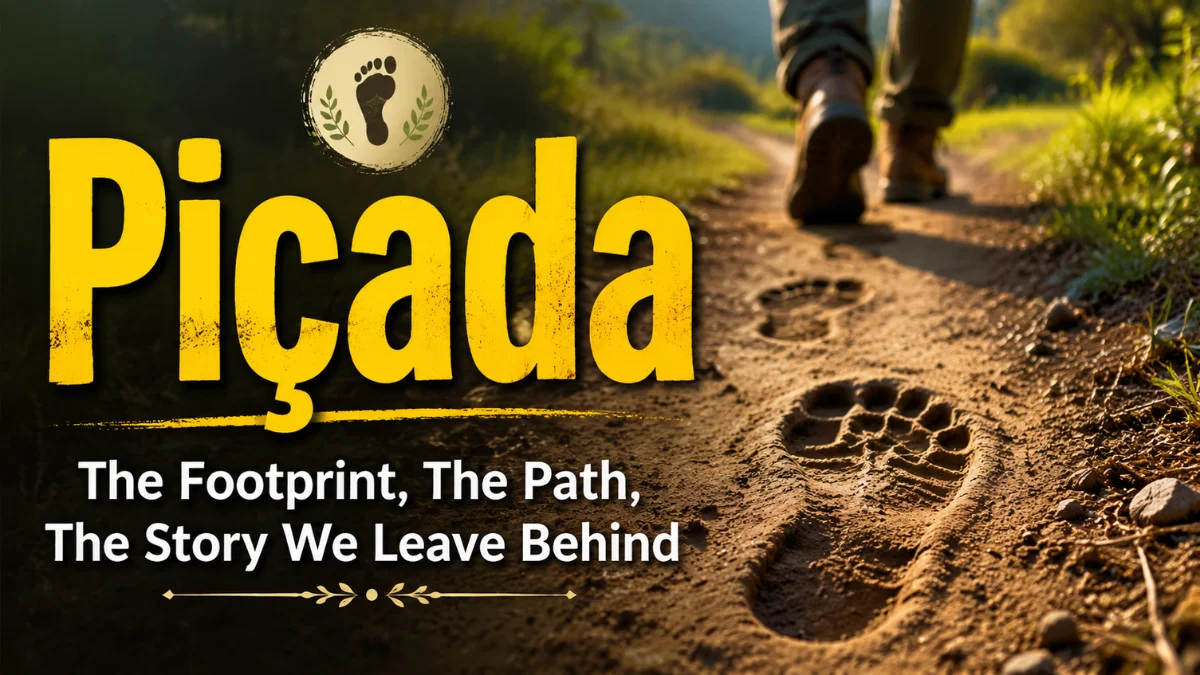
When someone in a Portuguese-speaking region points to the ground and says Piçada, they are usually talking about a visible mark left by a foot. That could be a print in fresh mud after a rainstorm, an impression in loose soil near a riverbank, or even a scuff on a dusty floor. The literal meaning is concrete and easy to grasp.
But here is where things get interesting. Piçada does not just describe a static print. It also carries a sense of the action that created it. The stepping, the pressing down, the transfer of weight from body to ground—all of that is implied. In English, we would need a phrase like “the mark from a footstep” to capture the same idea. Portuguese packs it into a single word.
I have noticed that people who work closely with the land tend to use Piçada most naturally. Farmers, hunters, and shepherds rely on it to describe trails left by repeated movement. A single footprint is one thing. A Piçada that appears day after day in the same spot turns into something else entirely. It becomes evidence of habit, routine, or the quiet passage of animals through a forest.
That evolution from a single mark to a worn trail is central to understanding this word. Piçada can refer to the path itself, the visible result of many footsteps layering on top of each other over weeks or years. English has words like track, trail, or worn path, but each of those misses something. Piçada retains a sense of living process. The path is still being walked. The story is still unfolding.
Where Piçada Comes From: The Verb Pisar
To really get Piçada, you have to look at its parent verb: pisar. This is a common Portuguese verb that means to step on, to tread, or to trample. It has a physical, grounded feeling to it. When you pisar something, you are actively placing your foot down with intention or weight.
Portuguese has a wonderful habit of turning verbs into nouns that capture both the action and its result. Piçada follows that pattern perfectly. The suffix -ada generally indicates the outcome or product of the verb’s action. So from pisar, you get Piçada. The stepping itself, plus whatever that stepping leaves behind.
Grammatically, Piçada is a feminine noun. That matters when you are forming sentences in Portuguese because articles and adjectives need to agree. You would say a Piçada instead of o Piçada, and any adjective describing it would take the feminine form. For English speakers learning the language, this is just one of those details that becomes second nature with practice. But getting it right signals that you understand the word as a native would.
I have always appreciated how this linguistic structure gives Piçada a kind of double life. It is simultaneously an event and an object. The act of stepping is temporary, but the mark it leaves can last for days, months, or even years. That duality makes the word surprisingly versatile.
The Cultural Weight of Piçada in Rural Life
Spend any time in the Portuguese countryside, and you will hear Piçada used in ways that city dwellers might find surprising. For rural communities, reading Piçadas is a practical skill. A farmer inspecting a field can look at the ground and know exactly what has passed through overnight. The depth of a print, the spacing between steps, the way the earth has been displaced—all of that information is encoded in the Piçada.
I once spoke with an older farmer in northern Portugal who told me he could distinguish his own sheep from a neighbor’s just by the Piçadas they left behind. Different weights, different gaits, different habits of movement. To him, the ground was a readable surface, and Piçada was the alphabet.
That kind of knowledge is disappearing in many parts of the world, but it survives in the language. Words like Piçada preserve ways of seeing that are intimately connected to the natural world. When you say Piçada, you are not just describing a mark. You are acknowledging a relationship between living things and the earth they move across.
This practical use extends to hunting as well. Hunters track game by looking for Piçadas in soft ground near water sources or feeding areas. The word becomes a tool for survival. And because the same term works for both human and animal footsteps, it reinforces a sense of shared space. We all leave Piçadas. The ground does not care whether the foot that made them had hooves or shoes.
Piçada as Metaphor: Memory, Destiny, and Influence
The symbolic uses of Piçada are where this word truly shines. Portuguese literature, particularly poetry and reflective prose, frequently reaches for Piçada to express ideas about impermanence, legacy, and the traces we leave behind.
Think about it this way. Every person moves through life making choices, meeting people, affecting circumstances. Most of those effects are invisible, lost to time. But some leave marks. A kind word that changes someone’s direction. A decision that clears a path for others to follow. An influence that echoes across years. Those are metaphorical Piçadas.
I have read poems where Piçada represents the faint evidence of a departed loved one. The idea that even after someone is gone, you can still see where they walked, still feel the shape of their presence pressed into the soft earth of your memory. That is heartbreaking and beautiful at the same time.
Other writers use Piçada to talk about destiny. The idea that life is a path we are constantly marking, and that our future selves will look back at the Piçadas we are leaving today. That interpretation carries a sense of responsibility. Every step matters. Every choice leaves a trace.
This metaphorical flexibility makes Piçada a favorite among lyric poets and literary novelists. It can be tender or ominous, hopeful or resigned, depending entirely on context. And because the literal meaning is so grounded in physical reality, the metaphor never feels abstract or pretentious. You always have the image of an actual footstep in your mind.
Piçada in Modern Portuguese Conversation
You might be wondering whether anyone actually says Piçada in everyday speech anymore. The answer is yes, but with some important qualifications.
In rural regions, Piçada remains completely natural and common. People use it to describe muddy footprints on a kitchen floor, the trail of a stray dog through a vegetable garden, or the path worn between a house and a barn. It is not a fancy or literary word in those contexts. It is just the right word.
In urban areas like Lisbon or São Paulo, Piçada is less frequent but far from extinct. City dwellers might use it when telling a story about a rainy day that left footprints through an apartment. Or when describing a hidden garden where the grass has been worn away by repeated steps. It carries a slightly more traditional or poetic flavor in the city, which actually makes it a nice choice for writers or speakers who want to add texture to their language.
Younger speakers sometimes gravitate toward pegada, which is a related word that has taken on additional slang meanings in Brazilian Portuguese. Pegada can mean grip, intensity, or even a catchy musical rhythm. But Piçada has stayed closer to its original sense. It has not drifted into slang territory, which means it remains clear and precise when you want to talk about literal footsteps or trails.
I have noticed that Portuguese speakers from the Azores and Madeira use Piçada more frequently than mainland urbanites. The island landscapes, with their volcanic soil and winding pastoral paths, seem to keep the word alive in daily use. Regional variations like this are one of the joys of learning Portuguese. The language shifts and breathes differently across different communities.
Piçada Versus Related Words: A Quick Comparison
To really understand Piçada, it helps to place it alongside similar words. Portuguese has a rich vocabulary for describing interactions between feet and ground, and each term has its own shade of meaning.
Pegada is the closest relative. It also means footprint or track, and in many contexts, pegada and Piçada can be used interchangeably. But pegada has a slightly broader range. It can refer to the sole of a foot, the act of gripping with the toes, or even the impression left by a hand in some specialized contexts. Piçada stays more focused on the footstep itself and the repetitive action of walking.
Rasto or rastro means trail, track, or trace. This word often implies something that has been left behind by a moving animal or person, but it does not carry the same sense of individual footsteps. Rastro could be a scent trail, a broken branch, or disturbed vegetation. Piçada is more specific. It is about direct impressions in the ground.
Trilha means trail or path, but usually refers to an established route rather than the marks that compose it. You walk on a trilha. You read the Piçadas that make it up. The two words complement each other nicely.
For English speakers learning Portuguese, understanding these distinctions helps you choose the right word for the right situation. Piçada is your choice when you want to emphasize the footsteps themselves, especially if they form a visible pattern or repeated path.
Why Language Learners Should Care About Piçada
I have taught Portuguese to English speakers on and off for years, and I always make a point of introducing words like Piçada early. Not because they are the most common vocabulary, but because they teach an important lesson about how language works.
The mistake that beginners make is assuming every word has a one-to-one translation. Footprint equals Piçada. Case closed. But that approach misses everything interesting about language. The real meaning lives in the associations, the cultural context, the history of how the word has been used.
Learning Piçada forces you to think in a more Portuguese way. You start noticing that the language often combines action and result into a single term where English would use two or three words. That pattern shows up everywhere once you know to look for it. Portuguese is efficient in ways that English is not, and Piçada is a perfect example.
For translators, Piçada presents an interesting challenge. A direct translation as a footprint will work in many cases. But sometimes the context calls for trail, or track, or even path. And in metaphorical passages, you might need to completely rephrase the sentence to capture the same feeling. A good translator does not just swap words. They rebuild meaning in the target language. Piçada teaches that lesson better than a hundred textbook exercises.
I also think there is value in learning less common words because they stick in your memory differently. Everyone memorizes hello, goodbye, please, and thank you. Those are automatic. But a word like Piçada, with its earthy feel and layered meaning, becomes a hook that your brain latches onto. Every time you see a footprint in wet soil or a worn path through grass, you will think of Piçada. And that kind of lasting connection is what real language acquisition looks like.
The Digital Life of Piçada: Footprints in the Virtual World
Here is a development that would have surprised earlier generations. Piçada has recently taken on a small but interesting role in discussions about digital life.
Portuguese speakers writing about online privacy, data traces, and digital identity have started using Piçada as a metaphor for the crumbs we leave behind as we move through the internet. Every website you visit, every search you perform, every link you click creates a kind of digital Piçada. Those marks accumulate over time, forming a trail that companies and algorithms can read.
The metaphor works beautifully because it preserves the original word’s sense of involuntary evidence. Just as you cannot walk across muddy ground without leaving Piçadas, you cannot browse the web without generating data traces. The digital Piçadas are not always visible to you, but they are there, pressed into the soft infrastructure of servers and databases.
This usage is still emerging, mostly in tech journalism and academic writing about digital rights. But I suspect it will grow. There is something satisfying about taking an old, rural word and applying it to the most modern of contexts. It proves that Piçada is not a relic. It is a living word that can stretch to meet new realities.
Practical Tips for Using Piçada Correctly
If you are learning Portuguese and want to start using Piçada in your own speech or writing, here is what I have learned from watching native speakers.
First, use Piçada when you are talking about visible marks on a surface that can hold an impression. Soil, sand, mud, snow, and soft grass are all classic contexts. You would not typically use Piçada for a footprint on concrete or hardwood flooring, because those surfaces do not hold a lasting impression in the same way.
Second, Piçada works well when you want to emphasize the repetitive nature of footsteps. A single accidental print might just be a pegada. But a path that forms from people walking the same route every day is a Piçada. That repeated action is part of the word’s core meaning.
Third, do not be afraid to use Piçada metaphorically in your own writing. One of the signs of advanced language ability is playing with words in creative but understandable ways. If you want to say that a past event left a lasting mark on someone’s character, try calling that mark a Piçada. Native speakers will understand what you mean, and they will probably appreciate the imagery.
Finally, pay attention to pronunciation. Piçada has a soft s sound on the ç, almost like the s in measure. The first syllable is stressed. Pee-sah-dah, but with that soft s in the middle. Getting the pronunciation right helps you sound more natural and confident.
Common Mistakes to Avoid With Piçada
Over the years, I have seen language learners make a few predictable errors with Piçada. Here is what to watch out for.
Do not confuse Piçada with pisada. Pisada exists in Portuguese, but it generally refers to the act of stepping or trampling rather than the mark left behind. The difference is subtle but real. Think of pisada as the action, and Piçada as the evidence of that action having occurred.
Avoid using Piçada for footprints that are not clearly defined. A vague smudge or scuff mark is not really a Piçada. The word implies a recognizable shape, something you could point to and say, yes, that is where a foot landed.
Also, resist the temptation to overuse Piçada in urban settings where other words would sound more natural. If you are describing the footprints of someone who walked through a puddle and then across a tile floor, those marks might be pegadas or marcas rather than Piçadas. Save Piçada for situations where the ground is soft and the impression is clear.
None of these are hard rules. Language is flexible, and different speakers have different instincts. But following these guidelines will help you sound more like a native and less like a textbook.
Why Piçada Deserves a Place in Your Vocabulary
I have spent a lot of time thinking about why certain words from other languages resonate with me while others do not. Piçada is definitely in the first category. It has a physicality that you can almost feel. When I say Piçada, I imagine the give of damp earth under a boot heel. I imagine looking down and seeing the clear outline of a sole pressed into the ground. I imagine the quiet evidence of someone who passed this way and then kept moving.
That physical feeling is rare in language, especially in an age where so much communication happens on screens. Piçada pulls you back down to earth. It reminds you that people have bodies, that bodies move through space, and that movement leaves traces whether we intend it to or not.
There is also something humbling about Piçada. No matter how carefully you walk, you will leave marks. You cannot help it. And those marks will tell a story about you to anyone who knows how to read them. Your pace, your weight, your direction, your hesitations. All of it is there in the Piçada.
That humility extends to the metaphorical meaning as well. The influence you have on others, the paths you create or destroy, the memories you leave behind. Those are your Piçadas too. You do not get to choose whether to leave them. You only get to choose what kind of marks they are.
FAQs About Piçada
1. What exactly does Piçada mean in English?
Piçada most closely translates to footprint or footstep, but it often implies repeated action and can even mean a worn path or trail formed by many footsteps over time.
2. Is Piçada commonly used in modern Portuguese conversation?
Yes, especially in rural areas and natural settings, though urban speakers may prefer the related word pegada in casual conversation.
3. Can Piçada be used metaphorically in writing and speech?
Absolutely. Portuguese literature frequently uses Piçada to represent memory, legacy, influence, and the traces people leave behind on each other’s lives.
4. What is the difference between Piçada and pegada?
Pegada is a broader term that can mean footprint, grip, or intensity, while Piçada stays closer to the literal sense of a footstep mark and the path created by repeated walking.
5. Where does the word Piçada come from?
Piçada derives from the Portuguese verb pisar, meaning to step on or tread, with the suffix -ada indicating the result or product of that action.
The Lasting Impression of Piçada
Words like Piçada do not come along every day. Most vocabulary is functional, useful, and quickly forgotten. But this one stays with you. Once you understand what Piçada really means, you start seeing its relevance everywhere. In the worn grass beside a frequently opened gate. In the faint trail left by a pet moving through tall grass. In the invisible but undeniable marks you leave on the people whose lives intersect with your own.
I walked away from that Portuguese novel years ago with more than just a new word. I walked away with a different way of looking at the world. Every step matters. Every path tells a story. Every mark, no matter how small, is evidence of a life in motion.
If you are learning Portuguese, I hope you will make room for Piçada in your active vocabulary. Use it literally when the situation calls for it. Use it metaphorically when you want to add weight to your writing. And let it remind you that language, at its best, does not just name things. It helps you see them.
The next time you notice a footprint in soft ground or think about the influence you have had on someone else’s journey, remember Piçada. Better yet, share the word with someone who has never heard it before. That is how language stays alive. One conversation, one footstep, one Piçada at a time.
Learn about Misned

Julian Vane is a versatile writer at Wellbeing Makeover covering tech, health, and global culture. With years of experience across various industries, Julian brings a well-rounded perspective to lifestyle and business, helping readers stay informed and inspired in an ever-changing world.