
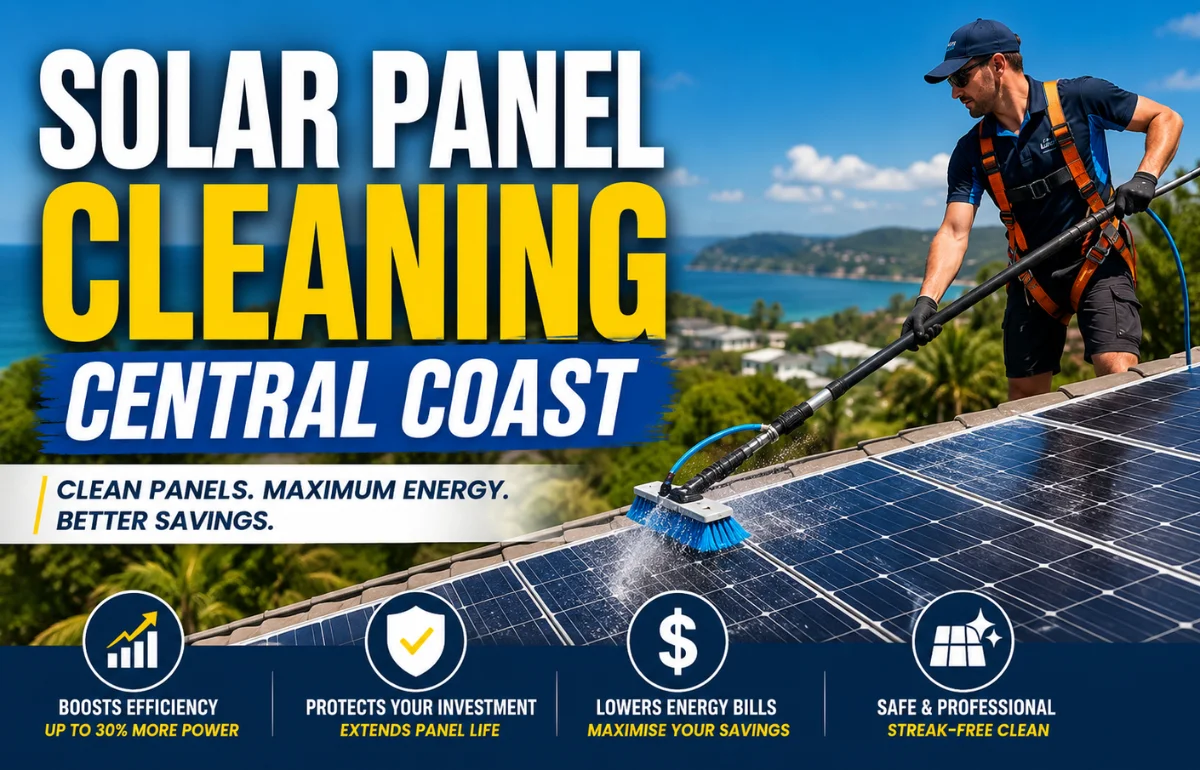
Solar panel cleaning Central Coast refers to the professional or DIY process of removing dirt, salt residue, bird droppings, lichen, and other accumulated debris from the surface of photovoltaic (PV) solar panels installed on homes and businesses along New South Wales’s Central Coast region. Because this stretch of coastline sits in a high-salt-air environment with significant wildlife activity and seasonal pollen, panels here degrade in efficiency faster than in drier inland areas if left unmaintained.
Regular cleaning — typically every six to twelve months — restores the panels’ ability to absorb maximum sunlight and, by extension, generate the electricity output your system was designed to deliver. It is not just a cosmetic exercise; it is a maintenance requirement with a direct impact on your energy bill and the lifespan of your investment.
Why the Central Coast Is a Particularly Demanding Environment for Solar Panels
I have spoken with quite a few homeowners across Gosford, Terrigal, Woy Woy, and The Entrance who installed solar systems and assumed, quite reasonably, that the coastal rain would do most of the cleaning work for them. It does not. And understanding why is the first step to protecting what is often a $6,000–$15,000 investment sitting on your roof.
The Central Coast presents a combination of environmental stressors that you simply do not get in the western suburbs of Sydney or in inland towns. Salt-laden sea air settles on panel surfaces and, when it dries, leaves a white mineral film that scatters incoming light before it even reaches the photovoltaic cells. Combine that with the region’s abundance of gum trees — which drop sticky sap and fine pollen — and a healthy local bird population that treats rooftops as rest stops, and you have a recipe for significant soiling within just a few months of a professional clean.
Lichen is another issue unique to coastal and humid regions. Once lichen gets a foothold on a panel surface, it bonds with the glass at a microscopic level and cannot be shifted by rainfall or a standard garden hose. Left unchecked, lichen causes permanent micro-abrasion on the anti-reflective coating that most premium panels rely on for maximum light absorption. I have seen cases on the Central Coast where lichen colonies had been growing undisturbed for three or four years, and by that point, some performance loss was simply irreversible.
The salt air also accelerates corrosion on panel frames and mounting hardware, making periodic inspection a sensible companion to the cleaning itself. A cleaner who is paying attention will flag deteriorating sealant, loose mounting screws, or cracked junction box covers during a routine visit — things that, if caught early, cost very little to fix.
How Much Efficiency Do Dirty Solar Panels Actually Lose?
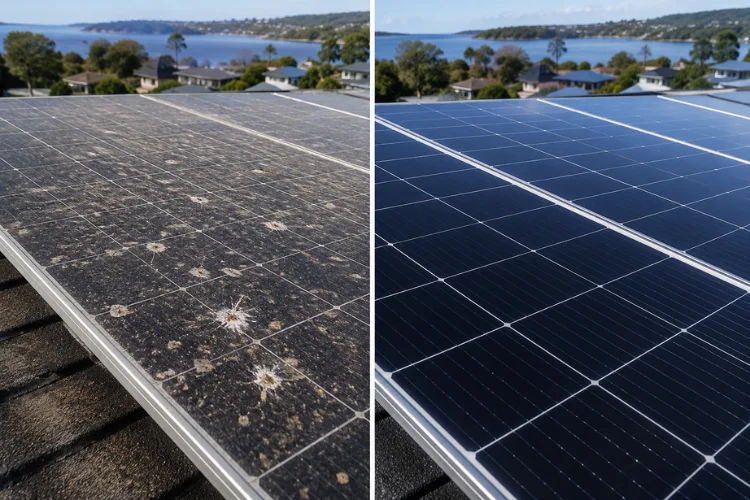
This is probably the question I get asked most often when the topic comes up, and the answer tends to surprise people. A single thin layer of dust might only reduce output by 5–7%. That sounds manageable until you factor in that coastal conditions layer multiple soiling types simultaneously — salt film, pollen, bird droppings, and organic matter — each compounding on the last.
Research from the University of California, San Diego (frequently cited in solar maintenance literature) found that soiling could reduce panel output by as much as 25% in a single year under normal conditions. Coastal environments with high humidity, salt air, and biological growth push that figure closer to 30–35% after two years without cleaning. One study conducted on Australian coastal rooftop systems found a 15–20% efficiency gain immediately following a professional clean.
To put that in household terms: if your 6.6kW system generates an average of 25–27 kWh per day when clean, a 25% soiling loss means you are operating closer to 19–20 kWh daily. At current Australian electricity rates (around $0.30–$0.35 per kWh for most NSW households), that gap costs you $600–$900 per year in lost solar savings. A professional solar panel cleaning on the Central Coast typically costs between $150–$275 for a standard single-storey system. The return on investment is not subtle.
Professional Cleaning vs. DIY: What You Need to Know Before Climbing That Ladder
Here is where I want to be direct with you, because this is a topic where enthusiasm can lead to costly mistakes.
The instinct to grab a bucket and a squeegee is understandable. But solar panels on most Australian homes are installed on pitched roofs at heights that exceed safe ladder reach without proper fall-arrest equipment. Falls from roofs are one of the leading causes of serious injury for Australian adults attempting home maintenance tasks. No energy bill saving is worth that risk.
Beyond safety, there are cleaning technique considerations that most homeowners are not aware of:
Water quality matters more than most people think. Tap water contains dissolved minerals that leave streaks and spots on panel glass when they evaporate. Professional cleaners use purified or deionised water — essentially water that has had its mineral content stripped out — which leaves no residue behind. Using hard tap water can actually leave your panels in worse optical condition than before you started, in terms of light transmission.
Pressure washing is almost universally the wrong choice. It is tempting for those who already own a pressure washer, but the force can compromise the silicone seals around panel edges, force water into junction boxes (causing electrical faults), or etch the anti-reflective coating on the glass surface. Some panel warranties are explicitly voided by pressure washing.
The right brush matters. Soft-bristled brushes on water-fed carbon fibre poles — the tool of choice for professionals — are designed to agitate and lift debris without scratching glass or aluminium frames. Hard brushes, abrasive sponges, and metal scrapers all cause micro-scratching that accumulates over time and permanently reduces light transmission.
That said, there are situations where a careful homeowner with ground-level or very low-pitch access can maintain panels adequately between professional cleans. If your panels are accessible from a first-floor balcony or flat roof section, a gentle rinse with a hose (no nozzle pressure) to remove loose dust in dry periods is a reasonable supplementary measure. Just do not mistake that for a full clean.
What to Expect From a Professional Solar Panel Cleaning Service on the Central Coast
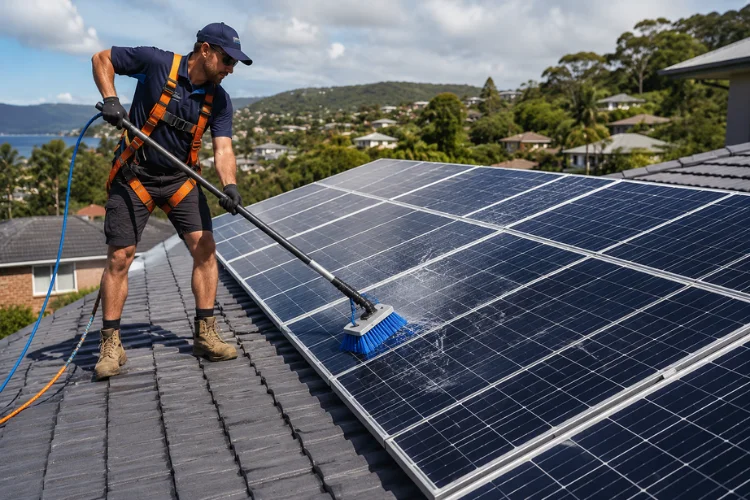
A good professional clean is not complicated, but there are specific steps that separate a thorough job from a quick rinse-and-go. When I have observed this process done properly, it follows a fairly consistent sequence.
The technician starts with a visual inspection of the array — checking for cracked panels, loose wiring, deteriorating seals, or signs of hotspot damage (dark patches on the panel surface caused by localised cell failures). This takes five to ten minutes and is genuinely valuable, as it catches problems that the homeowner would have no way of detecting.
The cleaning itself uses a soft-bristled brush on a water-fed pole connected to a portable deionised water system. Each panel is scrubbed from top to bottom, with particular attention to the bottom edge where soiling concentrates due to water run-off pooling. The purified water rinse then flushes debris away without leaving mineral deposits.
For panels affected by lichen, a biodegradable lichen-treatment solution may be applied, left to dwell, and then brushed off. This requires more time and is typically charged as an add-on, but it is the only reliable way to remove established lichen without damaging the panel surface.
After cleaning, a final visual check confirms the panels are clear, and the technician will photograph any concerns noted during inspection. A reliable service provider will give you a brief written summary of anything that needs attention.
Total time for a standard 6.6kW system (around 16–20 panels) on a single-storey home runs approximately 60–90 minutes. Two-storey homes require more equipment setup time and carry a safety surcharge in most pricing structures, which is entirely reasonable given the access challenges involved.
Solar Panel Cleaning Prices on the Central Coast: A Realistic Guide
Pricing across the Central Coast varies based on system size, storey height, the presence of lichen, and whether inspection or bird-proofing services are added. The table below gives a realistic picture of what to expect from reputable local providers.
These figures reflect current market pricing from providers operating across Gosford, Erina, Terrigal, Woy Woy, Wyong, and surrounding suburbs. As with most trades, getting two or three quotes is wise, but be cautious of pricing that is significantly below market — it often indicates corners being cut on water quality, equipment, or safety compliance.
The Lichen Problem: A Uniquely Central Coast Challenge
Lichen deserves its own section because it is so prevalent in this region and so misunderstood. Lichen is not moss, and it is not simply dirt. It is a symbiotic organism — part fungus, part algae — that physically bonds to porous and semi-porous surfaces, including the glass coating of solar panels. It thrives in the humid, shaded microclimates that form under tree canopies and along south-facing roof sections.
The reason lichen is such a problem for solar panel owners is that it cannot be removed by rainfall and resists most DIY cleaning methods. Its root-like structures (called rhizines) embed themselves into the glass surface at a microscopic level. Remove the visible lichen body without treating those rhizines, and it will regrow within months.
Professional removal uses a combination of physical agitation with a soft brush and a biodegradable biocide solution. The solution breaks down the biological bonds before the brushing removes the organism. Attempting to scrape lichen off with a hard implement — a paint scraper, a stiff brush, anything abrasive — invariably scratches the glass and can compromise the anti-reflective coating that premium panels depend on.
If your property has overhanging trees on the southern or western side, lichen colonisation of your panels is essentially inevitable without regular maintenance. A six-monthly professional clean is the only reliable preventative strategy for Central Coast homes in leafy suburbs like Holgate, Matcham, Somersby, or Avoca.
How Often Should You Have Your Solar Panels Cleaned on the Central Coast?
The honest answer is: more often than most people do it. The solar industry standard recommendation is every six to twelve months. For Central Coast properties, I would lean toward the six-month end of that range, particularly if:
- Your property is within two kilometres of the ocean (salt air deposition is significantly higher)
- You have deciduous or native trees overhanging or adjacent to the roof
- Your panels face north or west and receive heavy bird traffic
- Your system monitoring data shows an unexplained decline in output
Some homeowners on the Central Coast opt for a twelve-month schedule because it aligns with other annual maintenance tasks and fits the budget more comfortably. That is workable, provided you are not dealing with heavy lichen or significant tree coverage. For those with more challenging environments, twice a year is the smarter investment.
One practical tip: schedule your clean for late autumn (May–June) after the pollen season has peaked and before the cooler months when the system works harder to offset reduced sunlight hours. A second clean in late summer (February–March) catches the summer’s accumulated bird activity and prepares the system for winter. This timing maximises your return across both peak seasons.
Bird Proofing: The Preventative Step That Reduces Cleaning Frequency
Many Central Coast homeowners do not realise that a significant portion of their panel soiling comes not from the birds themselves, but from the nesting activity underneath the panels. Pigeons, starlings, and brush turkeys are particularly drawn to the sheltered space beneath solar arrays, where they nest and accumulate debris that then washes over the panel surfaces during rain.
Installing bird-proofing mesh (also called solar skirt or solar panel mesh) around the perimeter of the array creates a physical barrier that prevents nesting without harming wildlife. It also eliminates the hygiene concerns and additional weight load associated with accumulated nesting material on rooftop structures.
Most reputable solar panel cleaning providers on the Central Coast offer bird proofing as a service add-on. It is a one-time installation that typically lasts the lifetime of the panel array and pays for itself quickly in reduced cleaning frequency and panel longevity.
Questions to Ask Before Hiring a Solar Panel Cleaner on the Central Coast
Not all cleaning services are equal, and the difference between a thorough professional and someone with a bucket and a stepladder is significant. Before booking, ask:
- Do you use deionised or purified water, or tap water?
- What type of brush and pole system do you use?
- Are you insured for public liability and working at heights?
- Do you provide a post-clean inspection report?
- Can you treat lichen if found?
- Do you offer bird proofing as a service?
If a provider hesitates on the water quality or insurance questions, that is useful information. Reputable operators on the Central Coast answer these without pause because they are standard parts of their service offering.
If you are ready to move forward and want professional guidance for your project, connecting with experienced local specialists is the fastest way to get an accurate quote and assessment for your specific property.
Does Cleaning Affect Your Solar Panel Warranty?
This is a question that often goes unasked until there is a problem. The short answer: yes, how you clean your panels can affect your warranty, and this is documented in the fine print of most major panel manufacturer warranties.
Most panel warranties (LG, SunPower, Tindo, REC, and others) explicitly state that cleaning must be carried out using non-abrasive methods, appropriate cleaning solutions (or pure water only), and in accordance with manufacturer guidelines. Using pressure washers, harsh chemical cleaners, or abrasive implements can void the product warranty, which is typically 10–25 years, depending on the brand.
This is another reason why professional cleaning, done by someone who understands these requirements, is the prudent choice. A technician who is familiar with Australian Standards and manufacturer specifications will clean in a way that maintains — rather than jeopardises — your warranty coverage.
FAQs: Solar Panel Cleaning Central Coast
How much does solar panel cleaning cost on the Central Coast?
Most residential cleans cost between $150–$275 for a standard single-storey system of up to 24 panels, with additional charges for second-storey access, lichen treatment, or large commercial arrays.
Can I clean my own solar panels?
You can rinse accessible panels gently with a hose to remove loose dust, but a full professional clean with deionised water and soft-bristle equipment is recommended at least once or twice a year to maintain efficiency and avoid warranty issues.
How often should solar panels be cleaned on the Central Coast?
Every six months is the recommended frequency for most Central Coast properties due to salt air, pollen, and bird activity — though properties with heavy tree coverage or ocean proximity may benefit from more frequent attention.
Will rain keep my solar panels clean enough?
Rain removes loose surface dust but does not address salt film, lichen, bird droppings, or sticky organic matter — all of which are common on the Central Coast and require physical agitation and proper water filtration to remove effectively.
Does solar panel cleaning improve energy output?
Yes — clean panels can recover 15–25% of lost efficiency compared to panels that have accumulated one to two years of soiling, which in dollar terms often represents several hundred dollars in additional annual energy savings.
Final Thoughts
Solar panel cleaning Central Coast is not a luxury service or an optional add-on — it is a straightforward maintenance requirement that protects the performance and longevity of one of the largest investments most Australian homeowners make in their property. The Central Coast’s specific mix of salt air, lichen, coastal wildlife, and seasonal pollen makes it a more demanding environment than many other regions, and panels here simply do not maintain themselves between cleans the way some owners assume they will.
The good news is that the service is affordable, fast, and delivers a measurable return in energy output almost immediately. Whether you are due for your first clean or trying to figure out why your system’s output has quietly dropped over the past year, the answer is almost always simpler — and less expensive — than most people expect.
To get the right advice for your specific system, property, and situation, feel free to contact our team, and we can point you in the right direction.
Other Useful Resources of Solar Panels
- Solar Panel Bird Proofing Melbourne: 7 Key Benefits
- Best Time to Use Solar Power: 7 Ways to Save More
- Solar Battery Cost Australia: 2026 Price Guide & Savings

I’m Salman Khayam, the founder and editor of this blog, with 10 years of professional experience in Architecture, Interior Design, Home Improvement, and Real Estate. I provide expert advice and practical tips on a wide range of topics, including Solar Panel installation, Garage Solutions, Moving tips, as well as Cleaning and Pest Control, helping you create functional, stylish, and sustainable spaces that enhance your daily life.