
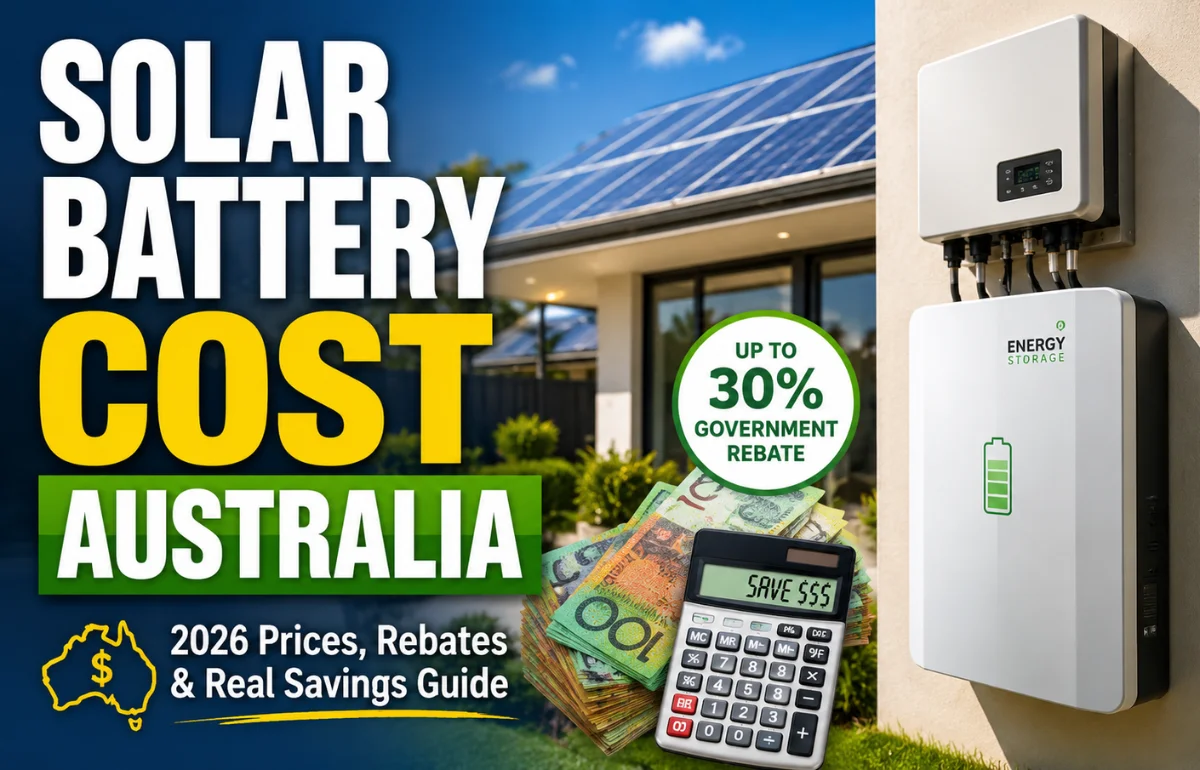
Solar battery cost in Australia typically ranges from around $4,000 to $18,000 or more, fully installed, depending on the battery’s storage capacity, brand, inverter type, and your home’s specific setup. As of 2026, a standard 10 kWh battery system — which suits the average Australian household — costs somewhere between $8,000 and $12,000 after the federal government battery rebate.
That rebate, introduced under the Cheaper Home Batteries Program, now takes around 30% off the upfront price of eligible systems, making solar battery cost in Australia meaningfully lower than it was just two years ago. If you’re weighing whether to add storage to your existing solar panels or start from scratch, this guide covers everything you need to make a confident, informed decision.
Why Solar Battery Cost in Australia Finally Got My Attention
A few years back, I had solar panels on the roof and was still getting slugged with high electricity bills. The panels were doing their job during the day — but the moment the sun dropped, the grid took over. I was essentially giving cheap solar energy away at a low feed-in tariff and buying it back at peak rates after 5 pm. When I started seriously looking into battery storage, the pricing felt opaque, inconsistent, and — honestly — a bit intimidating.
That experience is exactly why I wrote this article. The solar battery cost landscape in Australia has changed dramatically, and there’s a lot of genuinely useful information that doesn’t get surfaced clearly, especially when you’re comparing brands, rebates, and installation scenarios side by side.
What Drives Solar Battery Costs in Australia?
Before jumping into raw numbers, it’s worth understanding what you’re actually paying for. The total price of a home battery system isn’t just the battery unit itself — it’s a bundle of components and services.
The Battery Unit and How Its Capacity Affects Price
This is the storage hardware itself, measured in kilowatt-hours (kWh). The bigger the capacity, the more electricity it can hold, and the higher the price. A 5 kWh battery is a modest entry point; a 25 kWh system is closer to large-household or semi-off-grid territory.
The Inverter: A Hidden Component of Your Total Battery Cost
Batteries need an inverter to convert stored DC energy into AC electricity that your home can use. If you already have a hybrid inverter (one that supports battery connection), you may not need a new one. If you’re retrofitting a battery to an older solar system, you’ll likely need a battery inverter or to upgrade your existing equipment, which can add $1,500 to $4,000 to the project.
Installation Labour Costs Across Australian States
A licensed electrician must install your battery to meet Australian safety standards (AS/NZS 5139). Labour costs vary by state and by the complexity of your switchboard setup. Installation alone can run anywhere from $800 to $2,500+, depending on what’s involved.
Switchboard Upgrades and Their Impact on Solar Battery Pricing
Some older homes need the switchboard brought up to code before a battery can be safely connected. This is a cost that often surprises people — it can add $1,000 to $2,500 to the final bill.
Backup Functionality: An Often-Overlooked Battery Cost Factor
If you want your battery to keep your lights and fridge running during a blackout, you’ll need what’s called “whole-home backup” or at least a backup circuit. This requires additional wiring and configuration, which carries its own cost.
Solar Battery Prices in Australia: A Realistic 2026 Breakdown
The table below gives you a clear picture of what different battery sizes cost in Australia in 2026, both before and after the federal Cheaper Home Batteries rebate. These figures represent estimated installed costs including the battery unit and a compatible inverter, but exclude potential switchboard upgrades or backup wiring.
Note: Prices are indicative averages based on 2026 market data. Actual quotes will vary by brand, location, and installation specifics. The federal rebate is applied at the point of sale by registered installers.
One metric that experienced buyers use — but rarely get explained in standard guides — is the cost per usable kilowatt-hour. This tells you how much you’re paying for each unit of storable energy, which lets you compare differently sized systems on equal footing. As a rough benchmark, anything under $700 per usable kWh is considered good value in 2026. Larger systems tend to deliver better per-kWh economics because the fixed costs (installation, wiring, inverter) are spread across more capacity.
How Government Rebates Reduce Solar Battery Costs in Australia
The Australian Government’s Cheaper Home Batteries Program — part of the broader $2.3 billion energy transition package — has genuinely shifted the economics of home battery storage. Eligible households, businesses, and community organisations can receive a discount of approximately 30% on battery systems ranging from 5 kWh to 100 kWh.
What’s important to understand is that this rebate isn’t a cheque sent to your bank account — it’s applied directly by your installer at the point of sale, reducing your out-of-pocket cost upfront. This means you don’t have to wait, claim, or apply separately. You just need to ensure your installer is registered under the program and that the battery model you choose is on the approved product list.
On top of the federal scheme, some states run additional incentives:
- Victoria has offered battery rebates through the Solar Victoria program, though funding availability changes periodically.
- New South Wales has run the Peak Demand Reduction Scheme (PDRS), which can provide additional bill credits.
- Western Australia operates its own residential battery rebate scheme in areas with grid stability challenges.
- South Australia has historically been one of the most battery-friendly states, given its high electricity prices and advanced grid infrastructure.
Combining federal and state rebates where both apply can reduce the effective solar battery cost in Australia by 35–45%, which is a substantial saving on a $10,000+ purchase.
Three Installation Scenarios That Affect Your Solar Battery Cost in Australia
Not all battery installations are created equal. The solar battery cost in Australia varies significantly depending on which of these three situations applies to you.
Scenario 1: New Solar and Battery System — Best Value per Dollar
If you’re starting from scratch — no existing solar — you’ll be getting panels, an inverter, and a battery installed as a single integrated package. This is typically the most cost-efficient approach because the inverter serves both functions, and everything is configured together from day one. A 6.6 kW solar system paired with a 10 kWh battery might cost $15,000 to $22,000 fully installed, depending on panel brand and battery choice.
Scenario 2: Adding a Battery to an Existing Hybrid Inverter — Lower Upfront Cost
If your current solar setup already has a hybrid inverter (one with battery-ready ports), adding a battery is relatively straightforward. The inverter doesn’t need replacing — you just need the battery unit itself and the connection work. This can bring the total installation cost down to $7,000–$12,000 for a mid-range system.
Scenario 3: Retrofitting a Battery to an Older Solar System — Highest Cost Risk
This is the most complex — and most common — scenario for households that installed solar several years ago with a standard string inverter. You’ll either need to add a separate battery inverter (AC-coupled system) or replace your existing inverter with a hybrid model. This can add $2,000–$4,000 to the battery installation cost, and you’ll want to get multiple quotes to find the most cost-effective retrofit path for your specific setup.
Battery Brands Shaping Solar Storage Costs in Australia Right Now
The Australian market is well-served with both established and newer battery brands. Here are some that appear consistently in installer recommendations:
Sungrow SBR Series
Sungrow has become one of the most popular battery brands in Australia due to competitive pricing and modularity. Their HV series allows you to stack multiple modules, so you can start at 9.6 kWh and expand up to 25.6 kWh without replacing hardware. This scalability makes it a smart buy if you’re not sure how much storage you’ll need long-term.
Tesla Powerwall 3
The Powerwall 3 is an all-in-one unit that includes its own inverter, which simplifies installation significantly. It’s priced at a premium compared to some competitors, but for households that value a polished ecosystem and seamless software monitoring, it remains a strong contender.
BYD Battery-Box
BYD’s Battery-Box HV and Premium lines are well-regarded for their LiFePO4 chemistry, which offers excellent thermal stability and a longer cycle life than older lithium-ion formulations. Cycle life matters: a battery rated for 6,000 cycles at 80% depth of discharge will serve you for roughly 16 years of daily cycling, compared to cheaper units rated for 3,000–4,000 cycles.
Sonnen
Sonnen batteries sit at the premium end of the market and include sophisticated energy management software. They’re also compatible with several Virtual Power Plant (VPP) programs, which allow you to earn credits by feeding stored energy back to the grid during peak demand — an often-overlooked way to improve your battery’s financial return.
Alpha-ESS, GoodWe, Fox ESS, Sigenergy
These brands offer competitive pricing and have growing installer networks across Australia. They’re worth considering if your primary concern is value per kWh rather than brand prestige.
Is the Solar Battery Cost in Australia Actually Worth Paying?
This is the question I get asked most often, and the honest answer is: it depends — but more people can say yes in 2026 than could two years ago.
The financial case for a battery works when:
- Your electricity retailer charges significantly more during peak evening hours than the feed-in tariff you receive for excess solar
- Your household uses a meaningful amount of power after dark (cooking, heating, cooling, EV charging)
- You have access to the federal rebate and any applicable state rebates
- You’re in a state with relatively high electricity prices (South Australia and Queensland, for example)
If your daily evening grid consumption is around 8–12 kWh and your electricity rate is above 30 cents per kWh, a 10 kWh battery could realistically save you $1,500–$2,000 per year. At that rate, payback on a $9,000 system lands in the 5–6 year range — comfortably within the battery’s 10-year warranty period.
The non-financial case is just as compelling for many households. Blackout protection, reduced reliance on fossil-fuel-heavy grid power, and the general peace of mind of energy independence are increasingly valued by Australian homeowners — particularly after the grid stress events seen across multiple states in recent summers.
For homeowners thinking about solar battery storage as part of a broader energy upgrade, exploring property improvement solutions can help identify a holistic strategy that combines battery storage with other efficiency upgrades.
Hidden Solar Battery Costs in Australia: Most Guides Don’t Mention
There are a few things that rarely appear in solar battery price guides but can materially affect what you end up paying.
Network tariff compatibility. Some electricity retailers and networks charge a flat daily rate plus usage — a time-of-use tariff. If you’re not on a time-of-use plan, your battery can’t save you much because the rates don’t change between peak and off-peak. Before buying a battery, confirm you can switch to a time-of-use tariff with your retailer.
Battery reserve settings. Most battery systems allow you to set a minimum reserve — say, 20% — that won’t be discharged during normal operation (saved for blackout backup). The higher your reserve setting, the less capacity is available for daily cycling, which affects your actual savings.
Degradation over time. Lithium batteries lose capacity gradually. A 10 kWh battery might only store 8–8.5 kWh after five years of daily cycling. Factor this into payback calculations rather than assuming constant performance.
Virtual Power Plant participation. Joining a VPP through your battery or retailer can add $100–$400 per year in additional credits. Not all batteries or states are VPP-eligible, but it’s worth checking — it can meaningfully improve the financial return of your system.
For those interested in diving deeper into the technical and financial aspects of battery systems and other home energy upgrades, property improvement training can be a practical resource for building a more informed, independent view of your options.
Solar Battery Cost Across Australian States: Key Differences
Labour costs, electricity prices, and rebate availability all differ by state, which means the effective solar battery cost in Australia isn’t uniform. Here’s a broad summary:
- Victoria: Strong rebate history, relatively affordable installation labour in major cities. VPP programs well-established.
- NSW: High electricity prices improve battery ROI. PDRS credits available. Competitive installer market in Sydney and surrounds.
- Queensland: High solar penetration means feed-in tariffs have dropped, making the case for self-consumption via batteries stronger than ever.
- South Australia: Arguably the strongest battery market in Australia. High grid electricity prices, good sun, and a grid that has historically managed high solar penetration with battery support.
- Western Australia: State battery rebate available in select zones. Synergy’s tariff structure makes time-of-use planning important.
- ACT: Progressive energy policies and competitive installer market. Federal rebate applies.
Frequently Asked Questions
How much does a solar battery cost in Australia in 2026?
Solar battery cost in Australia ranges from around $4,000 for a small 5 kWh system to $18,000+ for larger 20–25 kWh setups, after the federal rebate is applied. Installation is typically included in quoted prices from reputable installers.
What size solar battery do I need for an average Australian home?
Most three- to four-person Australian households find a 10–13 kWh battery fits their evening power needs well, though the right size depends on your actual daily consumption pattern and whether you have an EV to charge.
Does the Australian government give rebates on solar batteries?
Yes — the federal Cheaper Home Batteries Program offers approximately 30% off eligible battery systems (5–100 kWh), applied directly at the point of sale by registered installers. Some states offer additional rebates on top of this.
How long does a solar battery last in Australia?
Most quality lithium solar batteries last 10–15 years with daily cycling, and most brands offer a 10-year warranty. LiFePO4 chemistry batteries tend to offer the longest cycle life — often rated for 6,000 or more charge cycles.
Can I add a battery to my existing solar system?
Yes, in most cases — though the cost and complexity depend on your current inverter type. Hybrid-inverter systems are the easiest to add to, while older string-inverter setups may need additional equipment such as a battery inverter, which adds to the overall project cost.
Understanding Solar Battery Cost in Australia Before You Commit
Solar battery cost in Australia is no longer the barrier it once was. With federal rebates shaving roughly 30% off the upfront price, falling hardware costs, and rising grid electricity rates in most states, 2026 is arguably the most financially favourable time most Australian households have seen to make the move to battery storage.
The key is to go in with clear information: understand what scenario applies to your home, get at least three quotes from CEC-accredited installers, confirm your electricity plan supports time-of-use savings, and check both federal and state rebate eligibility before committing. A well-sized, well-installed battery should comfortably pay itself off within its warranty period — and give you years of genuine energy independence beyond that.
More Helpful Resources
- Solar Panel Maintenance Cost: 7 Smart Ways to Save
- Do Solar Panels Increase Home Value? 2025 Data Reveals
- How Long Do Solar Batteries Last? 7 Key Lifespan Facts

I’m Salman Khayam, the founder and editor of this blog, with 10 years of professional experience in Architecture, Interior Design, Home Improvement, and Real Estate. I provide expert advice and practical tips on a wide range of topics, including Solar Panel installation, Garage Solutions, Moving tips, as well as Cleaning and Pest Control, helping you create functional, stylish, and sustainable spaces that enhance your daily life.