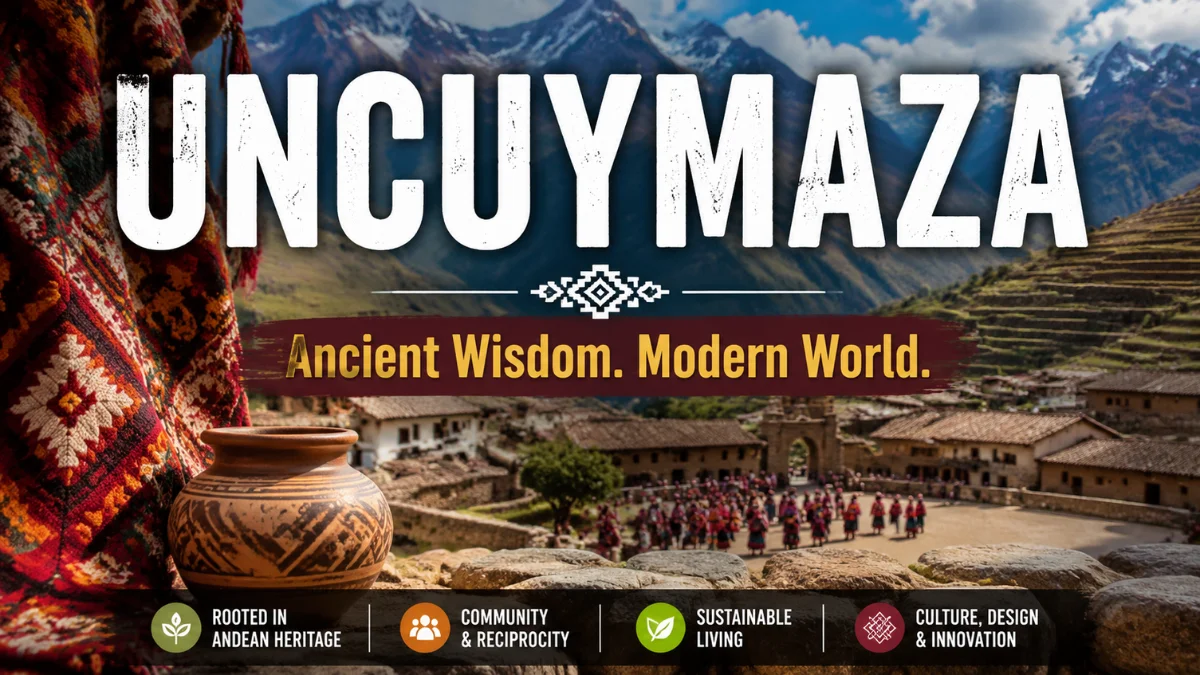
I first stumbled across the word Uncuymaza while researching indigenous design patterns for a friend’s home renovation. Honestly, I thought it was the name of a lost village in Peru. The deeper I dug, the more I realized I had it backwards. It’s not a place you find on a map. It’s a way of seeing the world. Over the past few months, I’ve watched this term pop up in leadership podcasts, sustainable architecture blogs, and even digital art forums. That’s when it hit me: Uncuymaza is having a quiet but powerful moment.
Rooted in the highlands of the Andes, Uncuymaza is one of those rare concepts that refuses to sit still. Depending on who you ask, it’s a code of ethics, a meeting point, a design trend, or a business strategy. But at its heart, it’s a living idea—one that has traveled from ancient agricultural ceremonies to the mood boards of modern designers and the mission statements of ethical CEOs. I want to walk you through how this happened, because understanding Uncuymaza might just change how you think about balance, community, and the work you do every day.
What Uncuymaza Meant at the Start: A Worldview of Balance and Reciprocity
To really get what Uncuymaza is today, we have to go back to its roots. And I don’t mean a few hundred years. We’re talking about the cosmological framework of pre-colonial Andean societies. For the Quechua and Aymara speaking communities, life wasn’t a series of transactions. It was a web of mutual debts and gifts between people, nature, and the spiritual world. Uncuymaza, in this original sense, was the glue holding that web together.
I like to think of it as a lived philosophy rather than a dusty set of rules. It wasn’t something you studied. It was something you did when you planted corn, when you repaired an irrigation ditch with your neighbors, or when you left an offering for the Pachamama (Mother Earth). The core principles were balance and reciprocity. You take from the land, you give back. You ask for help, you offer help in return. There’s no concept of a lone genius succeeding in isolation. Under an Uncuymaza worldview, prosperity is always shared, or it isn’t real.
What strikes me most is how this contrasts with the way many of us live now. Modern culture tends to reward extraction—taking resources, time, or attention without necessarily replenishing them. Uncuymaza flips that script. It asks, “What does the community need?” and “What does the land need?” before asking, “What do I want?” Anthropologists have noted that this principle shows up in everything from sowing rituals to conflict resolution. It’s not utopian. It’s practical. If you don’t maintain balance, the crops fail, the neighbors quarrel, and the spiritual protections fade.
So when I hear people today talk about “mindfulness” or “sustainability” as recent inventions, I smile. Uncuymaza has been doing that work for centuries. It just never needed a buzzword until we came along.
Uncuymaza as a Gathering Place: More Than a Dot on a Map
Here’s where the term gets a little tricky, and honestly, a little romantic. Some sources suggest Uncuymaza might also refer to a specific type of communal space—a real or symbolic town in the Peruvian highlands where people would converge for festivals, trade, and shared rituals. I’ve spent hours looking for a single GPS coordinate, but that misses the point. Whether or not a physical Uncuymaza exists on modern maps, the idea of it as a “place of gathering” has taken on a life of its own.
Travel writers, in particular, have latched onto this version. They describe Uncuymaza as a hidden gem, a village where time slowed down, where the textile patterns still tell stories, and where the communal oven is still fired up for every major holiday. I get the appeal. In an age where so many of us feel isolated—working remotely, scrolling alone, moving cities every few years—the fantasy of a town that literally exists to bring people together is magnetic.
But here’s what I appreciate about this interpretation. Even if the geographical Uncuymaza is partly myth, the function is real. Indigenous communities across the Andes still maintain gathering spaces that operate on the principles of mutual aid and shared identity. These aren’t just plazas. They are living archives. When an elder teaches a child to weave a specific pattern, that’s Uncuymaza in action. When neighbors rebuild a collapsed bridge before the rainy season, that’s Uncuymaza. The place becomes a verb.
I think that’s why this version of the term has survived. It gives us a mental image—a plaza with hand-dyed textiles, the smell of roasting corn, laughter spilling out of a stone doorway. That image reminds us that belonging isn’t automatic. It has to be built, protected, and renewed. And that’s a lesson any of us, whether we live in the Andes or a studio apartment in Chicago, can use.
The Artistic Revival: Uncuymaza in Interior Design and Craft
Now we get to the iteration that first caught my attention. In the last five or six years, Uncuymaza has emerged as a real aesthetic movement in interior design and contemporary craft. I’m not talking about cheap “ethnic” decorations you buy at a big box store. I mean a thoughtful, grounded design ethos that merges traditional Andean motifs with modern minimalism.
When designers talk about the Uncuymaza style, they’re usually pointing to a few key features. First, the color palette comes directly from the land: deep ochres, clay reds, mossy greens, and the grey of high-altitude stones. Second, texture matters more than polish. Handwoven textiles, unglazed pottery, and raw wood are staples. Third, there’s a rejection of mass-produced symmetry. You’ll see geometric patterns that are intentional but not rigid—patterns that ancestors might have used to mark harvests or family lineages.
What separates Uncuymaza from other “rustic” or “artisanal” trends is the storytelling. Every object has a narrative. A blanket isn’t just warm; it carries the pattern of a particular community. A wooden stool isn’t just functional; it was carved using techniques passed down through four generations. I visited a small gallery show last year that featured Uncuymaza inspired furniture, and the curator was careful to explain each piece’s origin story. Without that context, she said, it’s just decoration. With it, you’re living inside a conversation.
This approach appeals to me because it fights back against the anonymity of modern stuff. Most of us have homes filled with items from supply chains we can’t trace. Uncuymaza design asks you to slow down, to buy less but better, and to honor the hands that made your belongings. It’s also deeply aligned with the sustainability movement. By valuing heritage techniques and natural materials, it inherently rejects fast furniture and synthetic waste.
I’ve started incorporating small Uncuymaza touches into my own workspace—a handwoven pouch for my pens, a ceramic bowl from a local artisan who sources her clay ethically. It sounds small, but it changes the energy of the room. Suddenly, my desk isn’t just a productivity machine. It’s a collection of relationships.
From the Village to the Boardroom: Uncuymaza as Leadership Philosophy
Here’s where Uncuymaza surprised me the most. I never expected to see an ancient Andean concept show up in a Harvard Business Review case study, but here we are. Leadership consultants and organizational theorists have started using Uncuymaza as a framework for purpose-driven management. And the more I learn about it, the more sense it makes.
Traditional corporate leadership often rewards aggression, speed, and zero-sum thinking. You win, someone else loses. But that model is cracking under the weight of climate change, employee burnout, and public distrust. Enter Uncuymaza. This philosophy suggests a different kind of leader: one who sees their company as part of a larger social and ecological system, not a fortress to be defended.
What does that look like in practice? I’ve been following a few small businesses that explicitly cite Uncuymaza principles. One is a coffee cooperative that pays farmers a premium but also funds reforestation projects in the same regions. Another is a software startup that caps executive pay at five times the lowest wage, not out of charity, but because they believe imbalance corrupts decision-making. These leaders talk about reciprocity the same way an Andean farmer might talk about rotating crops. You can’t keep taking from your team or your environment without putting something back.
The traits of an Uncuymaza leader include empathy, long-term thinking, and a genuine willingness to share power. They ask questions like, “How does this decision affect our suppliers?” and “What do our employees need to thrive, not just produce?” It’s not soft. In fact, it’s incredibly hard, because it requires resisting the pressure for quarterly earnings at all costs.
I’ve tried applying a sliver of this to my own freelance work. Instead of squeezing every client for maximum profit, I’ve started asking if I can refer them to someone better suited. Instead of working through lunch, I take a real break and walk outside. Does that sound minor? Maybe. But over a year, those small choices add up to a completely different relationship with work—less anxious, more reciprocal. That’s the quiet power of Uncuymaza. It scales down to a single person just as easily as it scales up to a multinational boardroom.
Uncuymaza in the Digital Age: Usernames, Aliases, and Online Identity
I couldn’t write about this without mentioning the wildest frontier for Uncuymaza: the internet. Search for the term on social media, and you’ll find a growing collection of artists, musicians, and creators using it as a username or project alias. There’s a lo-fi hip-hop producer called Uncuymaza Beats. An illustrator who signs her digital paintings with a stylized “U.” A mindfulness account on Instagram that posts daily reminders about balance and reciprocity.
At first, I was skeptical. Is this appreciation or appropriation? The line gets blurry when a word leaves its original cultural context and floats into global cyberspace. But after reading some of these creators’ bios and watching their interviews, I think many of them are genuinely trying to honor the spirit of Uncuymaza rather than just co-opting a cool-sounding word.
They use it to signal a few things. First, a commitment to rooted creativity—making art that has depth and origin, not just viral chaos. Second, a rejection of the attention economy’s worst impulses. You won’t find an Uncuymaza influencer screaming for likes. The accounts I’ve seen are quieter, more thoughtful, often focused on nature, ancestral knowledge, or handicraft. Third, there’s a collective identity forming. People who adopt Uncuymaza online tend to find each other, forming small pods for mutual support, critique, and collaboration.
This digital version comes with risks. Without clear ties to Andean communities, the term could drift into meaningless trendiness. I’ve already seen a few brands misuse it as a hashtag for generic “spiritual” content. But I’ve also seen genuine efforts at accountability. One artist I follow includes a land acknowledgment in every post and donates a percentage of print sales to a Quechua language preservation fund. That feels like the real thing.
So I’m cautiously optimistic. The internet flattens and distorts everything eventually. But for now, Uncuymaza online is a small corner where people are trying to build something slower, kinder, and more connected. That’s worth protecting.
Why This Ancient Concept Refuses to Stay in the Past
I keep coming back to a simple question. Why does Uncuymaza keep showing up in such different places—farms, galleries, boardrooms, TikTok bios? What makes it so adaptable?
Here’s my theory. Uncuymaza isn’t really a single thing. It’s a pattern. A way of organizing relationships that prioritizes balance over extraction, community over isolation, and long-term health over short-term wins. That pattern can fit into almost any context. Plant a garden? That’s Uncuymaza if you rotate your crops and share the harvest. Design a chair? That’s Uncuymaza if you use local wood and carve it by hand. Run a team meeting? That’s Uncuymaza if you make sure every voice is heard and every task has a clear purpose.
The specifics change. The underlying structure stays the same. And that structure feels urgently relevant right now. We’re living through a moment of extreme disconnection—from nature, from each other, from the origins of our food and goods. Uncuymaza offers a practical antidote. It doesn’t demand that you move to a mountain or reject technology. It just asks that you pay attention to the give-and-take in every interaction.
I’ve started a small personal practice around this. Every evening, I ask myself one question: “Did I act from a place of reciprocity today?” Some days the answer is yes. Other days, I notice where I took more than I gave. That’s not guilt. It’s just data. And over time, that data shifts my habits.
You can do the same. You don’t need permission from an anthropologist or a certificate from a leadership institute. Uncuymaza is free. It’s been waiting for you in the highlands, in a woven blanket, in the space between a question and an answer.
Frequently Asked Questions About Uncuymaza
1. What is the basic definition of Uncuymaza?
Uncuymaza is an Andean concept rooted in balance, reciprocity, and communal well-being, which has evolved to influence design, leadership, and digital culture.
2. Is Uncuymaza a real place or just a metaphor?
It may refer to a real or symbolic gathering place in the Peruvian highlands, but today it is used more broadly as a metaphor for community, belonging, and cultural unity.
3. How is Uncuymaza used in interior design?
In design, Uncuymaza describes an aesthetic that blends traditional Andean motifs, natural textures, and handcrafted materials with modern minimalism and ethical storytelling.
4. Can Uncuymaza principles work in business leadership?
Yes, many consultants apply Uncuymaza as a leadership framework that prioritizes empathy, long-term stewardship, and the health of social and ecological systems over short-term profit.
5. Is it appropriate for non-Andean people to use the term Uncuymaza?
Respectful use is possible if you acknowledge its origins, support Andean communities, and apply the principles of reciprocity and balance rather than treating it as a trendy buzzword.
A Final Thought Before You Go
I didn’t expect to care this much about a single word when I started researching. But Uncuymaza has a way of pulling you in. It’s one of those rare ideas that is both ancient and brand new, specific to a place and universal in its appeal. You don’t have to redesign your whole life around it overnight. Maybe just notice one moment of imbalance today and try to correct it tomorrow. That small act? That’s Uncuymaza. And it’s been waiting for you all along.
Learn about Piçada

Julian Vane is a versatile writer at Wellbeing Makeover covering tech, health, and global culture. With years of experience across various industries, Julian brings a well-rounded perspective to lifestyle and business, helping readers stay informed and inspired in an ever-changing world.