
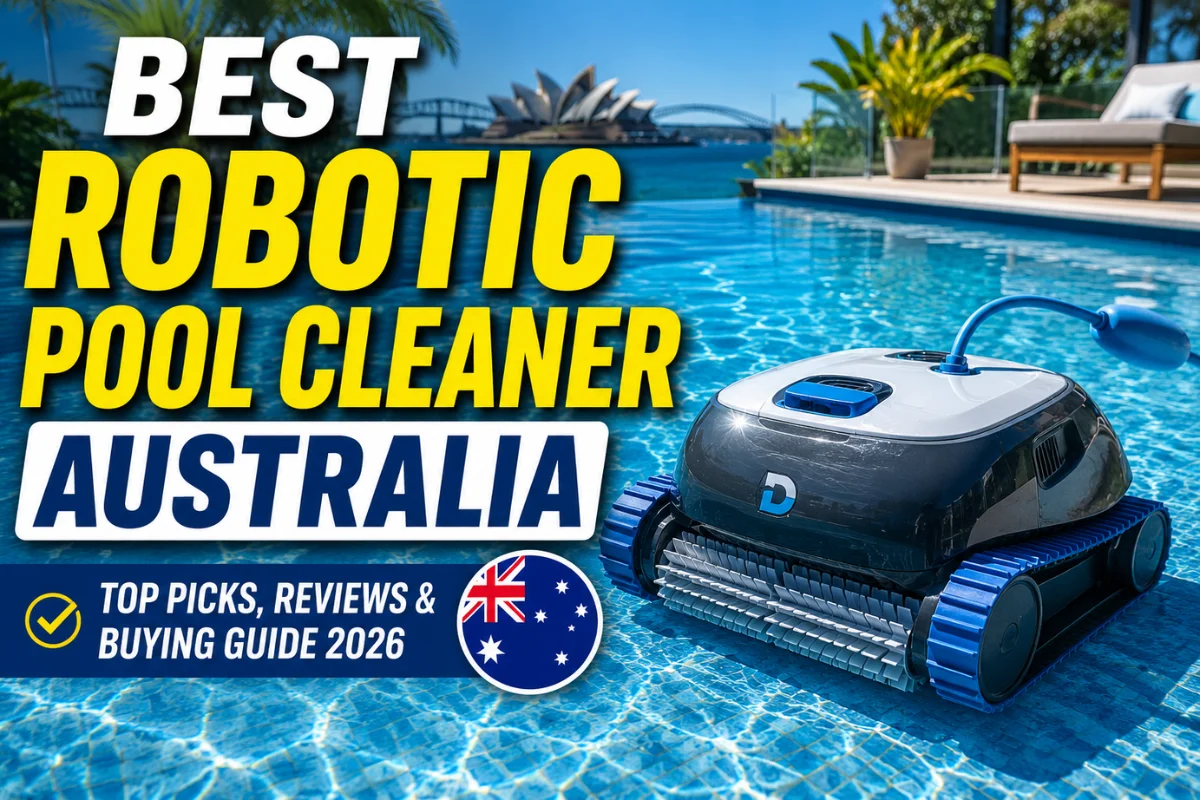
If you’re searching for the best robotic pool cleaner in Australia, the short answer is this: a robotic pool cleaner is a self-contained, electrically powered device that navigates your pool independently, scrubbing the floor, walls, and waterline while filtering debris — all without connecting to your pool’s existing filtration system.
The top-rated models for Australian conditions in 2026 include the Dolphin Nautilus CC Plus, Maytronics Dolphin Sigma, and Zodiac CX35, which consistently lead in cleaning performance, energy efficiency, and durability against Australia’s intense UV exposure and heavy organic debris loads.
Unlike suction or pressure cleaners, robotic models are smarter, cheaper to run, and genuinely hands-off — which is exactly what pool ownership in Australia should feel like.
Why Australians Need a Robotic Pool Cleaner More Than Anyone Else
Australia is not the easiest place to own a pool. You’re dealing with extreme UV radiation, eucalyptus leaves, insects, pollen, red dirt from western regions, and long summer stretches where the pool gets used daily. I’ve spoken with dozens of pool owners across Queensland, NSW, and WA, and the overwhelming consensus is that manual vacuuming or old-school suction cleaners simply can’t keep pace with the debris load an Australian backyard throws at a pool week after week.
Robotic cleaners change this equation entirely. They run on as little as 180 watts, they filter down to 2 microns in premium models (capturing pollen, algae spores, and fine silt), and they don’t steal suction from your pump — meaning your chlorination and chemical balance stays more stable. Over a pool season, that adds up to real savings on chemicals, electricity, and time.
The best robotic pool cleaner Australia homeowners need isn’t just about scrubbing. It’s about smart navigation, build quality that withstands harsh outdoor conditions, easy basket cleaning, and long warranty coverage. Let’s walk through exactly what separates the great from the average.
What to Look For Before Buying a Robotic Pool Cleaner in Australia

Pool Size and Shape
This is the first filter. A compact robotic cleaner built for pools up to 8 metres will struggle in a 15-metre freeform pool — it’ll miss corners, leave lines, and cycle inefficiently. Before you look at brand names, measure your pool and note whether it has tight curves, steps, a beach entry, or a deep end exceeding 2 metres. Most premium Australian models can handle pools up to 12–15 metres and depths to 3.5 metres, but mid-range options cut off at 10 metres and 2 metres depth.
Filtration Efficiency
Australian pools attract ultra-fine debris — pollen, algae, red dust in drier regions. Standard 150-micron filtration handles leaves and larger debris well, but if you’re in Queensland or near bushland, you want a unit with dual filtration or ultra-fine 2-micron cartridges. The difference becomes visible within two weeks of running the cleaner; pools with fine filtration look genuinely clearer.
Cleaning Cycle and Coverage
Standard cleaning cycles run 2–3 hours. Smart navigation (also called gyroscopic or algorithmic mapping) covers more of your pool systematically rather than bouncing randomly. You’ll see this advertised as “systematic scanning” or “AI navigation” in the 2025–2026 models. Random navigation isn’t necessarily bad for smaller pools, but for anything over 10 metres, systematic is worth the premium.
Brush Types
Rubber brushes grip tiles and fibreglass surfaces better than PVC brushes and don’t leave marks. If you have a concrete or pebblecrete pool, dual-action brushes that scrub more aggressively will be more effective at loosening algae. Most of the premium Australian-market models now include dual scrubbing brushes as standard.
Ease of Maintenance
The cleaner has to come out of the water after every cycle, and the filter basket or cartridge has to be emptied. This seems trivial until you’re doing it every other day in peak summer. Look for top-access filter baskets (you don’t have to flip the unit), and consider how easy it is to rinse the basket with a garden hose. Some cartridge systems are more fiddly than basket systems — a relevant trade-off given the frequency.
Top Robotic Pool Cleaners Available in Australia (2026)

The Australian market is well-served by Maytronics (Dolphin brand), Zodiac, Hayward, and Polaris. Here’s an honest comparison of the top contenders.
Maytronics Dolphin Nautilus CC Plus
This is the most popular robotic pool cleaner in Australia at the mid-to-premium tier, and there’s a good reason for that. The Nautilus CC Plus handles pools up to 12 metres, has dual scrubbing brushes, and offers weekly scheduling via a basic timer. Its dual filtration handles both fine and coarse debris in a single pass. It’s not the most technologically sophisticated machine on the market — there’s no smartphone app or Wi-Fi mapping — but it’s reliable, easy to maintain, and priced around $900–$1,100 AUD.
- Best for: Pool owners who want a dependable workhorse without app complexity.
Maytronics Dolphin Sigma
The Sigma is Maytronics’ flagship model in Australia, and it earns that title. It has gyroscopic navigation that maps your pool systematically, Wi-Fi connectivity with the MyDolphin Plus app, and ultra-fine filtration via dual cartridges. The Sigma climbs walls to the waterline and cleans the coping on models with the anti-tangle swivel cord. Expect to pay $1,800–$2,200 AUD, but you’re getting a machine that genuinely reduces your involvement in pool maintenance to almost zero.
- Best for: Larger pools, tech-savvy owners, or anyone who wants remote scheduling and tracking.
Zodiac CX35 (formerly Baracuda CX35)
Zodiac is an Australian brand (now part of Fluidra), and their cleaners are specifically tested in Australian conditions. The CX35 is a strong mid-range performer with a 3-hour cleaning cycle, fine-cartridge filtration, and a durable build that handles both concrete and fibreglass pools. The brush roll is particularly aggressive on algae staining, which makes it popular among owners with older plaster pools. Price sits around $1,200–$1,400 AUD.
- Best for: Pools with algae history, concrete or pebblecrete surfaces.
Hayward SharkVac XL
Hayward’s Australian range is designed for value-conscious buyers without sacrificing too much performance. The SharkVac XL covers pools up to 10 metres, has a large debris canister (good for leaf-heavy yards), and uses a basic navigation pattern that covers most pool shapes adequately. At around $700–$850 AUD, it’s one of the more affordable quality options. The trade-off is less systematic coverage and no app connectivity.
- Best for: Smaller pools, budget-conscious buyers who still want robot quality.
Polaris Freedom 655
The Polaris 655 is unique in the Australian robotic market because it’s battery-powered rather than corded. This removes cord-tangling entirely — a real-world frustration with many robotic cleaners. It uses an onboard lithium battery and charges in about 2.5 hours, giving roughly a 70-minute cleaning cycle. That’s sufficient for pools under 9 metres. The cordless design makes it feel more like a modern home appliance than a pool tool.
- Best for: Pool owners irritated by cord management, or those with oddly shaped pools where cords tangle.
Robotic Pool Cleaner Comparison Table
What the Internet Doesn’t Tell You About Robotic Pool Cleaners in Australia

Most articles cover the spec sheet. Here’s what I’ve found matters in real ownership:
Cord length is a hidden deal-breaker. Most robotic cleaners come with an 18-metre cord, which sounds like plenty until you account for the fact that you’re looping the cord from the power source across your pool deck and back. In pools over 10 metres, or where the power outlet is positioned awkwardly, a standard cord can restrict the robot’s range. Check whether the model allows cord extensions before buying.
Heat affects performance. In summer in Queensland or the NT, pool water can reach 32–34°C. Not all robotic cleaners are rated for sustained operation in high water temperatures. Premium models like the Dolphin Sigma are rated to 35°C; budget models may experience motor stress at sustained temperatures above 30°C. If you’re in tropical Australia, check the operating temperature spec before buying.
Robotic cleaners and salt chlorinated pools. The vast majority of Australian pools are salt chlorinated, and most robotic cleaners are compatible — but the salt environment does accelerate wear on motor seals and brush axles over time. Models with sealed motor compartments and stainless steel hardware fare significantly better than those with plastic hardware. Maytronics specifically designs Dolphin models for salt pools, which is part of why they dominate the Australian market.
The “floor only” limitation of budget models. Several budget robotic cleaners marketed as full cleaners in Australia only reliably clean the pool floor. Wall climbing is listed as a feature, but is inconsistent in practice — the robot starts climbing a wall and slides back down after a few centimetres. If waterline algae is a concern (and in Australian summers, it usually is), spend the extra money on a verified wall-climbing model.
How to Get the Most From Your Robotic Pool Cleaner
Running your robot consistently — 3 to 4 times per week in peak summer — dramatically reduces chemical demand because it removes organic debris before it breaks down into phosphates that feed algae. Think of it as proactive pool chemistry, not just aesthetics.
Rinse the filter basket or cartridge thoroughly after every use. Debris that sits in a wet filter develops bacterial growth that can be reintroduced into the pool on the next cycle. Store the unit in the shade between uses; UV exposure degrades the plastic housing over time, particularly on older Maytronics models without UV-resistant casing.
If you’re looking for broader wellbeing improvements around your home and lifestyle, you might find value in exploring our online services at Wellbeing Makeover — covering everything from home environment improvements to personal health consulting.
Cost of Running a Robotic Pool Cleaner in Australia

On Australian electricity rates (averaging around 28–32 cents per kWh in 2026), running a 180-watt robotic cleaner for 3 hours costs approximately 15–17 cents per cycle. Running it every second day through a 6-month pool season (roughly 90 cycles) costs about $14–$16 in electricity. By comparison, running your pool pump for an extra hour to compensate for inadequate cleaning costs far more over the same period.
Factor in reduced chemical costs — typically $100–$200 AUD per season for well-maintained pools with a robotic cleaner versus pools without — and the cleaner often pays for itself within two to three seasons.
Frequently Asked Questions
What is the best robotic pool cleaner for Australian conditions?
The Maytronics Dolphin Sigma is the top overall performer for Australian pools, handling salt water, UV exposure, heat, and heavy debris loads better than most competitors, while the Nautilus CC Plus offers the best value at the mid-range price point.
Are robotic pool cleaners worth it in Australia?
Yes — robotic cleaners reduce chemical costs, pool pump runtime, and manual labour significantly over a season, with most mid-range models paying for themselves within two to three years of regular use.
Can robotic pool cleaners handle pebblecrete pools?
Most premium robotic cleaners with dual scrubbing brushes handle pebblecrete adequately, but models with aggressive rubber brushes — like the Zodiac CX35 — perform best on rough textured surfaces without damaging them.
How often should I run my robotic pool cleaner in summer?
In Australian summer conditions, running your robotic cleaner three to four times per week is optimal for keeping debris levels low enough to reduce chemical demand and prevent algae formation.
Do robotic pool cleaners work in saltwater pools?
Yes, all major robotic pool cleaner brands available in Australia — including Maytronics, Zodiac, and Hayward — are compatible with salt chlorinated pools, though sealed motor compartments and stainless steel hardware extend longevity in saltwater environments.
Wrapping Up: Making the Right Call for Your Pool
Choosing the best robotic pool cleaner in Australia comes down to three things: your pool’s size and surface, how much automation you genuinely want, and your budget. For most homeowners, the Dolphin Nautilus CC Plus hits the sweet spot between price and performance. If you have a larger pool or want app-based scheduling, the Dolphin Sigma is worth the extra investment. If budget is the priority without sacrificing cleaning quality, the Hayward SharkVac XL delivers solid results.
Don’t buy based on brand reputation alone. Measure your pool, check the operating temperature specs for your climate zone, confirm the cord length works for your setup, and verify the filtration type matches the debris your specific yard produces.
If you’d like personalised guidance on home wellness or lifestyle improvements beyond the pool — or if you want to explore how to create an outdoor living space that genuinely supports your wellbeing — feel free to contact Wellbeing Makeover directly. We’d love to help.
A cleaner pool takes less work, costs less to maintain, and creates a better environment for the people using it. That’s not a small thing — that’s what good home management looks like.
Other Resources
- How Do You Clean Puke Out of Carpet? Expert Removal Tips
- Pool Cleaning in Spring Valley, Nevada Guide
- Sodium Bisulfate Pool: Safe pH Control Guide

I’m Salman Khayam, the founder and editor of this blog, with 10 years of professional experience in Architecture, Interior Design, Home Improvement, and Real Estate. I provide expert advice and practical tips on a wide range of topics, including Solar Panel installation, Garage Solutions, Moving tips, as well as Cleaning and Pest Control, helping you create functional, stylish, and sustainable spaces that enhance your daily life.