
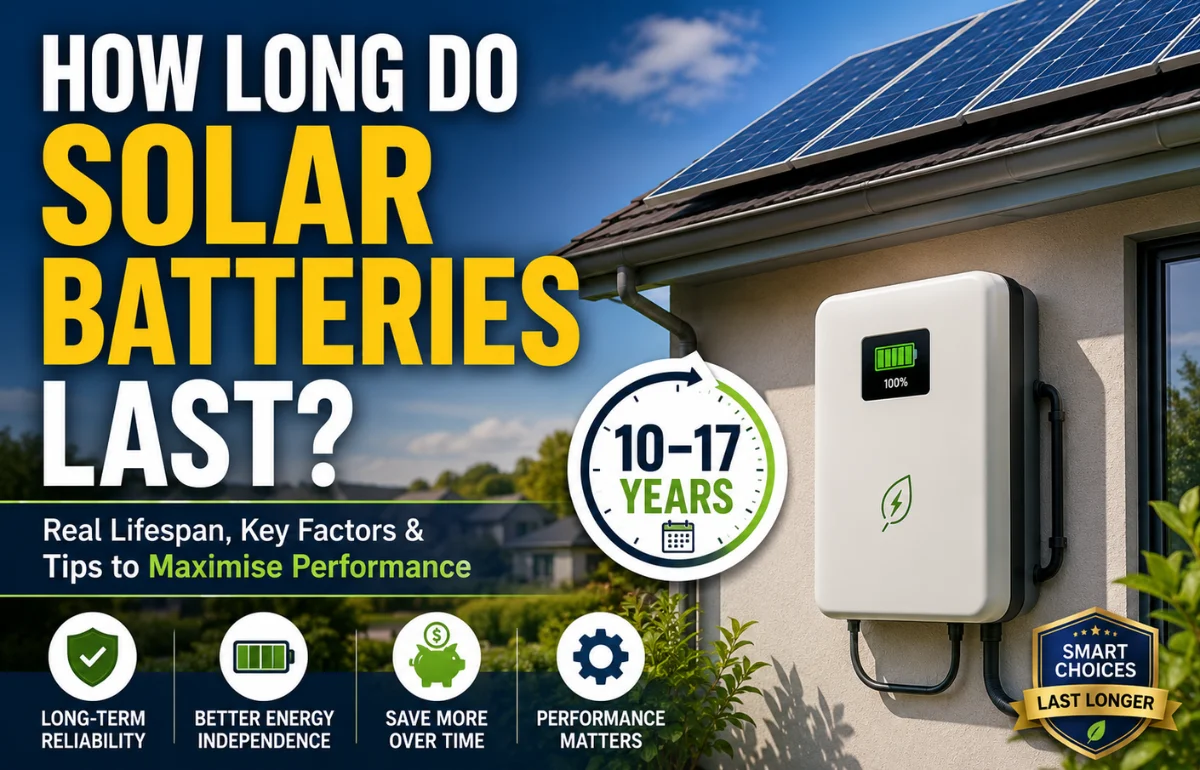
Most solar batteries last between 10 and 15 years under normal Australian conditions — and with good management, some stretch well beyond that. A solar battery is a device that stores excess electricity generated by your solar panels during the day so you can use it at night or during grid outages. Unlike the panels themselves, which can last 25–30 years, batteries degrade through repeated charge and discharge cycles. So how long do solar batteries last in practical, real-world terms?
That depends on the battery chemistry, where it’s installed, how hard it’s worked daily, and whether it’s been set up correctly from day one. This article covers all of that and more — including what the competitors and manufacturers aren’t always upfront about.
What Actually Happens to Solar Batteries as They Age
Before we talk numbers, it’s worth understanding what “ageing” actually means for a battery. Your solar battery doesn’t reach a hard stop date and switch off. Instead, it slowly loses the ability to hold its full capacity — a process called capacity degradation.
Think of it like a water tank developing a slow leak. At year one, it holds 10 litres. By year ten, it might hold 7.5 litres. The tank still works, it just stores less. Most manufacturers define end-of-life as the point when a battery retains less than 60–70% of its original capacity.
In my experience consulting with homeowners across Australia, the most common frustration isn’t a battery dying outright — it’s gradually noticing that the battery runs out earlier in the evening, then earlier still, and finally realising it’s no longer covering the overnight load it once did.
That gradual fade is normal. What isn’t normal — and what you want to avoid — is premature degradation caused by avoidable factors.
How Long Do Solar Batteries Last by Battery Type
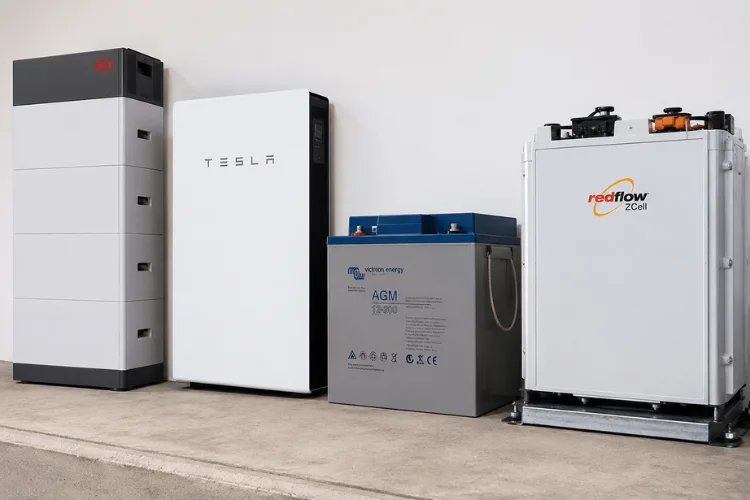
The type of battery chemistry you choose has a massive bearing on how long your storage system will last. Here’s how the main technologies compare in the Australian market.
Lithium Iron Phosphate (LFP)
This is the dominant chemistry in modern Australian residential installations — and for good reason. LFP batteries are thermally stable, can handle deep discharge cycles without significant stress, and typically offer 3,000 to 6,000 cycles at 80% depth of discharge. In practical terms, that translates to roughly 10–17 years of daily use.
Brands like BYD, Sungrow, and Alpha ESS use LFP cells, and it’s the chemistry behind the Tesla Powerwall 3. If you’re buying a battery today, there’s a very high chance it’s LFP.
Lithium NMC (Nickel Manganese Cobalt)
NMC batteries offer higher energy density — meaning more storage in a smaller, lighter package — but they’re slightly more sensitive to heat and deep discharge. Earlier versions of the Tesla Powerwall used NMC chemistry. These typically last 10–15 years but can degrade faster in hot climates like Queensland or the Northern Territory if not managed carefully.
Lead-Acid
Largely phased out for residential solar in Australia, lead-acid batteries are still found in off-grid rural setups where upfront cost is the priority. They typically last 3–7 years, require regular maintenance (for flooded variants), and struggle in high-cycle-rate environments. Unless your situation specifically calls for it, lead-acid is not a long-term investment.
Flow Batteries
Flow batteries are a relatively emerging technology with exceptional cycle life — up to 10,000–15,000 cycles — making them potentially the longest-lasting option. However, they’re currently not practical for homes due to size, complexity, and cost. They’re mainly deployed in commercial and industrial applications.
Solar Battery Lifespan Comparison Table
Factors That Affect How Long Solar Batteries Last
Depth of Discharge — The Most Misunderstood Factor
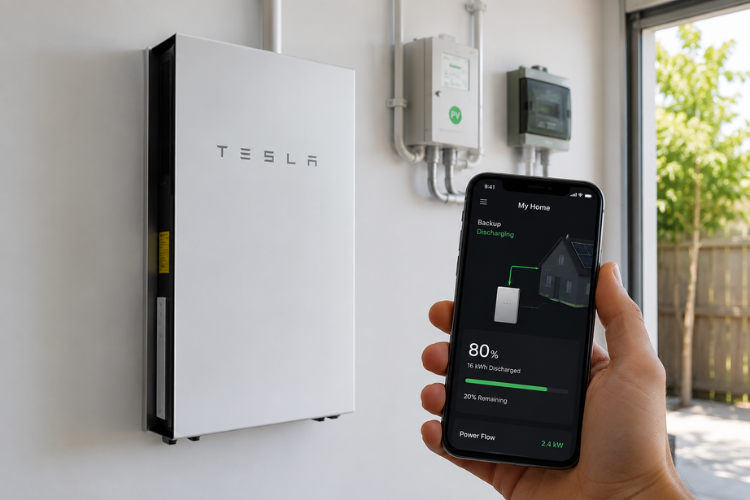
Depth of discharge (DoD) refers to what percentage of a battery’s capacity you draw down before recharging. A 10 kWh battery discharged to 20% remaining has a DoD of 80%.
Here’s what most articles miss: the relationship between DoD and cycle life isn’t linear — it’s exponential. Discharging a lithium battery to 100% every day can reduce its cycle life by 30–40% compared to discharging it to 80%. That’s a significant difference when compounded over a decade.
The sweet spot for most LFP batteries is keeping DoD below 80–85%. Most modern battery management systems (BMS) do this automatically, but it’s worth checking your settings — especially if your installer left the defaults at maximum discharge.
Temperature — The Silent Killer of Solar Battery Lifespan
This one is particularly relevant in Australia. High ambient temperatures accelerate the electrochemical reactions inside a battery, increasing wear with every cycle. Temperatures above 35°C can reduce how long solar batteries last by 15–25% of their projected cycle life.
A battery mounted in a north-facing, unshaded corrugated iron garage in Western Australia will age noticeably faster than the same model installed in a cool, south-facing Adelaide garage. I’ve seen installations in outer Sydney where poorly positioned batteries were running 8–12°C hotter than the ambient air temperature due to radiant heat from a metal roof nearby. That kind of oversight compounds over the years.
The fix is straightforward: shaded placement, adequate ventilation, and in hot climates, a wall away from direct sunlight.
Charge Rate
Charging a battery too fast — particularly to 100% repeatedly — stresses the cells. This is less of a concern with modern smart inverters that regulate charge rates, but worth mentioning for anyone with older hybrid inverters running on default settings.
What’s Actually Overstated: Cycling Frequency
Many guides make it sound like using your battery every day will burn it out quickly. That’s not quite right for LFP. These batteries are designed for daily cycling, and daily use does not meaningfully reduce how long solar batteries last — provided you’re not doing deep discharges. Daily use is perfectly fine and is exactly what the warranty cycle counts are based on. A battery sitting unused for months can actually experience calendar ageing, which is a different degradation mechanism.
What Solar Battery Warranties Tell You About Expected Lifespan
Understanding how long solar batteries last starts with reading the warranty — and knowing what it actually promises. Most Australian residential batteries come with a 10-year product warranty, often tied to a performance guarantee — typically that the battery retains at least 60–70% of its original capacity at the end of the warranty period.
It’s crucial to read what the warranty actually covers. There are usually four components:
- Product warranty covers manufacturing defects and failure under normal use — typically 10 years.
- Cycle warranty covers a set number of charge-discharge cycles, often 6,000 cycles. If you cycle your battery once per day, 6,000 cycles is approximately 16.4 years. The warranty expires when either the time period or the cycle count is reached — whichever comes first.
- Throughput warranty covers the total energy (in MWh) that can flow through the battery. This is less common but protects against unusually high-use applications.
- End-of-warranty capacity guarantee commits to a minimum remaining capacity — typically 60–70% — at the warranty’s end.
One thing that isn’t discussed enough: warranties are voided by incorrect installation far more often than most people realise. Undersized cabling, incompatible inverter pairings, and poor ventilation are the most common culprits. This is exactly why the quality of your installer matters as much as the quality of the battery itself. If you’re exploring upgrades or additions to your existing setup, tapping into professional home improvement services that include proper system assessment can save you from costly warranty issues down the track.
Real-World Solar Battery Lifespan vs. Manufacturer Claims
It’s fair to be a little sceptical of manufacturers’ claims about how long solar batteries last. Battery technology is still relatively young in the residential market, and independent long-term data on real-world Australian household performance is limited. Most warranties are structured around projected degradation curves based on laboratory testing — useful as a baseline, but not always representative of Australian summers or the way real households cycle their storage.
What we do know from early adopters and industry data:
- Powerwall 2 units installed in 2017–2018 in temperate climates (Melbourne, Adelaide, coastal NSW) are still performing at 75–85% capacity today — broadly in line with expectations.
- Batteries in tropical Queensland and the NT have shown more variable results, with some units degrading faster than projected when installed without adequate thermal management.
- Batteries coupled with virtual power plant (VPP) programs — where they’re cycled more aggressively by the network operator — have occasionally shown faster degradation than expected, particularly in early VPP trial cohorts.
One piece of information that rarely surfaces in standard guides: calendar ageing. This is degradation that occurs simply from the passage of time, independent of how much the battery is cycled. Lithium cells age chemically even when sitting idle, particularly if stored at a high state of charge or elevated temperatures. This means that a battery held at 100% charge in a hot garage over a Queensland summer will age measurably — even if you never draw a single kilowatt-hour from it. Factoring calendar ageing into your expectations is important, especially for households that generate significant solar but have lower evening consumption.
The honest answer is: well-managed LFP batteries in temperate climates will likely exceed their warranty period comfortably, reaching 15+ years. Batteries in harsh climates, or mismatched systems, may not.
How to Maximise How Long Your Solar Batteries Last
These are practical steps, not theoretical ones.
Get the installation right the first time. Poor installation is the single biggest risk factor for a shortened solar battery lifespan. Ensure your installer is CEC-accredited, and confirm the battery is compatible with your inverter — not just in theory, but with firmware versions checked and commissioning done properly.
Set your depth of discharge conservatively. Most batteries default to 90–100% DoD. I’d recommend setting the minimum state of charge to 15–20% to give the cells a buffer. You’ll sacrifice a small amount of usable capacity, but you’ll get more cycle life meaningfully in return.
Manage placement and temperature proactively. If your garage gets above 35°C in summer, consider adding a ventilation fan on a thermostat timer. It’s a $50 solution that could add years to your battery’s life.
Use smart monitoring. Most modern batteries come with an app or web portal. Check it monthly — not just for performance, but to catch unusual patterns early. A sudden drop in available capacity can indicate a cell fault that’s still under warranty if caught in time.
Avoid leaving the battery at 100% state of charge for extended periods. This is a lesser-known point: holding a lithium battery at full charge for days at a time causes more calendar ageing than cycling it moderately. If you’re going on holiday for a week, consider setting the charge limit to 80%.
For homeowners who want to understand the mechanics more deeply before making decisions, structured DIY learning programs covering solar system fundamentals can give you the confidence to have informed conversations with installers and monitor your system effectively.
Signs Your Solar Batteries Are Not Lasting as Long as They Should
Batteries don’t announce their decline. If you’re wondering whether how long your solar batteries last is on track with expectations, here’s what to watch for:
Reduced overnight coverage. If your battery used to carry you through to 6 am and now runs flat at 2 am, capacity has dropped — not your usage.
More frequent recharging from the grid. Your system data will show an increase in grid imports during hours when solar generation is low, before the battery would have previously covered that load.
Visible physical changes. For lead-acid, watch for corrosion or bulging. For lithium, any swelling is a serious sign of internal damage and should be assessed immediately by a licensed technician.
System alerts. Most battery management systems will log cell voltage imbalances, over-temperature events, and fault codes before the issue becomes obvious to the end user. Review your system’s event log periodically.
When Solar Batteries Don’t Last: Is Replacement Worth It?
When your battery reaches end-of-life, the question becomes whether replacement is economically worthwhile. By the time a battery installed today reaches the end of its life in the mid-2030s, battery costs are expected to be significantly lower than they are now, which makes the economics of replacement considerably more favourable than the original purchase.
In most cases, the inverter, cabling, and installation infrastructure remain usable, meaning a battery swap costs substantially less than the original system. If you’re in a state with a feed-in tariff that’s been declining year-on-year (as is the trend across the NEM), the value of battery storage will only grow over time.
It’s also worth knowing that some older battery systems can be expanded rather than replaced. Several manufacturers now offer modular designs where additional battery modules can be added to an existing unit, increasing capacity without a full system replacement. If your current battery is still functioning well but you’ve increased your energy usage — through an EV, for example — this can be a cost-effective middle path.
One final consideration: disposal. Lithium batteries are classified as hazardous waste and cannot go into general recycling. Australia is still developing its battery recycling infrastructure, so when you do reach end-of-life, check with your installer or local council for approved take-back programs. A few manufacturers now offer take-back warranties that include disposal, which is worth factoring in when comparing brands.
Frequently Asked Questions
How long do solar batteries last in Australia?
Most lithium solar batteries in Australian homes last between 10 and 17 years, depending on battery chemistry, climate, installation quality, and how the system is managed. LFP batteries in temperate climates typically perform at the higher end of that range.
Do solar batteries degrade faster in hot climates like Queensland?
Yes — high ambient temperatures above 35°C accelerate electrochemical wear inside the battery. Proper shading, ventilation, and thermal management during installation can significantly offset this, but some additional degradation in tropical climates is unavoidable.
What happens to a solar battery at the end of its life?
It doesn’t suddenly stop working — it continues to operate but holds progressively less charge. Most are considered at end-of-life when they retain less than 60–70% of their original capacity, at which point replacement becomes economically sensible.
Can I extend my solar battery’s lifespan?
Yes. The most effective steps are: keeping depth of discharge below 80–85%, ensuring good ventilation to manage heat, using a CEC-accredited installer, and avoiding prolonged storage at 100% charge. These measures together can add several years of effective life.
Does using a battery every day wear it out faster?
Not significantly for LFP batteries, which are designed for daily cycling. Provided the depth of discharge stays within the recommended range, daily use is normal and expected. What accelerates degradation is consistently deep discharging combined with high operating temperatures.
Final Thoughts
How long do solar batteries last comes down to a combination of technology, installation, climate, and daily management. The floor is around 10 years for a quality lithium battery; the ceiling, with careful management in a temperate Australian climate, is closer to 17–20 years. That’s a substantial range, and where your battery falls within it is largely within your control.
The biggest mistake I see Australian homeowners make isn’t buying the wrong battery — it’s underinvesting in the installation and setup. A premium battery in a poorly configured system will underperform a mid-range battery installed and commissioned correctly every single time.
If you’re planning a new battery installation or wondering whether your existing system has been set up to maximise longevity, it’s worth getting a professional system audit before assuming everything is working as intended.
More Resources
- Are Solar Batteries Worth It? 7 Key Facts for 2026
- How Many Solar Panels Do I Need? 2026 Expert Guide
- Solar Powered Outdoor Christmas Tree Lights Guide

I’m Salman Khayam, the founder and editor of this blog, with 10 years of professional experience in Architecture, Interior Design, Home Improvement, and Real Estate. I provide expert advice and practical tips on a wide range of topics, including Solar Panel installation, Garage Solutions, Moving tips, as well as Cleaning and Pest Control, helping you create functional, stylish, and sustainable spaces that enhance your daily life.