
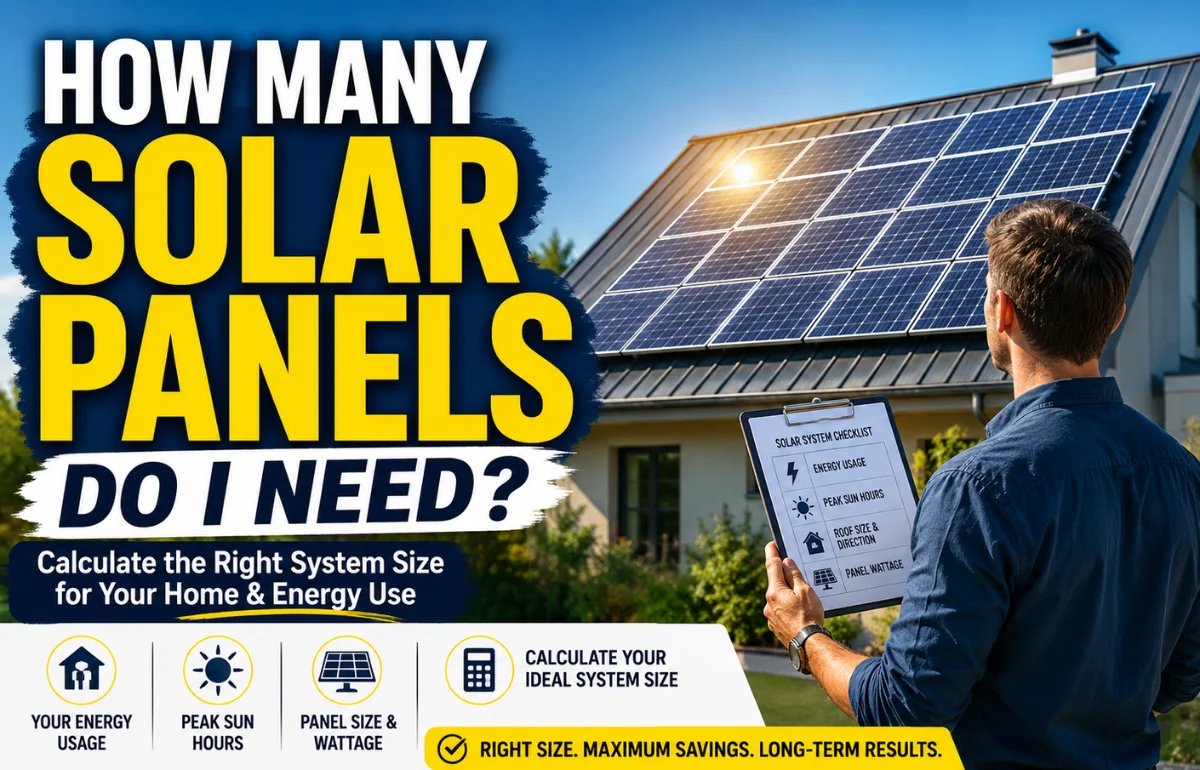
If you’ve been staring at your electricity bill and wondering how many solar panels do I need to actually make a dent in it, here’s the honest answer: most Australian homes need between 10 and 25 panels, depending on how much power you use, where you live, and what size panels you choose. That’s the short version. The longer version — the one that actually helps you make the right decision — is what this article is all about.
I’ve spent time researching and speaking with homeowners across different states who’ve gone through this process, and the number-one regret I hear is that people either undersized their system and still got hit with big bills, or they overinvested and took a decade to break even. Getting the sizing right from the start is everything.
Why “How Many Solar Panels Do I Need?” Is the Wrong First Question

It sounds counterintuitive, but the number of panels is actually the last thing you should calculate — not the first. Before you land on a number, you need to know three things: how much energy your household actually consumes, how many peak sun hours your location receives each day, and what wattage the panels you’re considering produce.
The reason this matters is that two homes on the same street could need completely different numbers of panels. A retired couple running a modest home might get by with 8 panels, while a family of five with an electric vehicle, a pool pump, and reverse-cycle air conditioning in every room might need 22 or more. The panel count is a result of your energy reality — not a starting point.
I learned this the hard way when a colleague of mine installed a 6.6 kW system based purely on what his neighbour had, without adjusting for the fact that his home faces south-west and gets afternoon shade from a large gum tree. His system underperformed by almost 30% in winter. It was an expensive lesson that a bit of proper calculation would have prevented.
Step One: Know Your Daily Energy Consumption
Before you can answer how many solar panels you need, you have to know how much energy your household actually burns through. Your electricity bill is the most useful document you own for this. Look for your quarterly consumption in kilowatt-hours (kWh), then divide it by 90 to get your average daily usage.
Here’s a rough guide by household type in Australia:
- 1–2 person household: 10–18 kWh/day
- 3–4 person household: 18–28 kWh/day
- 5+ person household: 28–45+ kWh/day
If you have an electric vehicle that charges at home, add roughly 8–12 kWh per day. A pool pump running 6–8 hours a day adds another 2–3 kWh. An all-electric home (no gas) typically uses 20–30% more than an equivalent home with gas for cooking and hot water.
One thing that’s rarely discussed online: your consumption pattern matters almost as much as your total usage. Solar panels only produce electricity during daylight hours, so if most of your energy use happens in the evening — think cooking, heating, TV, dishwashers — you’ll either need a battery storage system or you’ll be drawing heavily from the grid at night despite having solar. In that case, simply adding more panels won’t solve the problem without also rethinking when you use power.
Step Two: Find Your Location’s Peak Sun Hours
Location is the second major variable in working out how many solar panels you need in Australia. The country is one of the sunniest on earth, which is exactly why solar makes so much financial sense here. But sunlight isn’t uniform across the continent, and the number of peak sun hours your roof receives directly determines how much electricity your panels will generate.
Peak sun hours refer to the number of hours per day when sunlight intensity averages 1,000 watts per square metre — the standard rating condition for solar panels. Here’s a general breakdown by region:
What this means in practice: a 400W panel in Darwin will produce roughly 2.3–2.5 kWh per day, while the same panel in Hobart might only produce 1.4–1.7 kWh. That difference compounds dramatically when you multiply it across 15 or 20 panels over a 25-year system life.
Something I rarely see covered elsewhere: the direction your roof faces creates a multiplier on these figures. North-facing roofs in Australia receive the most consistent sunlight year-round. East and west-facing roofs typically capture 80–85% of what a north-facing roof would. South-facing roofs drop to 60–70% efficiency. If your best available roof space faces south, you may need 20–25% more panels to generate the same annual output.
Step Three: The Solar Panel Calculation Formula
Once you have your daily consumption and your peak sun hours, you have everything you need to calculate how many solar panels you need. The core formula is straightforward:
System Size (kW) = Daily Usage (kWh) ÷ Peak Sun Hours ÷ System Efficiency
System efficiency accounts for the real-world losses that occur in every solar installation — heat degradation, wiring resistance, inverter conversion losses, and dust accumulation on panels. A realistic efficiency figure to use is 0.75 to 0.80 (75–80%).
Then, to find the number of panels:
Number of Panels = System Size (kW) × 1,000 ÷ Panel Wattage
Let me run through three real-world examples showing how many solar panels different Australian households need:
Example 1: A Couple in Brisbane Using 16 kWh/Day
- Peak sun hours: 5.5
- System size: 16 ÷ 5.5 ÷ 0.77 = 3.78 kW
- Using 400W panels: 3.78 × 1,000 ÷ 400 = ~10 panels
- Approximate system cost after STCs: $4,000–$6,500
Example 2: A Family of Four in Melbourne Using 26 kWh/Day
- Peak sun hours: 4.2
- System size: 26 ÷ 4.2 ÷ 0.77 = 8.04 kW
- Using 415W panels: 8.04 × 1,000 ÷ 415 = ~20 panels
- Approximate system cost after STCs: $8,000–$12,000
Example 3: A Large Family in Perth Using 38 kWh/Day With an EV
- Peak sun hours: 5.5
- System size: 38 ÷ 5.5 ÷ 0.77 = 8.97 kW
- Using 450W panels: 8.97 × 1,000 ÷ 450 = ~20 panels
- Approximate system cost after STCs: $9,000–$14,000
The Panel Wattage Factor Most People Overlook
When working out how many solar panels you need, the wattage you choose matters more than most guides let on. The wattage of the panels affects not just the panel count, but also the roof space required, the racking costs, and the inverter specification. In 2025–2026, Australian solar installers are predominantly supplying panels in the 400W–460W range, with premium models pushing toward 500W and beyond.
Choosing higher-wattage panels doesn’t necessarily mean fewer panels are “better.” What matters is the cost per watt and the quality of the cells. Some budget 500W panels use lower-grade cells with faster degradation rates — losing output at 0.7–1% per year instead of the 0.3–0.5% you’d get from a Tier 1 manufacturer. Over a 25-year system life, that difference quietly costs you thousands in lost generation.
There’s also a roof space consideration that’s mathematically interesting: a 10 kW system using 400W panels requires 25 panels and roughly 42–45 m² of roof space. The same 10 kW system using 500W panels needs only 20 panels and around 34–38 m². If roof space is tight, or if you’re planning a battery later and want to expand the array, higher-wattage panels give you more room to grow.
Battery Storage: Does It Change How Many Panels You Need?

“How many solar panels do I need if I also want a battery?” is a question I get asked often, and the answer is: yes, batteries do change the equation — but not in the way most people expect.
Adding a home battery doesn’t mean you need more panels — it means the panels you already have can do more work. Without storage, any solar energy you generate during the day that you’re not using at that exact moment gets exported to the grid, usually at a feed-in tariff rate that’s significantly lower than what you pay for grid power. With a battery, that excess energy gets stored and used at night instead.
Where the math changes is when you want your battery to be meaningfully full each day. If you install a 10 kWh battery and your panels only generate 18 kWh on a good day — and your household uses 15 kWh during daylight — you’re only feeding 3 kWh into the battery. To reliably fill a 10 kWh battery, you’d typically want to oversize your solar array by 20–30% beyond what you’d need for a grid-only system.
This is a nuance that’s genuinely underrepresented in mainstream solar guides, and it’s worth raising with any installer you speak to. If battery storage is on your roadmap, size the array for the battery, not just for your daytime usage.
What Solar System Sizes Actually Cost in Australia (2026)
Once you’ve determined how many solar panels you need, the next natural question is what that system is going to cost. The Australian solar market has matured considerably, and prices have stabilised after years of dramatic falls. Here’s a realistic snapshot of current installed costs, after the federal Small-scale Technology Certificate (STC) rebate:
One thing worth noting: the 6.6 kW system has become the default “sweet spot” in Australia for single-phase homes, because most single-phase inverters are limited to 5 kW of export but can accept up to 6.6 kW of panel input. Going larger than 6.6 kW on a single-phase connection usually requires either a battery or a three-phase power connection — something worth confirming with your installer before signing any contracts.
How Roof Condition and Orientation Affect Your Panel Count
Your formula might tell you exactly how many solar panels you need — but your roof will have the final say. An aspect that deserves far more attention in the solar conversation is the condition and structure of your roof. Even if you calculate a perfect panel number, your actual installation may need adjustment based on:
- Roof pitch: Panels perform best at a tilt of 10–30 degrees in most Australian climates. Flat roofs can use angled mounting frames, but this adds cost and wind load considerations.
- Shading from chimneys, skylights, or nearby structures: A shadow falling on even one cell in a standard string-wired system can reduce the output of the entire string by 20–50%. This is why micro-inverters or DC optimisers (such as SolarEdge or Enphase systems) have grown in popularity — they allow each panel to operate independently, so shading on one panel doesn’t punish the whole array.
- Roof age and condition: If your roof is within 5–7 years of needing replacement, many installers will recommend replacing it first. Removing and reinstalling panels to replace a roof adds $1,500–$3,500 in labour costs.
These are the kinds of practical, site-specific details that make a significant difference to how your final system performs versus how the calculator said it would. They’re also the reason that getting a proper on-site assessment — not just an online quote — is so valuable. If you’re in the planning stages of a broader home upgrade, it can be worth exploring renovation planning support to make sure solar fits into the bigger picture of your home’s energy and structural needs.
Grid-Connected vs. Off-Grid: A Different Calculation Entirely
For homeowners in regional or remote Australia, the question of how many solar panels you need takes on a completely different shape when you’re going off-grid. An off-grid system needs to generate and store enough energy to cover your entire household load through extended low-sun periods — typically 2–4 consecutive cloudy days in most Australian regions.
This means off-grid systems are typically 30–50% larger than an equivalent grid-connected system, and the battery bank is sized to store 2–4 days of energy autonomy. A household that needs a 6.6 kW grid-tied system might need a 10–12 kW off-grid system with 20–40 kWh of battery capacity.
The economics of off-grid solar have improved dramatically in recent years, particularly for properties where connecting to the grid would cost $30,000 or more in network extension fees. But it’s a fundamentally different design problem, and one that genuinely warrants professional engineering assessment rather than a DIY calculation.
A Note on Future-Proofing Your System
One thing I always encourage homeowners to think about when calculating how many solar panels they need is where their energy use is heading, not just where it is today. Australia is in the middle of a major energy transition — electric vehicles are rapidly becoming mainstream, induction cooking is replacing gas, and heat pump hot water systems are displacing gas storage units. Each of these shifts adds to household electricity demand.
If there’s even a reasonable chance you’ll buy an EV in the next five years, or if you’re considering switching your gas appliances to electric, build that future load into your solar calculation now. Adding panels later is possible, but it often requires a second inverter or system upgrade that costs more than sizing correctly from the start.
For homeowners who want to understand more about how to incorporate solar into a holistic home improvement strategy, home improvement courses can offer a solid grounding in energy efficiency, building systems, and the decisions that actually add long-term value to your property.
FAQs
How many solar panels do I need for a 3-bedroom house in Australia?
A typical 3-bedroom Australian home uses around 18–25 kWh per day and usually needs a 5–8 kW system, which translates to roughly 13–20 panels depending on your location and panel wattage.
Can I run my whole house on solar panels?
Yes, many Australian homeowners generate more than 100% of their annual consumption from solar — though you’ll still draw from the grid at night unless you also install battery storage to cover evening usage.
How many solar panels do I need to charge a Tesla or EV at home?
An average EV adds 8–15 kWh per day to your energy needs, which typically requires an additional 3–5 panels (400W) beyond what you’d otherwise install to cover your household load.
Do more solar panels always mean more savings?
Not necessarily — beyond a certain size, panels that generate more power than you can use or store will export to the grid at low feed-in tariff rates, reducing your return on investment per panel.
How long does it take for solar panels to pay for themselves in Australia?
Most Australian households see a payback period of 4–7 years on a quality system, depending on electricity tariffs, feed-in rates, local sun hours, and how much of the solar generation is self-consumed rather than exported.
Where to Go From Here
Knowing how many solar panels you need is the foundation of a smart solar investment, but it’s only the starting point. The real work lies in finding a Clean Energy Council-accredited installer who does an actual on-site assessment, choosing panels and an inverter from reputable manufacturers with strong warranty support, and thinking about how solar fits into your home’s broader energy story — including insulation, appliance choices, and any future upgrades.
The Australian solar market is competitive enough that a well-informed buyer can get an excellent system at a fair price. The key is going into conversations with installers knowing your numbers, understanding your roof, and having a clear sense of your energy goals — not just for today, but for the next decade.
Run your calculation, get at least three quotes from accredited installers, and don’t let anyone rush you into a decision. The number of solar panels you need is something you can calculate with confidence. A solar system is a 25-year investment — it deserves 25 days of careful thought.
Other Solar Panel Resources
- Solar Powered Outdoor Christmas Tree Lights Guide
- Solar Powered Christmas Lights for Outside Guide
- Best Solar Hot Water System 2018 Guide

I’m Salman Khayam, the founder and editor of this blog, with 10 years of professional experience in Architecture, Interior Design, Home Improvement, and Real Estate. I provide expert advice and practical tips on a wide range of topics, including Solar Panel installation, Garage Solutions, Moving tips, as well as Cleaning and Pest Control, helping you create functional, stylish, and sustainable spaces that enhance your daily life.