
Are solar batteries worth it? Yes — for most Australian households with an existing solar panel system, a home battery is now worth it financially, particularly after the federal battery rebate reduces the upfront cost. A solar battery stores the excess electricity your panels generate during the day and lets you use it at night, cutting your reliance on grid power and shrinking your electricity bill.
Whether it genuinely makes sense for your home depends on your energy consumption habits, your state’s electricity tariffs, and the size of your existing solar setup. In this article, I’ll walk you through the real numbers, the honest caveats, and what I’ve seen work — and not work — for Australian homeowners making this decision.
What Is a Solar Battery and How Does It Actually Work?
Before we get into whether solar batteries are worth it, it helps to understand exactly what you’re buying. A solar battery — sometimes called a home battery storage system — is a rechargeable unit that captures the surplus electricity produced by your rooftop solar panels during the day. Instead of that excess energy being exported to the grid (often at a relatively low feed-in tariff), it gets stored in the battery and drawn upon when your panels aren’t producing — typically in the evening or on overcast days.
The system works through a battery inverter, which converts the direct current (DC) stored in the battery into the alternating current (AC) your appliances use. Many modern setups combine a hybrid inverter with the battery, handling both solar and storage in a single unit.
In practical terms, this means a household that used to export most of its solar generation at, say, 4–6 cents per kilowatt-hour (kWh), can instead self-consume that energy at night — avoiding grid electricity that can cost anywhere from 28 to 42 cents per kWh in most Australian states. That gap between the feed-in tariff and the retail electricity rate is precisely where the financial case for battery storage lives.
The Federal Battery Rebate: Why Solar Batteries Are Worth It Now More Than Ever
If you’ve been watching this space for a few years, you’ll know that the financial case for batteries was harder to make even as recently as 2023. Payback periods of 12–16 years weren’t uncommon, and that made most financial advisers wince.
The introduction of the federal battery rebate changed that calculus considerably. The rebate works similarly to the Small-scale Technology Certificates (STCs) that reduce the cost of solar panels — it provides upfront capital support that lowers the installed price of a home battery system. For a standard 10 kWh battery, this brings the effective installed cost down to approximately $9,000–$10,000 in most states, and in some cases lower when combined with state-level incentives.
In Victoria, for example, Solar Victoria offers additional battery rebates of up to $2,950 for eligible households, with income thresholds applying from July 2026. South Australia has the Home Battery Scheme, and Western Australia has its own battery rebate program. When federal and state rebates are stacked, the numbers shift noticeably in the homeowner’s favour.
Here’s what’s often missed in most coverage: the rebate amount you receive is directly tied to the battery capacity in kilowatt-hours. Larger batteries receive proportionally more support. This means upsizing from a 6.5 kWh to a 10 kWh battery may cost less in net terms than you’d expect once rebates are applied — something worth asking your installer about specifically.
Are Solar Batteries Worth It in Your State? A Real Savings Breakdown
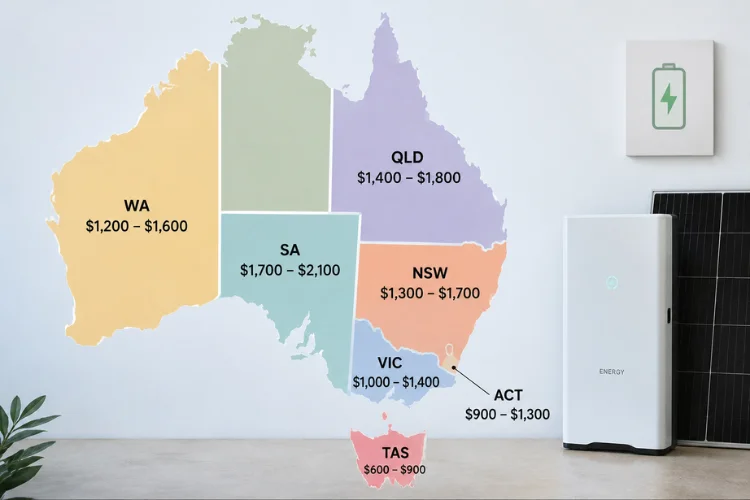
One of the most common frustrations I hear from Australian homeowners is that articles about solar batteries give generic national figures that don’t apply to their situation. So let’s be specific.
The savings you get from a solar battery depend on four local factors:
- Your overnight electricity consumption
- Your retail electricity tariff
- Your current feed-in tariff
- Whether your retailer offers time-of-use rates or flat tariffs
In states like South Australia and Queensland, where retail electricity rates are among the highest in the country and solar irradiance is strong, batteries tend to deliver the most compelling returns. In Tasmania and the ACT, where electricity rates are structured differently or feed-in tariffs are comparatively higher, the financial case is thinner.
The following table gives a realistic snapshot of estimated annual savings and simple payback periods for a 10 kWh battery, based on a household with moderate overnight usage (around 7 kWh per night) and a solar system of 7 kW or more. These figures assume the federal battery rebate has been applied, bringing the installed cost to approximately $9,500.
Estimates based on 2025–2026 retail tariffs, standard grid-connected systems, and federal rebate pricing. Individual results will vary.
One thing these tables don’t fully capture: if you’re on a time-of-use tariff — where electricity is cheapest overnight (sometimes as low as 12–18 cents/kWh) and most expensive during evening peak hours (up to 48 cents/kWh in some plans) — a battery that discharges during those peak hours can save you significantly more than the flat-rate figures suggest.
What Most Articles Won’t Tell You: Hidden Variables That Affect Whether Solar Batteries Are Worth It
Battery Capacity Degradation
Every lithium-ion battery loses a small percentage of its usable capacity each year — typically around 1–3% annually under normal cycling conditions. A 10 kWh battery might be functioning at 85–90% capacity by year eight. This doesn’t render it useless, but it does mean your savings will gradually taper as the battery holds slightly less charge. Quality brands like Tesla Powerwall, Sungrow, and BYD typically warrant 70% capacity retention over 10 years, which is a reasonable benchmark to compare against.
The Tariff Trap: Why Your Energy Plan Determines If Solar Batteries Are Worth It
Here’s something that genuinely surprised me when I first looked into this for a family member’s property on the New South Wales Central Coast. They were on a flat tariff that actually made their solar battery less economically efficient than switching to a time-of-use plan would have. The battery was doing most of its valuable work by avoiding peak-hour grid consumption — but on their flat tariff, there were no peak hours to avoid. Changing their energy plan before installing the battery added several hundred dollars per year in additional savings that the battery alone wouldn’t have unlocked.
The lesson: before your installer arrives, call your energy retailer and ask specifically about time-of-use tariffs compatible with battery storage. Some retailers even offer battery-specific tariffs.
Virtual Power Plants (VPPs): An Underrated Reason Solar Batteries Are Worth It
A lesser-discussed opportunity is enrolling your battery in a Virtual Power Plant program. VPPs link multiple home batteries across a network, allowing energy retailers or grid operators to draw small amounts of stored energy during periods of peak grid demand. In return, households earn credits or cash payments. Companies like AGL, Origin, and Amber Electric each operate VPP programs in different states. Participation can add $200–$600 per year in earnings on top of your standard electricity savings — though terms vary and some programs require you to reserve a portion of your battery for VPP use rather than personal consumption.
The Backup Power Value That’s Hard to Quantify
Not every benefit of a solar battery shows up on your electricity bill. If you live in an area prone to bushfire-related blackouts, storm damage, or network outages — and many Australians do — a battery with blackout protection capability provides genuine peace of mind that is difficult to put a dollar value on but is real nonetheless.
Standard grid-connected batteries shut down during a blackout for safety reasons (to protect lineworkers). But battery systems designed with “islanding” capability can disconnect from the grid and continue powering your home independently. Not all batteries support this out of the box, and it often requires specific inverter configurations and additional wiring. If backup power is important to you, raise this with your installer before signing anything.
Are Solar Batteries Worth It If You Don’t Have Solar Panels Yet?
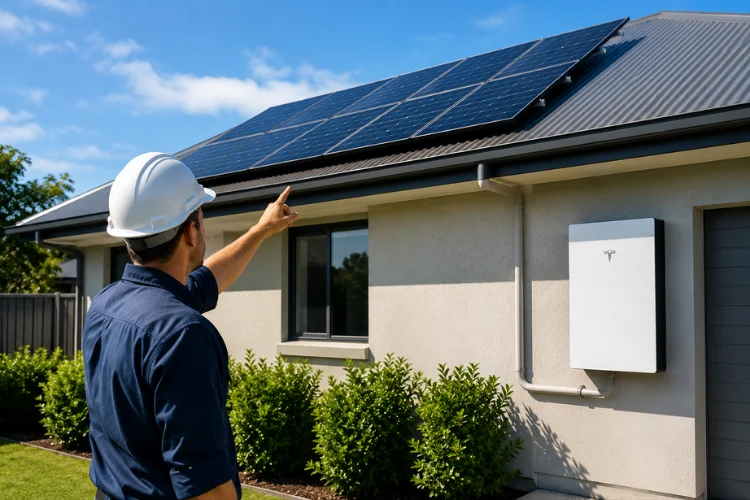
If you’re considering getting solar panels and a battery at the same time, the financial dynamics are actually quite favourable. Bundling the two in a single installation typically reduces combined labour costs, and a single hybrid inverter handles both functions — eliminating the need for a separate battery inverter later.
The key question for a simultaneous install is system sizing. A common mistake is pairing a large battery with a small solar array that can’t reliably fill it on a daily basis. As a general rule, your solar system should generate at least 1.5 to 2 times your daily household consumption to reliably charge a 10 kWh battery. A good solar installer will model this based on your roof orientation, shading, and local solar irradiance data.
If you’re thinking about broader home upgrades alongside your solar project — from insulation to energy-efficient appliances — our home makeover services cover a range of improvements that work in combination with solar to reduce your home’s overall energy demand, which in turn improves your battery’s effectiveness.
Choosing the Right Battery: What to Look For
One of the most practical questions that comes up after deciding that solar batteries are worth it is which model to actually buy. With the market now offering dozens of options, choice paralysis is real. Here are the factors that actually matter when comparing them:
- Usable capacity (kWh): This is the amount of energy you can actually draw from the battery. It’s always less than the total capacity listed in the spec sheet. A 10 kWh battery typically has a usable capacity of around 9–9.8 kWh.
- Round-trip efficiency: The percentage of energy put into the battery that you get back out. Quality lithium-ion batteries operate at around 90–95% round-trip efficiency. This matters because every charge cycle involves some energy loss.
- Continuous power output (kW): How much power the battery can supply at one time. This determines whether your battery can run high-draw appliances like a ducted air conditioner simultaneously with other loads.
- Cycle life and warranty: Most quality batteries are warranted for 6,000 to 10,000 cycles at 70–80% capacity retention. Some premium models now offer 15-year warranties, which aligns better with a 10–12 year payback timeline.
- Software and monitoring: Modern batteries come with companion apps that let you monitor energy flows, set charge and discharge schedules, and configure backup power settings. This is less of a luxury feature than it sounds — a well-configured battery genuinely outperforms a set-and-forget one.
A Realistic 10-Year Financial Model: Are Solar Batteries Worth It Over Time?

Let me illustrate what the numbers might actually look like for a family in suburban Brisbane with:
- A 10 kW solar system (already installed)
- A 10 kWh battery at $9,500 installed after the federal rebate
- Average overnight electricity consumption of 8 kWh
- A retail tariff of 32 cents/kWh and a feed-in tariff of 5 cents/kWh
In this scenario, the battery allows the household to avoid purchasing approximately 2,700–2,900 kWh of grid electricity per year. At 32 cents/kWh, that’s a saving of around $864–$928 per year from tariff avoidance alone. Add the forgone feed-in income (at 5 cents, this is a relatively minor offset), and factor in VPP earnings of roughly $300 per year, and total annual benefit reaches approximately $1,150–$1,200.
Over 10 years, with modest electricity price inflation of 3% annually, cumulative savings approach $13,000–$14,000 — against a $9,500 outlay. That’s a net positive of around $3,500–$4,500 over the battery’s warranted life. Not spectacular, but solidly positive — and that’s before accounting for the backup power and environmental benefits.
For homeowners looking to deepen their understanding of home energy systems and make smarter renovation decisions, our renovation training resources cover practical frameworks for evaluating energy upgrades like this one.
When Solar Batteries Are NOT Worth It
Honesty matters here. Asking “are solar batteries worth it” assumes the answer is always yes — but there are genuine circumstances where a solar battery purchase doesn’t make financial sense right now:
- Small solar systems (under 5 kW): A system that size rarely generates enough daily surplus to reliably fill a battery, particularly in winter. A battery in this situation will frequently pull from the grid to top itself up, undermining the economics.
- High feed-in tariffs: Some households on legacy feed-in tariff contracts (particularly older contracts in Queensland or South Australia) locked in tariff rates of 44–66 cents/kWh. If you’re still on one of these, exporting your surplus solar is almost certainly more valuable than storing it. Check before you act.
- Low electricity usage: A two-person household using only 10–12 kWh per day total may not generate enough overnight demand to benefit meaningfully from a 10 kWh battery.
- Poor roof orientation for solar generation: If your solar system is primarily north-facing in a location with high shading, generation may be insufficient to make battery storage cost-effective.
Frequently Asked Questions
How long does it take for a solar battery to pay for itself in Australia?
With the federal battery rebate applied, most Australian households in NSW, QLD, SA, and WA can expect a simple payback period of between 5 and 8 years, depending on electricity usage and local tariffs.
Can a solar battery power my home during a blackout?
Only batteries with blackout protection or “islanding” capability can power your home during a grid outage — not all batteries include this by default, so confirm with your installer before purchase.
What size solar battery do I need for a typical Australian home?
A 10 kWh battery is the most common choice for a three-to-four-person Australian household, matching well with overnight electricity consumption of 6–9 kWh and a solar system of 6.6 kW or larger.
Do solar batteries work on cloudy days?
Yes — a solar battery charges whenever your solar panels produce more than your home consumes, even on partly cloudy days, though it will charge more slowly and may not reach full capacity during extended overcast periods.
Are there government rebates for solar batteries in Australia?
Yes — the federal battery rebate is available nationally, while state-specific rebates exist in Victoria, South Australia, Western Australia, and the ACT, with eligibility criteria varying by program and income level.
The Bottom Line
So, are solar batteries worth it in Australia in 2026? For the majority of solar-equipped households, particularly those in NSW, QLD, SA, and WA with moderate-to-high overnight energy consumption, the answer is now a measured yes — especially with the federal battery rebate factoring into the equation. The financial case is no longer marginal; it’s becoming the mainstream choice for a reason.
That said, the specifics of your home, your energy habits, your tariff structure, and your state’s incentive landscape all matter. A battery isn’t a plug-and-play investment — it rewards homeowners who take the time to understand their energy usage, choose the right system size, and pair the installation with an appropriate electricity plan.
If you’re in the early stages of planning your home’s energy future, the smartest first move is getting at least three quotes from accredited installers and asking each of them to model your specific consumption data. The numbers will tell you more than any general article can.
More Resources
- How Many Solar Panels Do I Need? 2026 Expert Guide
- Solar Powered Outdoor Christmas Tree Lights Guide
- Solar Powered Christmas Lights for Outside Guide

I’m Salman Khayam, the founder and editor of this blog, with 10 years of professional experience in Architecture, Interior Design, Home Improvement, and Real Estate. I provide expert advice and practical tips on a wide range of topics, including Solar Panel installation, Garage Solutions, Moving tips, as well as Cleaning and Pest Control, helping you create functional, stylish, and sustainable spaces that enhance your daily life.