
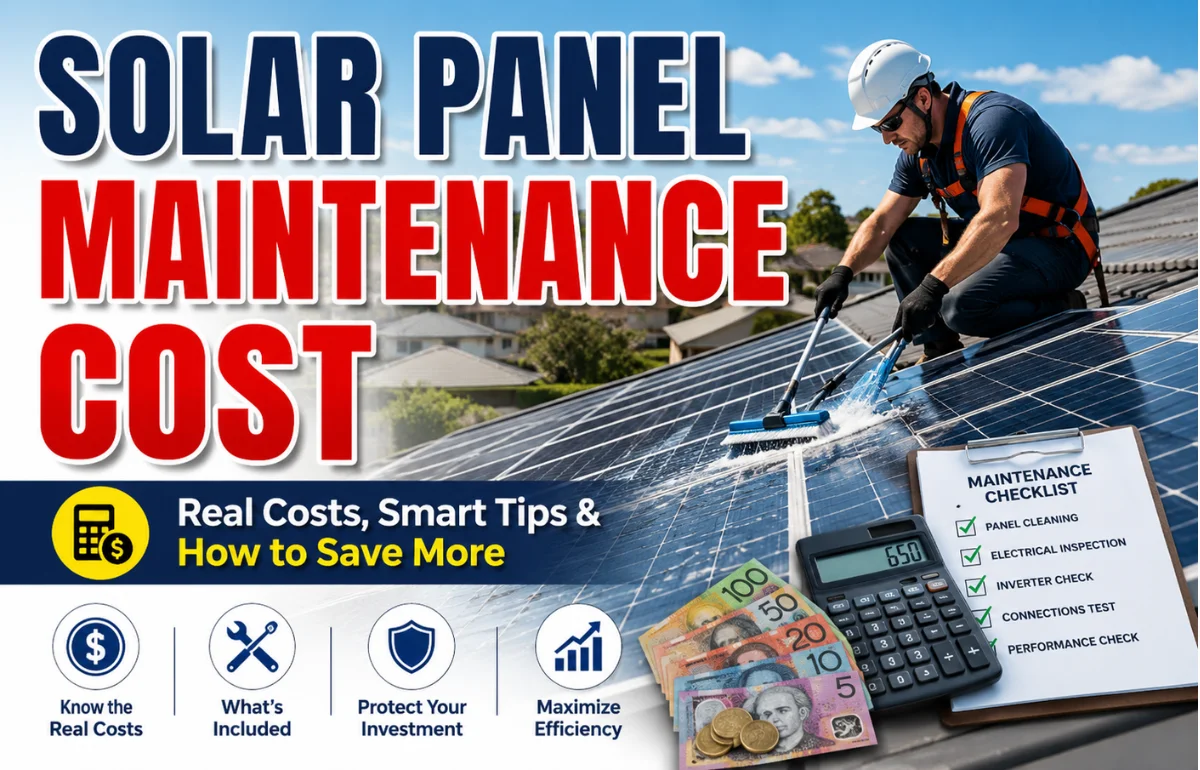
Solar panel maintenance cost in Australia typically ranges from $150 to $650 per visit for a standard residential system, covering both inspection and cleaning. To put it simply: it’s the total expense involved in keeping your solar power system operating safely, efficiently, and at its full energy-generating potential.
This includes routine cleaning, professional electrical inspections, inverter checks, and any necessary repairs or component replacements. Unlike what some installers might tell you at the point of sale, solar panels are not entirely maintenance-free.
They’re exposed to the full force of the Australian climate — scorching summers, dust storms, coastal salt air, and the occasional hailstorm — and all of that takes a toll over time. Getting on top of solar panel maintenance costs early is one of the smartest financial decisions a homeowner can make.
Why Solar Panel Maintenance Cost Is Worth Paying
I’ve spoken to plenty of homeowners who genuinely believed their solar system would just “run itself” for 25 years with zero attention. That’s an understandable assumption — it’s often what salespeople imply. But after seeing what neglected systems look like even five years in, I can say clearly: the cost of doing nothing is almost always higher than the cost of doing something small regularly.
Solar panels sit on your roof in direct exposure to UV radiation, wind, dust, bird droppings, and whatever the weather your part of Australia throws at them. All of that gradually degrades performance. A layer of dust across your panels can reduce output by anywhere from 5% to 25%, depending on your location and the time between cleans. In a dry, inland area like Western NSW or the outskirts of Adelaide, that figure creeps toward the higher end far more quickly than most people expect.
Beyond efficiency, there are genuine safety concerns. The DC isolator switch — required by Australian regulations to be mounted on the roof — is one of the first components to show deterioration. UV exposure and heat cycling cause the casing to crack, allowing moisture to seep in. That’s a fire risk, not just a performance issue. A qualified electrician catching that during a routine inspection can save you from a much more expensive — and dangerous — outcome.
What’s Included in Solar Panel Maintenance Costs?
When we talk about solar panel maintenance cost, it’s helpful to break it into its component parts, because not every visit involves the same work.
Solar Panel Cleaning Cost: What to Expect
Cleaning is the most frequent and visible part of solar maintenance. It’s exactly what it sounds like: removing dust, grime, bird droppings, pollen, and any other debris that’s settled on your panels. In coastal areas, salt residue is a particular problem — it creates a film that doesn’t wash off with rain the way dust can.
Professional cleaners use deionised or purified water with soft brushes or squeegees to avoid scratching the glass. Don’t underestimate how important that is — abrasive cleaning methods can micro-scratch the surface, which scatters light rather than transmitting it, reducing efficiency permanently.
Electrical Inspection: A Core Part of Solar Maintenance Costs
A professional electrical inspection goes well beyond looking at whether the panels are dirty. A qualified electrician or Clean Energy Council (CEC) accredited installer will check:
- The condition and integrity of all wiring and connections
- The DC isolator switch for signs of cracking, water ingress, or overheating
- The inverter for fault codes, dust accumulation, and performance history
- All junction boxes and conduit for signs of deterioration
- Any evidence of hot spots, micro-cracks, or snail trails on individual panels
- Earth bonding continuity and overall system safety
This is the kind of check that homeowners simply cannot replicate on their own, no matter how handy they are.
Inverter Servicing and Its Impact on Solar Maintenance Costs
Your inverter converts direct current (DC) from the panels into the alternating current (AC) that your home actually uses. It’s the workhorse of the system and, statistically, the component most likely to need replacement within the system’s lifespan — typically around the 10-to-15-year mark.
As part of a comprehensive maintenance visit, a technician will check the inverter display or monitoring portal for any logged errors, clean internal cooling fins if accessible, and verify that communication with monitoring software is functioning correctly.
Pest and Bird Management: An Overlooked Solar Maintenance Cost
This is one area where Australian solar owners get caught out more often than expected. Pigeons — particularly in Sydney, Melbourne, and Perth — love nesting under rooftop solar arrays. They’re warm, sheltered, and largely undisturbed. The problem is that nesting materials and droppings can damage cables, block ventilation, and create additional fire risk. Bird mesh installation, if it’s not already part of your system, is worth factoring into your solar panel maintenance cost planning.
Solar Panel Maintenance Cost: A Realistic Breakdown
Let me give you a practical look at what you can actually expect to pay across the different types of maintenance, based on current Australian market rates.
Solar Panel Cleaning Costs by System Size
Cleaning typically costs between $12 and $18 per panel. Ground-floor or easily accessible systems cost less. Two-storey homes, steep roofs, or sites requiring scissor lifts will push the price higher.
Solar Inspection Cost: What a Professional Visit Runs
A basic inspection for a standard 6.6kW residential system runs around $250. A detailed inspection that includes electrical testing — thermographic scanning, insulation resistance testing, and full component checks — typically ranges from $350 to $500 for the same system size. For larger commercial-scale systems (50kW and above), those figures scale considerably.
Other Solar Panel Maintenance Cost Items to Budget For
- Bird mesh/pigeon proofing: $400–$1,000 installed professionally, depending on roof size and accessibility. DIY kits run $80–$200 but require safe roof access and the right tools.
- Inverter replacement: When the time comes, budget approximately $1,500–$3,500 for a residential inverter, including installation. This is rarely a surprise expense if you’ve been monitoring your system — most inverters will show fault codes or reduced output well before they fail completely.
- Panel replacement: If a single panel cracks beyond what the warranty covers, replacement costs $300–$600 per panel, including labour. This is where a good product warranty from a reputable manufacturer genuinely pays off.
- Solar panel removal and reinstallation: If you need roof work done, panels typically need to come off first. Removal and reinstallation can cost $300–$600 per panel, so it pays to coordinate any roof repairs with your solar maintenance schedule where possible.
The Hidden Solar Panel Maintenance Costs of Doing Nothing
Here’s the part that rarely gets talked about in a straightforward way: skipping maintenance doesn’t save you money. It costs you money through a series of slower, harder-to-notice drains.
A system running at 15% below its rated output because of accumulated soiling and an undetected hotspot is losing you money every single day — in electricity you’re buying from the grid that your panels could have generated, and in feed-in tariff credits you’re not earning because you have less surplus to export. Over a year, that could easily amount to $300–$600 in lost value for an average household. Over five years of neglect, the financial case for regular maintenance becomes very clear.
There’s also the warranty dimension, which I think is genuinely underestimated. Most panel manufacturers include maintenance clauses in their warranty terms. If something goes wrong and you can’t demonstrate that the system was regularly inspected and maintained, you may find the manufacturer declines your claim. That could turn a warranty-covered replacement into an out-of-pocket expense running into thousands of dollars.
And if you’re thinking about selling your home, a well-documented maintenance history for your solar system is a genuine selling point. Buyers who understand solar will ask for it. Those who don’t still respond to the fact that the system has been professionally looked after.
How Often Should You Pay Solar Panel Maintenance Costs?
The honest answer is: it depends on where you live and how your system is configured. But as a general framework, here’s what I’d suggest for a typical Australian residential system:
- Ongoing (monthly): Check your monitoring app or inverter display. Look for any unusual drops in daily generation output. Cross-reference with your electricity bill quarterly to catch any longer-term underperformance.
- Every 6 months: Do a visual inspection from the ground. Look for visible debris, bird activity, or obvious damage. Check that vegetation around the roof hasn’t grown to cast new shade over the panels.
- Every 1–2 years: Have the panels professionally cleaned. In coastal, rural, dust-prone, or high-bird-traffic areas, annual cleaning is the smarter choice. In urban areas with regular rainfall and minimal pollution, every two years can be sufficient.
- Every 2–5 years: Book a full professional electrical inspection. For home systems under 40kW, every two to three years is a reasonable interval. If your system is older than 10 years, I’d lean toward annual inspections.
If you’re planning a broader home upgrade — perhaps adding a battery system, upgrading your switchboard, or undertaking a renovation — it’s worth bundling your solar inspection with those other electrical works. Our home upgrade services at Wellbeing Makeover can help connect you with the right professionals to handle multiple aspects of your home’s energy and infrastructure in one coordinated plan.
Warranties and Solar Panel Maintenance Costs: What’s Actually Covered
Understanding your warranty coverage is a practical part of managing solar panel maintenance costs, because it directly affects how much you’ll pay out of pocket when something goes wrong.
Product Warranty (10–15 Years): Reducing Solar Repair Costs
This covers manufacturing defects in the panels themselves — things like delamination, internal corrosion, failed cell connections, and early component failure. It does not cover physical damage caused by hail, storms, pests, or mishandling, and it does not cover neglect.
Performance Warranty (25 Years): Protecting Long-Term Solar Panel Value
Manufacturers guarantee that panels will produce at or above a minimum percentage of their rated capacity — typically 80–85% after 25 years. If your panels degrade faster than that threshold, you may have a valid claim. In practice, making a successful performance claim is difficult without professional monitoring data, which is one more reason to keep your monitoring system connected and logging.
Workmanship / Installation Warranty and Solar Servicing Costs
This is the installer’s warranty and covers errors in the installation itself — poor wiring, incorrect mounting, unsafe electrical connections. The duration varies significantly between installers. When choosing an installer, ask specifically about their workmanship warranty and ensure it’s in writing.
Home Insurance and Solar Panel Maintenance: What It Covers
Standard building insurance in Australia typically covers solar panels as part of the home structure, meaning storm, hail, fire, and accidental damage are usually covered. Always notify your insurer when solar panels are installed, as failure to disclose can affect your claim eligibility. Routine maintenance and wear-and-tear are not covered under any standard policy.
DIY vs Professional Solar Panel Maintenance: Where the Cost Line Is
I want to be clear about this because I’ve seen homeowners make costly mistakes by misjudging where the DIY-safe zone ends.
You can safely do the following yourself, without touching the roof or any electrical components:
- Monitor your system via the inverter app daily or weekly
- Check your inverter display for error indicators
- Observe your electricity bills for unusual spikes
- Inspect panels visually from the ground for obvious debris or bird activity
You should not do the following yourself:
- Climb on the roof to clean panels (falls are a serious risk; roof access is a job for trained professionals with appropriate safety equipment)
- Attempt to fix wiring, replace components, or reset electrical faults — these are licensed electrical works
- Remove or reposition panels
- Attempt inverter repairs
Anything involving roof access or electrical components must be handled by a licensed electrician or CEC-accredited installer. DIY electrical work on a solar system can void your warranty, breach Australian electrical safety regulations, and create genuine hazards for you and your household.
If you’re keen to understand the process more deeply before engaging professionals, practical knowledge helps you ask better questions and make more informed decisions. Our practical renovation education covers home systems, including solar, giving you the background to manage your property more confidently without putting yourself in harm’s way.
Key Factors That Drive Your Solar Panel Maintenance Cost Up or Down
Not every homeowner will pay the same rates. Here are the variables that genuinely move the needle on what you’ll spend:
- Location: Rural and remote properties attract higher call-out fees. Coastal properties require more frequent cleaning due to salt accumulation. Inland areas with dust exposure (think regional NSW, SA, or WA) similarly need more frequent cleans.
- Roof height and access: A single-storey home with a gentle pitch is straightforward. A double-storey home with a steep roof may require scaffolding or an EWP (elevated work platform), adding to the cost.
- System age: Older systems need more thorough inspections because components are closer to end-of-life. Wiring insulation degrades, junction boxes weaken, and inverters approach their operational ceiling.
- System size: More panels mean more cleaning, more connections to inspect, and more to test. A 20kW system costs notably more to maintain than a 6.6kW system.
- Pest activity: If birds have already nested under your panels, remediation — cleaning out nesting materials, repairing any cable damage, and installing deterrents — adds to the cost.
- Type of installation: Standard rooftop installations are simpler. Flat-roof systems with racking frames, ground-mounted arrays, and carport installations each have their own access and inspection challenges.
Frequently Asked Questions
How much does it cost to service solar panels in Australia?
A professional service for a standard residential 6.6kW system typically costs between $250 and $500, depending on whether it’s a basic inspection or a full electrical test and clean.
How often do solar panels need to be cleaned?
In most Australian locations, a professional clean every one to two years is sufficient. Coastal, dusty, or high-bird-traffic areas benefit from annual cleaning.
Does home insurance cover solar panel maintenance?
Home building insurance generally covers solar panels for storm, hail, or fire damage, but it does not cover routine maintenance, wear-and-tear, or cleaning costs.
Can I clean my solar panels myself?
You can rinse panels from the ground using a hose if your system allows it, but climbing on the roof is not recommended. For a thorough and safe clean, professional cleaners with the right equipment and safety gear are the better option.
What happens if I don’t maintain my solar panels?
Unmaintained panels gradually lose efficiency, which means higher electricity bills and reduced feed-in tariff earnings. In more serious cases, undetected faults can create electrical hazards, and failing to maintain the system may void your warranty.
Managing Solar Panel Maintenance Cost Over the Long Term
Solar panels are one of the most significant investments a homeowner can make — and one of the most rewarding, when managed well. The solar panel maintenance cost, spread over the lifetime of a system, is genuinely modest compared to the savings and revenue a well-functioning system generates year after year.
The key is treating maintenance as a scheduled, predictable part of home ownership rather than something you only think about when something goes wrong. Build a simple schedule: monitor monthly, inspect visually twice a year, clean professionally every one to two years, and book a full electrical check every two to three years. Document everything, keep your receipts, and know your warranty terms.
When you approach it that way, the cost feels much more manageable — because it is. And the peace of mind that comes from knowing your system is safe, performing correctly, and fully covered by its warranty? That’s worth every cent.
More Resources
- Do Solar Panels Increase Home Value? 2025 Data Reveals
- How Long Do Solar Batteries Last? 7 Key Lifespan Facts
- Are Solar Batteries Worth It? 7 Key Facts for 2026

I’m Salman Khayam, the founder and editor of this blog, with 10 years of professional experience in Architecture, Interior Design, Home Improvement, and Real Estate. I provide expert advice and practical tips on a wide range of topics, including Solar Panel installation, Garage Solutions, Moving tips, as well as Cleaning and Pest Control, helping you create functional, stylish, and sustainable spaces that enhance your daily life.